
Why payroll becomes complex at scale and why your choice matters in 2026
As your organisation grows, payroll quietly transforms from a routine monthly task into a critical business function that touches compliance, finance, technology, and employee trust. What once worked for a small team quickly becomes inadequate when you are managing hundreds or thousands of employees across multiple locations, pay structures, and statutory frameworks. At scale, payroll is no longer just about salary processing. It becomes about precision, accountability, automation, and risk management.
Payroll complexity increases as your business scales
Compliance pressure increases exponentially
Large companies operate across states, regions, and sometimes countries. Each jurisdiction brings its own payroll tax rules, provident fund norms, professional tax slabs, labour welfare contributions, and reporting timelines. In India alone, frequent updates to income tax rules, social security provisions, and state-level labour laws make manual tracking extremely risky. Industry surveys consistently show that regulatory compliance is one of the top three challenges faced by enterprise payroll teams, especially in fast-growing organisations.
Accuracy becomes a financial and reputational risk
When payroll volumes are high, even small calculation errors can lead to large monetary losses, delayed statutory filings, employee dissatisfaction, and audit complications. Variable pay, overtime, incentives, arrears, reimbursements, and retroactive changes add further layers of complexity. According to global payroll benchmarking reports, payroll errors remain one of the most common causes of employee complaints in large organisations, despite increased digitisation. This highlights that scale demands not just automation, but reliable and well governed automation.
Multi-location operations demand automation and integration
Large companies rely on multiple systems to function smoothly. Payroll must connect seamlessly with HRMS, attendance and leave management, expense systems, accounting software, and banking platforms. Without deep integration, payroll teams spend excessive time reconciling data, fixing mismatches, and managing approvals manually. In 2026, cloud-based payroll systems with strong APIs, real-time syncing, and role-based access controls are no longer optional. They are foundational requirements for enterprise operations.
Why choosing the right payroll software in 2026 matters for you
By 2026, payroll software is no longer evaluated only on cost or basic functionality. You are choosing a long-term operational backbone that impacts compliance confidence, audit readiness, employee experience, and leadership visibility. Modern payroll platforms are expected to deliver real-time statutory updates, automated filings, advanced reporting, enterprise-grade security, and the ability to scale without performance issues.
Industry data shows that the global payroll and HR software market continues to grow steadily, driven by cloud adoption, compliance automation, and the need for better workforce analytics. Large companies are increasingly replacing fragmented tools with unified payroll platforms to reduce risk and improve efficiency. The right payroll software helps you move from reactive payroll management to proactive control.
In the sections ahead, you will see how leading payroll solutions for large companies address these challenges through feature depth, automation capabilities, pricing models, and enterprise readiness. This will help you evaluate not just which software works today, but which one will continue to support your organisation as it grows beyond 2026.
1. HivePayroll
Overview
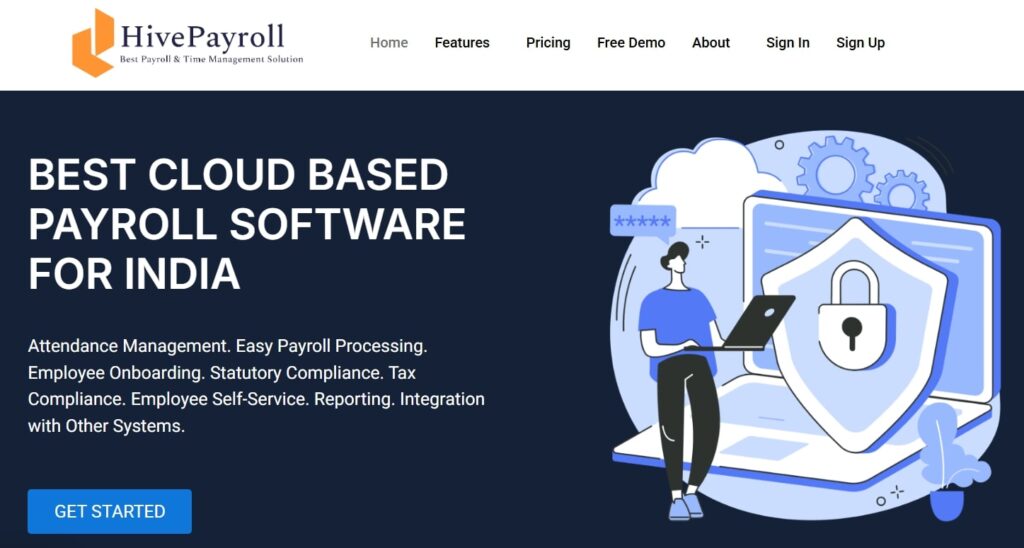
HivePayroll is a cloud-based payroll software that helps you manage employee pay, tax compliance, attendance, leave, and reporting for your business. It is designed to automate payroll processes and make statutory compliance easier, especially for companies operating in India’s complex regulatory environment. HivePayroll also offers managed payroll services where expert teams assist with payroll execution and compliance tasks.
Despite being popular among small and medium businesses, HivePayroll’s flexible architecture and cloud delivery make it capable of supporting larger organisations if you customise the solution according to your workforce size and complexity.
Ideal for you if you want:
- Automated payroll calculations and compliance support
- Integration of attendance, leave, and payroll in one system
- Employee self-service access to payslips and reports
- Managed services support from a vendor team
- An India-focused payroll solution that stays updated with local laws
Key Features Table
| Feature Category | Capabilities Included | Why It Matters for a Large Company |
| Payroll Processing | Automated payroll calculations, pay runs, payslip generation | Reduces errors and speeds up your month-end payroll runs among large employee counts |
| Compliance & Tax | TDS, PF, ESI, professional tax calculations, statutory updates | Helps you align with ever-changing Indian statutory rules |
| Attendance & Leave | Timesheet, attendance tracking, leave management | Centralises data for accurate payroll and labour compliance |
| Reporting & Analytics | Real-time reports on payroll costs, deductions, compliance | Improves visibility and supports decision-making |
| Employee Experience | Self-service portal, mobile access, payslip access | Improves transparency and reduces HR support load |
| Integrations & Extensions | Sync with HR systems or accounting tools | Smooths workflows between your HR and finance teams |
| Data Security | Secure cloud storage and access controls | Protects sensitive employee and payroll data |
Notes: Some capabilities (like integration reach or advanced workflow automation) may require additional custom setup or support from the vendor. Price and packages vary based on company size and specific requirements.
Pricing Table
Here is a snapshot of HivePayroll’s pricing as per the latest available data for 2025-26. Actual pricing and plans may change, so contact the vendor for the most up-to-date quotes.
| Plan Name | Base Cost (₹ per month) | Employee Pricing (₹ per employee) | Best For |
| Standard | ₹1,499 | ₹35 | Growing companies evaluating payroll automation |
| Premium | ₹2,499 | ₹55 | Organisations seeking additional reporting and support |
| Ultimate | ₹3,999 | ₹95 | Larger teams needing advanced workflows and features |
Important pricing notes for you:
- Plans usually include a 15-day free trial so you can evaluate features before committing.
- Per-employee charges apply after the core seat count and depend on your total employee numbers and payroll complexity.
- Transparent pricing is a focus, but confirm any add-on costs related to integrations, onboarding, or compliance support.
Why HivePayroll Works for Large Companies
Automated compliance: India’s payroll regulations change often, and HivePayroll handles statutory updates for TDS, PF, and other deductions automatically. This saves your HR and finance teams time and reduces compliance risk.
Integration ready: The software helps you unify payroll with attendance records, leave management, and reporting infrastructure so your payroll data remains consistent across systems.
Employee centric: With self-service portals and mobile access, your workforce can directly view payslips, tax proofs, and leave balances. This reduces HR manual queries and improves transparency.
Data security and scalability: ISO 27001:2013 certification ensures that sensitive payroll data remains protected, which is especially important when handling information for large teams.
Who Should Consider HivePayroll?
You might choose HivePayroll if your company:
- Has a complex payroll environment with multiple pay components and compliance needs.
- Operates primarily in India and requires strong local statutory support.
- Wants a blend of self-service automation and vendor support.
- Prefers a solution that grows with your organisation and integrates with HR systems over time.
Potential Limitations to Keep in Mind
- HivePayroll’s feature set is strong for payroll and compliance, but for extremely large enterprises with global payroll needs, you may need additional customisation or third-party integrations.
- Advanced workforce analytics and AI-driven forecasting may not be as deep as some global enterprise payroll suites.
- Always confirm integration availability with your existing HRIS, ERP, or accounting platforms before final selection.
2. Keka HR
Overview
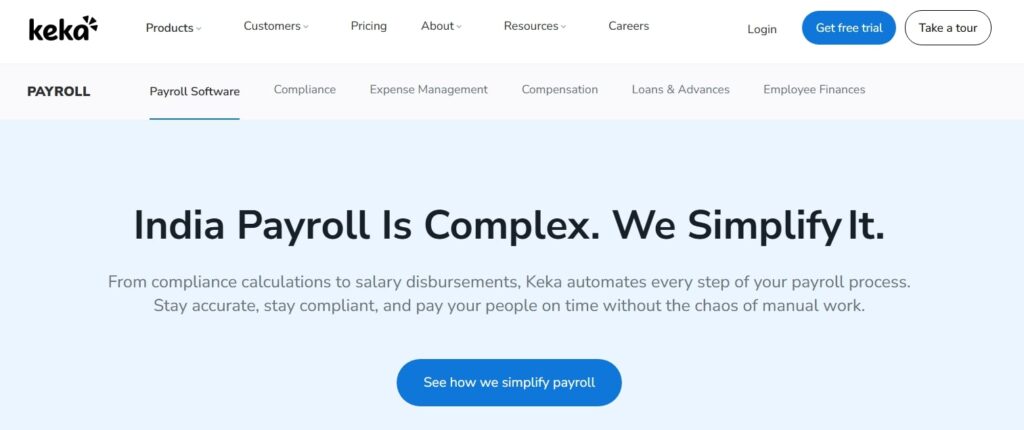
Keka HR is a modern cloud-based Human Resource and Payroll platform that helps you simplify payroll automation, compliance, attendance, leave, and employee self-service from one central system. Founded in 2014 and headquartered in India, Keka has grown to serve over 10,000+ companies and processed 15 million+ payroll runs across client organisations.
Keka is positioned as an employee-centric HR and Payroll platform that combines payroll automation with core HR features such as attendance tracking, compliance automation, performance management, recruitment support, and self-service portals. Its clean and intuitive interface and powerful automation tools help HR and finance teams streamline complex payroll processes while maintaining compliance at scale.
You should consider Keka HR if you want:
- A unified system for payroll, HR management, attendance, and performance
- Automatic statutory compliance for Indian payroll as rules change
- Clear payroll runs and audit trails with minimal manual effort
- Employee and manager self-service tools for payslips, leave, and approvals
- A platform that scales with your business growth without excessive manual coordination
Key Features Table
| Feature Category | Capabilities Included | Why It Matters for a Large Company |
| Payroll Processing | Automated salary calculations with PF, ESI, TDS, PT handling | Ensures accurate and timely payroll runs while reducing manual errors |
| Compliance & Tax | Statutory compliance automation and filing-ready reports | Helps you stay aligned with Indian labour and tax laws |
| Attendance & Leave | Attendance capture, leave management, overtime tracking | Centralised data ensures reliable input for payroll and workforce planning |
| Reporting & Analytics | Real-time dashboards and customizable reports | Improves visibility into payroll costs and workforce metrics |
| Employee Experience | Self-service portal and mobile access | Reduces HR helpdesk tickets and improves transparency |
| Integrations | API connections with accounting and HR tools | Keeps your broader business systems connected and streamlined |
| Data Security | Role-based access and cloud security | Protects sensitive employee payroll and HR data |
Why these features matter for you:
Keka’s integrated payroll and HR suite ensures that payroll inputs, attendance records, and compliance calculations flow smoothly across systems. This reduces data duplication and manual reconciliation, which are common pain points in large organisations with distributed teams.
Pricing Table
Below is an indicative snapshot of Keka HR’s pricing based on recent vendor data. Prices may vary based on employee count, add-ons, and custom enterprise agreements.
| Plan Name | Base Cost (₹ per month) | Employee Pricing (₹ per employee per month) | Best For |
| Foundation | ₹9,999 (up to 100 employees) | ₹90 per additional employee | Entry into HR automation and payroll |
| Strength | ₹12,999 (up to 100 employees) | ₹120 per additional employee | Mid-tier automation with attendance and advanced roles |
| Growth | ₹15,999 (up to 100 employees) | ₹150 per additional employee | Full suite with performance management and engagement tools |
Important pricing notes for you:
- Keka usually requires a setup or onboarding fee to help you configure payroll rules, statutory settings, and employee data imports correctly.
- Larger organisations often negotiate enterprise pricing with volume discounts or longer-term commitments.
- These prices are indicative and subject to change; always request a vendor quote based on your exact workforce size and payroll complexity.
Why Keka HR Works for Large Companies
Unified HR and payroll automation improves productivity.
Keka’s ability to tie attendance, leave, and payroll data into one platform eliminates manual transfers and reconciliation tasks that typically burden HR and finance teams in large organisations.
Centrally handled statutory compliance.
Payroll compliance can be a heavy burden when workforce size grows. Keka’s statutory engines keep tax deductions and filings up to date so you remain compliant across all payroll runs without having to manually update rates and forms.
Better employee self-service reduces HR tickets.
With an easy-to-use employee and manager self-service portal, your workforce can view payslips, track leave and attendance, and update personal details without constantly reaching out to HR. This is valuable in larger organisations where HR queries can be high in volume.
Strong user reviews for usability.
Validated user reviews highlight that Keka’s clean interface and intuitive navigation make day-to-day HR and payroll operations easier to manage, even for teams without deep technical expertise.
Who Should Consider Keka HR?
You should consider Keka HR if your organisation:
- Has a distributed workforce requiring centralised attendance and payroll automation
- Needs statutory compliance management within Indian payroll frameworks
- Wants to unify payroll with other HR functions like performance, attendance, and leave
- Values employee self-service capabilities to reduce administrative load
Keka is particularly suited for mid-market and large enterprises that want a tightly integrated HR and payroll platform rather than a standalone payroll solution.
Potential Limitations to Keep in Mind
- Keka’s pricing structure may feel more like an HRMS suite than a standalone payroll tool if you only need payroll features, especially for large employee counts.
- Some users note that the mobile app may not yet be as powerful as the web interface, which could affect on-the-go payroll adjustments.
- For very large enterprises with global payroll needs outside India, additional custom integrations or specialised global payroll tools may be necessary.
3. greytHR
Overview
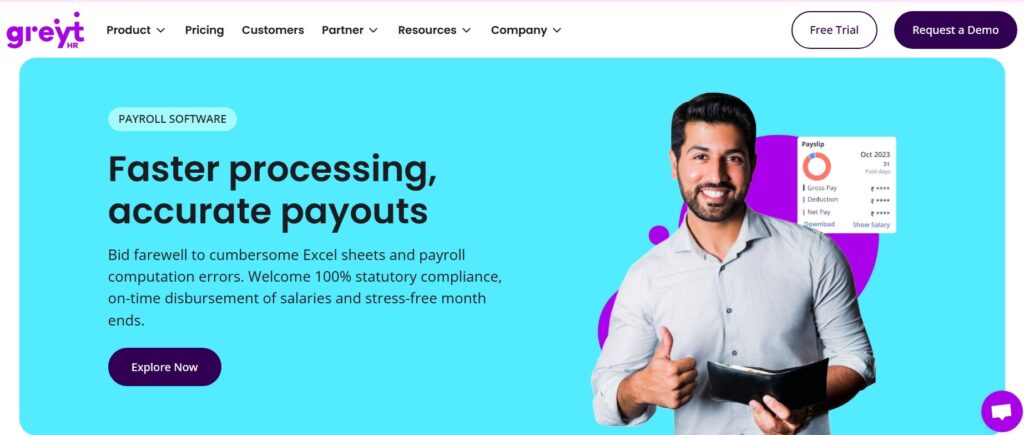
greytHR is a mature, India-focused cloud HRMS and payroll platform that helps you automate payroll runs, statutory compliance, attendance and leave management, and employee self service. The vendor positions itself as a full-suite HR and payroll solution used by tens of thousands of organisations in India, and it emphasises fast payroll runs, statutory accuracy, and enterprise grade uptime. If your operations are primarily India centric and you need reliable statutory coverage with scalable payroll automation, greytHR should be on your shortlist.
Quick facts you can quote
- greytHR reports adoption by thousands of organisations and markets itself as serving more than 30,000 companies.
- The product is explicitly designed to automate statutory calculations such as PF, ESI, TDS and professional tax and to provide payroll reports and filing-ready outputs.
- User review platforms show strong praise for payroll accuracy and compliance, with occasional notes that the product is India focused and may require integrations for global payroll needs.
Key Features Table
| Feature category | What greytHR offers | Why this matters for you as a large company |
| Payroll processing | Automated salary runs, batch pay runs, arrears, reversals, payroll adjustments | Cuts month-end cycle time and reduces manual reconciliation for large employee bases. |
| Statutory compliance | Built-in PF, ESI, TDS, professional tax, statutory reports and filing-ready outputs | Reduces regulatory risk by keeping calculations aligned with India rules. |
| Attendance & leave | Time and attendance capture, shift management, leave policies, biometric integrations | Ensures accurate inputs into payroll and lowers exceptions. |
| Employee self service | Payslips, tax forms, leave requests, dashboard and mobile access | Lowers HR helpdesk load and improves transparency for employees. |
| Reporting & analytics | Standard and custom payroll reports, cost breakups, audit trails | Gives finance leaders the visibility needed for budgeting and audits. |
| Integrations | API and third-party connector options, payroll disbursement integrations | Lets you connect payroll to banking, ERP, and HR systems, which is essential at scale. |
| Security & reliability | Cloud hosting with uptime SLAs and certified security practices | Protects sensitive payroll data and supports enterprise availability expectations. |
Pricing Table
Pricing for enterprise payroll changes by contract size and features. Use this table as an orientation and always request a customised quote for your headcount and needs.
| Pricing signal | What vendor materials show | What to expect for large companies |
| Per employee starting price | greytHR advertises pricing starting around INR 35 per employee per month on its website. | Entry level per employee price for very large workforces is often negotiable; expect volume discounts for 1,000+ employees. |
| Monthly subscription examples | Market listings and resellers show modular plans and tiered pricing examples. | For enterprise deals you will likely see a base platform fee plus a PEPM component and onboarding charges. |
| Onboarding & support | greytHR highlights onboarding and proactive customer support. | Factor implementation, statutory configuration and integration costs into your total cost of ownership. |
Practical tip: ask the vendor for a detailed TCO projection that includes implementation, integration, managed payroll (if any), accounting connectors, and expected yearly price escalations.
Why greytHR works for large companies
- Strong India statutory depth. If your legal and payroll footprint is India centric, greytHR’s built-in statutory engines and compliance guides reduce your manual update burden and lower audit risk. Many enterprise payroll incidents come from missed statutory changes; greytHR’s focus helps prevent that.
- Faster payroll cycles and uptime. greytHR highlights fast payroll processing and enterprise availability, which matters when you process thousands of payslips across multiple payroll cycles. That reliability reduces operational stress during month end.
- Proven scalability across many customer sizes. The vendor’s large customer base and long tenure in the market indicate operational maturity, support processes, and a track record for handling scale.
- Good user sentiment on accuracy. Reviews frequently call out payroll accuracy and statutory correctness as strengths. Accuracy at scale is the single biggest contributor to employee trust in payroll operations.
Potential limitations you should evaluate
- India focus may limit global payroll coverage. If you have significant operations outside India, you may need a multi-vendor approach or custom integrations to handle local statutory requirements abroad. Reviewers note greytHR’s strength is India centric.
- User experience variability. Some users report that workflows for complex payroll exceptions can require several steps. If your payroll has many exception cases, evaluate the demo with typical scenarios.
- Price changes and contract terms. greytHR has communicated price updates in the past. For a predictable budget, negotiate multi-year terms or caps on annual increments.
Who should consider greytHR
You should shortlist greytHR if you:
- Run payroll primarily in India and need strong statutory coverage.
- Want a single platform that ties attendance, HR data and payroll to reduce reconciliation.
- Prefer a mature vendor with a broad customer base and country-specific expertise.
If your company has heavy multi-country payroll responsibilities, include greytHR in a broader comparison with global payroll platforms and plan for either integrations or a hybrid architecture.
Implementation checklist for your procurement conversation
Use these items when you talk to greytHR or a reseller:
- Ask for a statement of work that outlines statutory setups for each state where you operate.
- Request sample payroll outputs, TDS reports and PF reports for your specific pay structures.
- Confirm API endpoints and confirm support for your ERP and bank salary disbursement process.
- Clarify onboarding timelines, data migration scope, and support SLAs for month end during cutover.
If your primary payroll complexity stems from India statutory rules, multi-state operations, and heavy month end volumes, greytHR is a proven choice that trades on deep local compliance expertise and stable payroll automation. For global payroll needs, pair greytHR with a strategy for integrations or a global payroll partner. Use a pilot payroll run and a detailed TCO exercise to validate fit before committing enterprise wide.
4. HROne
Overview
HROne is a cloud HRMS and payroll platform built for Indian organisations that need an integrated hire-to-retire solution. You can use it to automate payroll runs, statutory calculations, time and attendance, leave, onboarding, performance, and expense workflows from one central system. HROne positions itself as easy to use, mobile friendly, and suitable for organisations that want a single platform for HR and payroll.
Key Features Table
| Feature category | Capabilities included | Why this matters for your large company |
| Payroll processing | Automated pay runs, configurable pay groups, arrears, reversals, bulk payroll actions | Speeds month end and lowers the chance of mass payroll errors |
| Statutory compliance | Built-in PF, ESI, TDS, professional tax calculations, compliance updates | Keeps you aligned with Indian statutory rules and reduces filing risk. |
| Attendance & shift management | Geo-tagging, selfie attendance, offline punch capture, shift patterns | Ensures accurate attendance inputs across locations and remote teams. |
| Employee self service | Mobile app, payslip access, leave requests, digital acknowledgements | Reduces HR tickets and improves employee transparency. |
| Reporting & analytics | Standard dashboards, payroll reconciliation, exportable reports | Gives finance and HR leaders visibility into payroll spend and variances |
| Integrations & marketplace | Connectors for accounting tools, calendars, API options, third-party apps | Lets you link payroll to ERP, banks, and productivity tools for end-to-end workflows |
| Security & reliability | Cloud hosting, uptime SLAs, user roles and access control | Protects sensitive payroll data and supports enterprise availability expectations |
Pricing Table
HROne publishes transparent starter plans and per user pricing signals. For large organisations you will likely move to the Enterprise plan with custom pricing. Always request a tailored quote based on headcount and modules required.
| Plan | Base cost (per month) | Additional user price | Notes for large companies |
| Basic | ₹4,950 for 50 users | ₹99 per additional user per month | Good to evaluate core payroll and attendance features. |
| Professional | ₹6,500 for 50 users | ₹130 per additional user per month | Adds workforce workflows and digital acknowledgements. |
| Enterprise | Custom pricing | Custom | Recommended for 50+ users with negotiation for volume discounts and added modules |
Practical pricing notes for you
• HROne normally charges on a per user per month basis and offers tiered bundles for the first block of users.
• Expect onboarding and implementation elements to be scoped into enterprise deals. Ask for a total cost of ownership that includes integration, onboarding, and annual increases.
Why HROne works for large companies
- You get a single platform that covers payroll, attendance, HR workflows and performance, which reduces data silos and reconciliation work.
- The product is mobile first and supports modern attendance features like geo-fencing and selfie punches, useful when your workforce is distributed across offices and remote sites.
- HROne emphasises ease of use and fast onboarding, which helps when you roll out payroll changes across multiple departments or locations. Vendor materials and user reviews highlight usability as a strength.
Potential limitations you should evaluate
- If you have global payroll needs outside India, HROne focuses primarily on Indian statutory coverage and may require additional vendors or integrations for international payroll.
- Some reviews mention occasional technical glitches and limits when creating very custom reports, so validate reporting and exception workflows with sample scenarios.
- Minimum seat commitments in published plans mean that startups or organisations with fluctuating headcount should negotiate flexible terms. Confirm minimum commitments and exit clauses in the contract.
Implementation checklist for your procurement conversation
- Share sample payroll runs with the vendor and request a sandbox payroll using your pay components, variable pay rules, and statutory scenarios.
- Ask for copies of typical statutory reports such as PF, ESI and TDS outputs for review and for bank disbursement file formats.
- Confirm API availability and specific connectors for your ERP, accounting software, and bank salary disbursement process.
- Validate attendance integrations you plan to use, for example biometric devices or mobile geo-fencing, and run a reconciliation test.
- Secure SLAs for month-end support during cutover and a documented rollback plan in case of issues.
- Negotiate pricing caps or multi-year pricing guarantees if predictable budgeting is important.
HROne is a strong choice when your payroll complexity is India centric and you want an integrated HR and payroll platform that places emphasis on usability and mobile-first features. For organisations with strict global payroll needs or extremely custom reporting demands, plan for either custom integrations or consider pairing HROne with a global payroll partner. Use a pilot payroll run and a detailed TCO comparison to make a confident procurement choice.
5. factoHR
Overview
factoHR is a cloud-based HRMS and payroll software developed by Version Systems Private Limited that helps organisations automate core HR tasks, attendance tracking, payroll processing, compliance, and employee self-service in one unified platform. It is used by over 3,500+ companies and supports more than 2.6 million employees across 20+ countries, making it a scalable solution for growing enterprises.factoHR
factoHR is designed for both HR and payroll teams who need automation and accuracy for volume payroll processing, statutory compliance, time and attendance, and workforce management from a single dashboard. Its mobile-friendly experience and configurable workflows help reduce HR workload while improving data accuracy.factoHR
You should consider factoHR if you want:
- End-to-end payroll automation with integrated HR functions
- Real-time attendance and leave-linked payroll processing
- Employee and manager self-service via web and mobile apps
- A solution that scales with workforce growth without multiple point solutions
- Strong statutory compliance support within IndiafactoHR
Key Features Table
| Feature Category | Capabilities Included | Why It Matters for Your Large Company |
| Payroll Processing | Automatic payroll runs, salary calculations, arrears, deductions | Handles complex payroll scenarios with minimal errors and faster pay cycles |
| Statutory Compliance | Built-in compliance for PF, ESI, TDS, statutory forms | Reduces regulatory risk with automatic statutory rules updates and compliant calculationsfactoHR |
| Attendance & Leave | Geo-fencing, selfie punch, shift scheduling, leave workflows | Ensures accurate attendance data flows directly into payroll calculationsfactoHR |
| Employee Self-Service | Mobile app access to payslips, income tax info, leave requests | Reduces HR support tickets and improves employee transparencyfactoHR |
| Reporting & Analytics | Dashboard reports on attendance, payroll summaries, workforce metrics | Helps finance and HR leaders make informed decisions |
| Integrations | Biometric device support, third-party connectors | Connects payroll to attendance capture tools and other enterprise systemsSoftwareSuggest |
| Scalability & Security | Cloud-based with role-based access and customizable workflows | Supports large employee bases and protects sensitive data |
factoHR’s payroll module is part of a broader HR suite that integrates core HR processes so that payroll, attendance, leave, performance, onboarding, and exit workflows share consistent data. This unified architecture reduces reconciliation work and ensures accuracy when payroll count grows.factoHR
Pricing Table
Pricing for factoHR is typically customised based on company size, modules, and employee count. Below is an indicative view of pricing signals gathered from vendor sources and reseller listings. Always request a detailed quote for accurate enterprise pricing.TechJockey+1
| Plan / Indicative | Monthly Cost (₹) | Scope | Who It Works For |
| Entry Payroll Plans | ₹69 – ₹119 per employee per month | Basic payroll + compliance | Large companies wanting straightforward payroll automationfactoHR |
| Core Suite | Starts ~₹4,999 | Payroll, attendance, leave, HRMS | SMB and mid-enterprise evaluating unified HR + payrollTechimply |
| Premium & Ultimate | ~₹5,999 – ₹6,999 | Adds performance, travel, expense integration | Organisations needing broader HR functionalityTechimply |
| Enterprise Custom | Custom pricing | Full modules + integrations + support | Larger enterprises with tailored requirements |
Important pricing notes for you:
- Plans may scale based on total employee headcount, features enabled, and service add-ons.Techimply
- Enterprise deals usually include onboarding, data migration, and integration support.
- Ask for a total cost of ownership (TCO) that covers annual costs, implementation fees, and support fees.
Why factoHR Works for Large Companies
Unified platform reduces siloed data.
factoHR merges HR and payroll into one system, so payroll runs always draw from accurate attendance and leave data without manual intervention. Its integrated design helps reduce errors that typically happen when multiple systems are stitched together manually.factoHR
Mobile-friendly self-service improves efficiency.
A mobile app and employee self-service portal let your workforce access payslips, tax information, and attendance records anytime. This reduces manual HR queries and accelerates approval cycles, especially for distributed or field-based teams.factoHR
Strong attendance tracking enhances payroll accuracy.
factoHR supports geo-fencing, selfie punch, and shift scheduling to capture time accurately across locations. When attendance data flows directly into payroll, your finance team spends less time reconciling hours and data mismatches.factoHR
Scalability for evolving needs.
With support for multiple HR modules and modern workforce management, factoHR scales from mid-sized to large enterprises as your company grows. Many organisations appreciate its ability to consolidate HR functions without investing in multiple standalone systems.factoHR
Potential Limitations to Keep in Mind
- Pricing transparency varies. Most enterprise pricing is not publicly listed, so you will need to engage with sales for custom quotes and volume discounts.factoHR
- Initial setup can require guidance. Some users note a learning curve when first configuring workflows and integrations.SoftwareSuggest
- Performance experience can vary. A few reviews mention occasional performance slowdowns with large data loads, so benchmark performance with your data scenarios.G2
Who Should Consider factoHR
You should choose factoHR if your organisation:
- Has a large workforce and needs accurate, automated payroll linked to attendance and HR functions.factoHR
- Wants self-service tools that reduce HR transaction volume.factoHR
- Operates across locations and needs mobile-friendly attendance and shift tracking.factoHR
- Prefers a single HR and payroll suite rather than multiple point tools.factoHR
factoHR is especially strong for India-centric statutory compliance and organisations that value integration with biometric systems and mobile attendance capture.SoftwareSuggest
Potential Implementation Checklist
Use this checklist with your procurement team when evaluating factoHR:
- Ask for a sandbox demo using your actual payroll scenarios and statutory rules.
- Confirm the payroll compliance engine handles PF, ESI, TDS, and other local statutory reports without manual overrides.factoHR
- Validate attendance and leave data flows into payroll without reconciliation steps.factoHR
- Review mobile app capabilities for employee self-service and manager approvals.factoHR
- Clarify integration options with your ERP, accounting tools, biometric devices, and banks.SoftwareSuggest
factoHR is a scalable and capable choice if you seek a unified HR and payroll platform with strong attendance integration and mobile-friendly self-service. Its statutory compliance capabilities and dashboards help large companies streamline payroll operations and reduce manual effort. Evaluate the platform with real payroll scenarios to ensure performance and integration needs are met before enterprise deployment.
6. sumHR
Overview
sumHR is a cloud-based HR and payroll platform built to help organisations digitise HR processes and automate payroll with minimal manual effort. It focuses on providing a user-friendly experience for HR teams, employees, and administrators while enabling scalable payroll operations across large employee populations. sumHR also brings attendance, leave management, employee self-service, reporting, and compliance capabilities into one modern interface. (sumhr.com)
sumHR is known for simplicity, modular flexibility, and integration potential with complementary business apps such as attendance systems and accounting tools. It is suitable for companies that want payroll automation without overly complex setup and for HR teams that value intuitive dashboards and actionable insights.
Key Features Table
| Feature Category | Capabilities Included | Why It Matters for Large Companies |
| Payroll processing | Automated salary computations, pay runs, arrears, arrear reversals | Reduces manual workload and improves accuracy for large payroll volumes |
| Statutory compliance | PF, ESI, TDS, professional tax handling, statutory reports | Helps you stay compliant with Indian statutory requirements |
| Attendance & leave | Time tracking, leave policies, shift schedules | Centralises attendance data for accurate payroll calculations |
| Employee Self-Service | Payslips, reimbursements, leave requests via web and mobile | Reduces HR support burden and improves transparency |
| Reporting & analytics | Custom reports, payroll summaries, workforce insights | Enables better financial planning and audit readiness |
| Integrations | APIs and connectors to HRIS, accounting, attendance tools | Lets payroll work in tandem with broader business systems |
| Security | Role-based access and secure cloud hosting | Protects sensitive data and supports enterprise security standards |
sumHR blends essential payroll automation with a friendly interface that helps HR teams gain visibility into payroll and compliance without needing heavy technical complexity.
Pricing Table
sumHR pricing is not entirely public and typically requires a personalised quote. Below is an indicative snapshot of pricing tiers based on vendor signals and industry listings. Always get a customised quote for accurate budgeting.
| Plan | Base Monthly Cost (₹) | Employee-wise Pricing (₹ per employee) | Best For |
| Starter | ₹5,000 | ₹50 | Small-to-mid sized teams evaluating payroll automation |
| Growth | ₹8,000 | ₹75 | Expanding teams needing advanced workflows and analytics |
| Enterprise | Custom | Custom | Large organisations with compliance, automation and reporting needs |
Practical pricing notes for you:
• Enterprise pricing usually involves volume-based discounts for 1,000+ employees.
• Setup and onboarding fees may apply for large rollouts and data migration.
• sumHR often customises pricing based on modules selected and integrations required.
Source for indicative pricing signals: industry listings on software comparison platforms.
Why sumHR Works for Large Companies
Unified payroll and HR management
sumHR combines payroll with core HR functions such as leave management, attendance synching, and employee self-service in one interface. This reduces context switching for HR teams and data reconciliation between systems.
Easy to use and quick to deploy
Many users highlight sumHR’s intuitive interface and comparatively shorter onboarding cycle. For large teams, this means payroll and compliance features are up and running quickly with less dependency on dedicated technical resources.
Statutory compliance engines
sumHR handles key statutory requirements in India (PF, ESI, TDS, professional tax). By automating calculations and report generation, you reduce compliance risk and speed up filings.
Employee self-service improves productivity
Mobile and web portals allow employees to access payslips, submit leave requests, and view earnings breakdowns. This self-service layer reduces repetitive HR queries and helps your teams focus on strategic tasks.
Potential Limitations to Keep in Mind
- Pricing transparency: sumHR does not publicly list all pricing elements, so you need to engage with the sales team for custom pricing and enterprise packages.
- Scalability perception: Some users note that sumHR works exceptionally well for mid-sized enterprises but may require additional custom support for very large payroll complexities (for example, multi-country payroll).
- Advanced reporting: While sumHR offers strong reporting capabilities, some enterprise users may require deeper BI integrations for advanced analytics.
Who Should Consider sumHR
You should shortlist sumHR if your organisation:
- Is growing rapidly and needs payroll automation that scales with minimal complexity.
- Wants a unified HR suite with payroll, attendance, and self-service features.
- Prefers a modern UI and straightforward configuration for managers and HR teams.
- Operates within Indian statutory frameworks and seeks compliance automation.
sumHR is particularly strong for companies looking for a balance between usability and automation without the overhead of very complex global payroll engines.
Implementation Checklist for Your Procurement Process
- Request a tailored payroll demo using your actual pay components and statutory scenarios.
- Confirm compliance coverage for all applicable statutory regimes (state-wise professional tax, income tax changes, PF/ESI updates).
- Verify integration support with your accounting systems, attendance capture tools, and banking payfile formats.
- Assess onboarding timelines and support SLAs for month-end readiness and data migration.
- Clarify pricing agreement terms, including volume discounts and potential price escalations in multi-year contracts.
Bottom Line for Decision Makers
sumHR is a compelling payroll and HR suite if your organisation needs scalable payroll automation combined with intuitive HR workflows and strong employee self-service. It works especially well when your payroll complexity is centred around India statutory compliance and domestic operations. For organisations with highly custom needs or global payroll footprints, evaluate sumHR alongside specialised enterprise payroll suites and planned integrations.
7. Pocket HRMS
Overview
Pocket HRMS is a cloud-based HR and payroll platform designed to help you automate payroll, compliance, attendance, leave, and employee lifecycle management from a single system. It positions itself as an AI-enabled, enterprise-ready HRMS with a strong focus on usability, mobility, and statutory accuracy for Indian organisations. Pocket HRMS is widely adopted by mid-sized and large companies that want modern HR experiences while keeping payroll compliant and auditable at scale.
For large organisations, Pocket HRMS aims to reduce payroll risk by combining automated statutory calculations with configurable workflows, approvals, and employee self service. Its mobile-first design is especially useful if your workforce is distributed across offices, plants, sales teams, or remote locations.
You should consider Pocket HRMS if you want:
- Payroll automation tightly linked to attendance and leave
- India statutory compliance with regular updates
- Strong employee and manager self service via mobile and web
- Workflow driven approvals and audit trails
- A platform that can scale across departments and locations
Key Features Table
| Feature category | Capabilities included | Why this matters for large companies |
| Payroll processing | Automated salary computation, multi pay structures, arrears, reversals, bulk payroll runs | Handles high payroll volumes accurately and shortens month end cycles |
| Statutory compliance | PF, ESI, TDS, professional tax, labour law ready reports | Reduces compliance risk and dependency on manual statutory updates |
| Attendance & leave | Biometric integration, geo tagging, shift management, leave policies | Ensures reliable attendance data flows directly into payroll |
| Employee self service | Payslips, tax declarations, leave requests, approvals via mobile and web | Lowers HR query volume and improves employee transparency |
| Workflow automation | Configurable approval workflows and role based access | Helps maintain control and governance in large organisations |
| Reporting & analytics | Payroll summaries, compliance reports, cost analysis | Supports audits, budgeting, and leadership reporting |
| Security & access | Role based permissions, secure cloud hosting | Protects sensitive payroll and employee data at scale |
| Integrations | APIs and connectors for ERP, accounting, and attendance tools | Enables payroll to fit into your broader enterprise ecosystem |
Pocket HRMS focuses on creating a balance between deep payroll functionality and a modern user experience, which is often a key requirement in large organisations with diverse user groups.
Pricing Table
Pocket HRMS generally follows a modular, employee-based pricing model. Exact pricing depends on employee count, selected modules, and implementation scope. The table below provides directional guidance only.
| Plan type | Indicative pricing signal | Best suited for |
| Payroll only | Per employee per month pricing starting in the lower double digits | Organisations seeking focused payroll automation |
| HRMS plus Payroll | Higher per employee pricing based on modules selected | Large companies wanting a unified HR and payroll platform |
| Enterprise | Custom pricing | 1,000+ employee organisations with complex workflows and integrations |
Practical pricing notes for you:
- Enterprise customers usually negotiate volume based discounts.
- Implementation, onboarding, and data migration costs should be clarified upfront.
- Ask for a detailed total cost of ownership covering three to five years.
Why Pocket HRMS Works for Large Companies
Strong payroll and compliance foundation
Pocket HRMS automates core Indian statutory calculations and reporting, which is critical when your payroll spans multiple states and complex pay structures. This reduces manual intervention and compliance exposure.
Mobile-first employee experience
Large organisations often struggle with employee adoption. Pocket HRMS addresses this through a polished mobile app that allows employees and managers to access payslips, submit requests, and approve workflows without depending on HR teams.
Workflow driven control and governance
With configurable approval flows and role based permissions, you can enforce payroll governance even as the number of users and managers increases. This is especially important during salary revisions, arrears processing, and bonus cycles.
Scales across departments and locations
Pocket HRMS supports multi location and multi department structures, which makes it suitable for organisations with branch offices, factories, or field teams operating under a single payroll umbrella.
Potential Limitations to Evaluate
- Global payroll coverage: Pocket HRMS is strongest for India centric payroll. If you operate payroll in multiple countries, you may need integrations or additional vendors.
- Advanced analytics depth: While reporting is strong for payroll and compliance, some enterprises may want deeper BI integrations for advanced workforce analytics.
- Customisation effort: Highly customised payroll rules or legacy structures may require careful configuration during implementation.
Who Should Consider Pocket HRMS
You should shortlist Pocket HRMS if your organisation:
- Has a large, distributed workforce within India
- Wants payroll tightly integrated with attendance and HR workflows
- Values mobile access and employee self service adoption
- Needs structured approvals and audit readiness
- Is looking for a modern HR and payroll platform without extreme complexity
Pocket HRMS is a strong fit for enterprises that want reliable payroll compliance combined with a modern HR experience.
Implementation Checklist for Your Evaluation
- Run a pilot payroll using your real pay components, arrears, and statutory scenarios.
- Validate biometric and attendance integrations across all locations.
- Review statutory reports and reconciliation outputs with your finance team.
- Test approval workflows for payroll changes and salary revisions.
- Confirm support SLAs for month end processing and statutory filing periods.
Pocket HRMS is a solid choice for large Indian organisations that want to modernise payroll operations without sacrificing compliance or control. Its strength lies in combining payroll accuracy, mobile friendly self service, and workflow governance in a single platform. Before finalising, validate performance with your real payroll data and secure a clear multi year pricing and support commitment.
8. RazorpayX Payroll
Overview
RazorpayX Payroll is an automated payroll and compliance platform offered by Razorpay, a leading Indian fintech company known for its cloud payments, business banking, and financial automation tools. RazorpayX Payroll helps you streamline payroll processing, statutory compliance, salary disbursals, attendance and leave management, and employee self-service from one unified dashboard. Razorpay+1
While widely adopted by startups and fast-growing businesses, RazorpayX Payroll also offers enterprise-level capabilities and custom plans for organisations with complex workforce requirements. Its deep integration with Razorpay’s money movement system means you can automate salary disbursements, compliance payments, and filings in connected workflows rather than handling them manually. Razorpay
You should consider RazorpayX Payroll if you want:
- Automated payroll and compliance with minimal manual steps
- End-to-end salary processing and direct bank transfers
- Integrated reimbursement and leave management tools
- Easy connection with HRMS and finance systems via APIs
- Employee self-service portals for payslips, documents, and tax declarations Razorpay+1
Key Features Table
| Feature Category | Capabilities Included | Why It Matters for Your Large Company |
| Payroll processing | Automated payroll calculation, one-click payroll runs, arrears, salary reversals | Reduces manual workload and accelerates payroll cycles for large teams |
| Compliance & statutory | Automatic calculation and filing of TDS, PF, ESI, PT | Helps you stay compliant with Indian statutory requirements without manual tracking |
| Salary disbursal | Direct bank transfers to employees, contractors | Ensures timely payments and reduces reconciliation effort |
| Attendance & leave | Online leave tracking, attendance approvals, holiday tracking | Captures leave data and integrates it into payroll automatically |
| Employee self service | Payslips, tax declarations, documents, reimbursements | Reduces HR support tickets and improves employee transparency |
| Integrations & APIs | API connections with HRMS, accounting tools, attendance systems | Enables your payroll to sync with broader enterprise systems |
| Reporting & analytics | Standard payroll reports, compliance filings, customized reports | Supports finance audits and decision-making |
| Security & reliability | SOC2 and ISO compliant, role-based access control | Protects payroll data at enterprise scale and aligns with security norms |
RazorpayX Payroll’s comprehensive feature set means payroll, compliance, and employee services live on one platform rather than being scattered across multiple point tools.
Pricing Table
RazorpayX Payroll offers tiered pricing based on organisational size and feature requirements. For exact quotes, you should contact Razorpay sales directly.
| Plan Name | Indicative Monthly Cost | Scope | Best For |
| Prime | ~₹2,499 per month | Up to ~30 employees | Smaller teams or pilot deployments |
| Elite | ~₹8,499 per month | Up to ~1,000 employees | Mid-market and scaling teams |
| Enterprise | Custom pricing | 1,001+ employees | Large companies with custom needs |
Practical pricing notes for you:
• RazorpayX Payroll commonly partitions plans based on headcount, so enterprise deals will be custom priced and can include volume discounts and bespoke integration support. Razorpay
• Clarify how compliance filings, statutory payments, and support services are tiered across plans so there are no hidden gaps.
• Many organisations negotiate multi-year agreements for pricing predictability.
Why RazorpayX Payroll Works for Large Companies
Automated compliance and filings:
RazorpayX Payroll handles statutory compliance automation for TDS, PF, PT, and ESI, and even prepares filings so you can avoid manual calculations and reduce risk of errors or missed deadlines. Razorpay
Direct salary disbursal:
Thanks to Razorpay’s payment infrastructure, salary distributions to employee and contractor bank accounts are integrated directly into the payroll run. This eliminates the manual process of exporting payment files and uploading them to banking portals.
Robust integrations:
RazorpayX Payroll works with popular HRMS, attendance, and finance tools, including Darwinbox, SAP SuccessFactors, Oracle HCM, Zoho People, and other HR tech partners. This helps you avoid duplicate data entry and ensures payroll remains synchronized with employee records. Razorpay
Employee experience and self service:
Your workforce gets a dedicated portal where they can access payslips, tax forms, reimbursements, and leave balances, improving transparency and reducing queries to HR teams. Razorpay
Security and enterprise readiness:
RazorpayX Payroll is built on infrastructure compliant with enterprise security standards, including SOC2 and ISO certifications, and supports granular access controls to protect sensitive payroll data. Razorpay
Potential Limitations to Evaluate
- India centric payroll focus: RazorpayX Payroll’s statutory compliance and workflows are designed for Indian businesses. If your payroll operations extend globally, you may need additional tools or integrations for international statutory compliance.
- Headcount-based pricing: The tiered plan structure tied to specific headcount bands can be less flexible for organisations with fluctuating monthly employee counts.
- Feature access by plan: Advanced features like deep analytics and customized workflows may be reserved for higher tiers, so confirm plan details during evaluation.
Who Should Consider RazorpayX Payroll
You should shortlist RazorpayX Payroll if your organisation:
- Has a large workforce in India and seeks automated compliance and salary disbursals.
- Wants payroll tightly integrated with banking and finance flows.
- Values employee self service for payslips, documents, reimbursements, and tax declarations.
- Plans to sync payroll with existing HRMS and accounting systems.
- Prefers a single platform that combines payroll, statutory compliance, and employee services.
RazorpayX Payroll is particularly compelling for organisations that already use Razorpay’s banking or finance products, or that value integrated payment and payroll experiences.
Implementation Checklist for Your Evaluation
- Run a pilot payroll with your real pay components and statutory deductions to validate accuracy and reporting.
- Confirm integration touchpoints with your HRMS, attendance systems, and finance platforms.
- Review compliance outputs for PF, ESI, TDS and pay filings with your compliance team or consultant.
- Test self-service workflows for employees to access payslips and request reimbursements.
- Clarify pricing tiers based on headcount, support coverage, and compliance assistance.
RazorpayX Payroll brings together payroll automation, statutory compliance, and direct salary disbursals in a unified platform that is particularly strong for Indian enterprises. Its integrations and automated compliance workflows reduce manual workload and improve reliability at scale. As you evaluate RazorpayX Payroll, use a pilot and integration plan to ensure it fits your enterprise scale, compliance needs, and IT ecosystem.
Zoho Payroll
Overview
Zoho Payroll is a cloud-based payroll management solution from Zoho Corporation that helps you automate payroll calculations, manage statutory compliance, process salary payments seamlessly, and deliver a streamlined employee experience. While Zoho Payroll scales from startups to larger organisations, its modular pricing and rich set of automation features make it a strong contender for enterprises in India aiming to simplify payroll operations without sacrificing control or accuracy. Zoho
Zoho Payroll also integrates naturally with Zoho People (HRMS), Zoho Books (accounting) and other Zoho products to provide extended payroll-linked workflows, analytics, and compliance documentation all in one ecosystem. Zoho
You should consider Zoho Payroll if you want:
- Automated statutory compliance for India payroll including EPF, ESI, professional tax, labour welfare fund (LWF), TDS and other deductions Zoho+1
- Automated payroll calculations and pay runs with formula-based components and approvals Zoho
- Employee self-service portals and mobile access to payslips and tax documents Zoho
- Clear reporting and audit readiness via built-in compliance and payroll reports Zoho
- Integration with HRMS and finance systems such as Zoho People and Zoho Books Zoho
Key Features Table
| Feature Category | Capabilities Included | Why It Matters for Large Companies |
| Payroll processing | Automatic payroll calculation, arrears, pay runs, salary revisions | Improves accuracy and reduces manual effort for large payroll runs Zoho |
| Statutory compliance | PF, ESI, PT, LWF, TDS calculations, formatted EPF/ESI reports | Helps you stay compliant with Indian statutory rules without manual updates Zoho |
| Attendance & leave | Shift definitions, attendance regularisation, leave policies, leave balances | When integrated, ensures payroll uses accurate time and leave inputs Zoho |
| Employee self-service | Payslips, tax declarations, reimbursements, leave requests | Reduces HR queries and empowers employees with self-service access Zoho |
| Reporting & analytics | Built-in payroll, statutory and deduction reports | Supports audit readiness and payroll cost visibility Zoho |
| Integrations | Zoho People, Zoho Books, APIs | Connects payroll to HR and accounting systems for seamless workflows Zoho |
| Workflow automation | Multi-level approvals, custom roles | Adds governance and verification steps for large payroll processes Zoho |
| Security & scalability | Role-based permissions, cloud deployment, secure access | Protects payroll data and ensures enterprise-grade availability |
Zoho Payroll’s ecosystem advantage means you can extend payroll functionality easily into HR, accounting, and reporting without building complex custom integrations. Zoho
Pricing Table
Zoho Payroll pricing for Indian organisations is transparent and modular, with options that fit different size segments. You can also start a free trial for 14 days before committing to a paid plan. Zoho+1
| Plan | Cost Structure | Includes |
| Free | ₹0 (up to 10 employees) | Core payroll, payslip generation, basic statutory compliance, employee self-service Zoho |
| Standard | ₹1,000 per org/month + ₹40/employee/month | All Free features plus loans/advances, Form 16, TDS recording, custom salary components Zoho |
| Professional | ₹3,000 per org/month + ₹60/employee/month | Bonus/off-cycle pays, advanced salary components, approvals, reporting tags Zoho |
| Premium | ₹4,000 per org/month + ₹80/employee/month | Includes attendance/leave management, advanced automation and workflow customisation Zoho |
Important pricing notes for you:
- Pricing is billed annually and exclusive of GST. Zoho
- Larger organisations often negotiate volume discounts or custom enterprise contracts for headcounts beyond typical plan caps.
- The free plan is suitable for evaluation and very small teams, but larger companies will likely need Standard or higher plans with built-in approvals and integrations. Zoho
Why Zoho Payroll Works for Large Companies
Comprehensive statutory compliance automation
Zoho Payroll provides automated deduction calculations for key statutory obligations such as EPF, ESI, professional tax, LWF and TDS and generates structured reports that help you stay audit-ready. It also adjusts calculations based on employee locations and statutory requirements automatically. Zoho
Integration with HR and finance systems
If you use Zoho People for HR management or Zoho Books for finance, payroll data, attendance inputs, and accounting entries can sync naturally, removing reconciliation friction and duplication. Zoho
Employee self-service and transparency
Your workforce can view payslips, tax worksheets, reimbursements, and leave balances from their portal, reducing queries to HR. This improves employee experience and lets your HR team focus on strategic priorities instead of admin tasks. Zoho
Scalability and governance
Multi-level approvals and role-based access help enforce governance over pay runs and revisions, which is essential when you are handling payroll for large teams with complex pay structures. Zoho
Potential Limitations to Keep in Mind
- Attendance/leave modules can require careful configuration and, in some cases, integration with Zoho People for full functionality. When integrated, you need to disable standalone leave and attendance modules to avoid conflicts. Zoho
- For non-India payroll operations, Zoho Payroll’s statutory workflows focus primarily on Indian laws, so global payroll may require additional tools.
- Advanced analytics beyond standard reporting may require third-party BI tools or Zoho Analytics for deeper insights.
Who Should Consider Zoho Payroll
You should shortlist Zoho Payroll if your organisation:
- Requires accurate statutory compliance automation for Indian payroll.
- Wants payroll tightly integrated with HR and accounting systems in the Zoho ecosystem.
- Values employee self-service and audit readiness.
- Prefers a scalable model with transparent pricing and clear upgrade paths.
- Is looking for payroll automation that reduces manual effort while improving visibility.
Zoho Payroll is particularly compelling for organisations that already use other Zoho products, as integrations help streamline workflows even further. Zoho
Implementation Checklist for Your Evaluation
- Verify statutory report outputs (EPF ECR, ESI, PT summaries, TDS challans) for accuracy across your typical payroll runs.
- Confirm attendance and leave integration requirements, especially if planning to integrate with Zoho People. Zoho
- Review approval workflows to ensure multi-level controls reflect your internal governance needs.
- Validate employee self-service access and mobile usability for payslips and documents. Zoho
- Ask for a detailed quote including volume discounts for your headcount and expected usage.
Zoho Payroll combines automation, compliance accuracy, user-centric design, and ecosystem integrations to deliver a robust payroll solution for large Indian companies. Its tiered pricing and scalable plans provide flexibility, while its integration with HR and accounting systems helps you reduce duplication and improve governance. For organisations aiming to modernise payroll with strategic control and visibility, Zoho Payroll is a strong option to evaluate in your enterprise shortlist. Zoho+1
9. Zimyo Payroll
Overview
Zimyo Payroll is a cloud-based HR and payroll platform built for fast-growing and large Indian organisations that want automation, compliance accuracy, and employee friendly self service. Zimyo positions itself as a modern, modular HR and payroll system that covers payroll processing, statutory compliance, attendance, leave, performance, and workforce analytics within a single ecosystem.
For large companies, Zimyo focuses on simplifying complex payroll structures, handling frequent statutory changes, and reducing manual effort through workflow automation. Its clean interface and configurable modules make it suitable for organisations that want control and scalability without excessive system complexity.
You should consider Zimyo Payroll if you want:
- Automated payroll processing with India statutory compliance
- Payroll tightly linked with attendance and leave data
- Scalable workflows for large and distributed teams
- Employee and manager self service portals
- A modern HR and payroll platform that grows with your organisation
Key Features Table
| Feature category | Capabilities included | Why it matters for large companies |
| Payroll processing | Automated salary calculation, arrears, bonus runs, off cycle payroll | Supports high volume payroll runs with reduced error risk |
| Statutory compliance | PF, ESI, professional tax, TDS calculations and reports | Keeps payroll aligned with changing Indian labour and tax laws |
| Attendance & leave | Shift management, leave policies, attendance tracking | Ensures accurate payroll inputs across departments and locations |
| Employee self service | Payslips, tax declarations, leave requests, approvals | Reduces HR ticket volume and improves transparency |
| Workflow automation | Multi level approvals and role based access | Maintains governance and audit control at enterprise scale |
| Reporting & analytics | Payroll summaries, compliance reports, workforce insights | Supports audits, budgeting, and leadership visibility |
| Integrations | APIs and connectors for HRMS, accounting, attendance systems | Allows payroll to fit into your existing enterprise tech stack |
| Data security | Secure cloud hosting and access controls | Protects sensitive employee and payroll data |
Zimyo’s payroll module works best when used as part of its broader HR ecosystem, where attendance, leave, and employee data flow directly into payroll calculations without reconciliation gaps.
Pricing Table
Zimyo follows a modular, per employee pricing model. Exact pricing depends on headcount, selected modules, and implementation scope. The table below provides directional guidance only.
| Plan type | Indicative pricing approach | Best suited for |
| Payroll only | Per employee per month pricing | Organisations needing focused payroll automation |
| HR plus Payroll | Higher per employee pricing based on modules | Large companies seeking unified HR and payroll |
| Enterprise | Custom pricing | 1,000 plus employees with complex workflows |
Practical pricing notes for you:
- Large organisations usually receive volume based discounts.
- Implementation and data migration costs should be clarified upfront.
- Ask for a multi year total cost of ownership to avoid surprise escalations.
Why Zimyo Works for Large Companies
Simplifies complex payroll structures
Zimyo supports multiple salary components, variable pay, incentives, and arrears, which is essential when your payroll includes diverse compensation structures across teams and roles.
Strong compliance automation
The platform automates core Indian statutory calculations and generates filing ready reports. This reduces dependency on manual compliance tracking and lowers regulatory risk as payroll scale increases.
Employee friendly self service
Employees and managers can access payslips, tax information, and leave balances directly. For large organisations, this significantly reduces repetitive HR queries and improves overall payroll transparency.
Scales with organisational growth
Zimyo is designed to scale as headcount grows. Its modular architecture allows you to start with payroll and add more HR capabilities as your needs expand.
Potential Limitations to Evaluate
- Global payroll coverage: Zimyo primarily focuses on Indian payroll. If you operate payroll in multiple countries, you may need additional vendors or integrations.
- Advanced analytics depth: While reporting is strong for payroll and compliance, advanced workforce analytics may require external BI tools.
- Configuration effort: Highly customised payroll rules may require careful setup during implementation.
Who Should Consider Zimyo Payroll
You should shortlist Zimyo if your organisation:
- Has a large or rapidly growing workforce in India
- Needs payroll automation linked directly with attendance and leave
- Wants modern self service experiences for employees and managers
- Prefers a modular HR and payroll system that can expand over time
- Values compliance accuracy and workflow driven control
Zimyo is well suited for enterprises that want a balance between usability, automation, and scalability without the overhead of very complex global payroll engines.
Implementation Checklist for Your Evaluation
- Run a pilot payroll using real pay components and statutory rules.
- Validate attendance and leave data integration across all locations.
- Review statutory reports with your compliance or finance team.
- Test approval workflows for salary changes and payroll runs.
- Confirm pricing terms, volume discounts, and long term cost predictability.
Zimyo Payroll is a capable and scalable option for large Indian organisations looking to modernise payroll operations while maintaining compliance and control. Its strength lies in combining payroll accuracy, workflow governance, and employee self service within a single platform. Before finalising, validate performance with your real payroll scenarios and secure a clear long term pricing agreement.
10. Qandle Payroll
Overview
Qandle is a cloud-based HRMS and payroll platform designed to support growing and large Indian organisations with payroll automation, statutory compliance, attendance, leave management, and employee lifecycle workflows. Qandle positions itself as a configurable, process-driven system that adapts well to organisations with structured HR policies, multiple departments, and approval hierarchies.
For large companies, Qandle focuses on governance, control, and flexibility. It allows you to define payroll rules, approval layers, and compliance logic in line with your internal policies while keeping payroll processing accurate and auditable. Its strength lies in handling structured HR and payroll operations rather than offering a lightweight payroll-only tool.
You should consider Qandle Payroll if you want:
- Payroll automation aligned with structured HR policies
- Strong control over approvals and role-based access
- India statutory compliance built into payroll runs
- Integration between attendance, leave, and payroll
- A system that supports scale without losing process discipline
Key Features Table
| Feature category | Capabilities included | Why it matters for large companies |
| Payroll processing | Automated salary calculations, arrears, bonus processing, off-cycle payroll | Supports complex payroll scenarios at scale with reduced manual effort |
| Statutory compliance | PF, ESI, professional tax, TDS calculations and statutory reports | Helps you remain compliant with Indian labour and tax laws |
| Attendance & leave | Shift rules, leave policies, attendance tracking, regularisation | Ensures accurate payroll inputs across locations and teams |
| Approval workflows | Multi-level approvals for payroll changes and HR actions | Maintains governance and reduces risk in large organisations |
| Employee self service | Payslips, tax details, leave requests, approvals | Reduces HR queries and improves transparency |
| Reporting & audits | Payroll summaries, compliance reports, audit trails | Supports internal audits, statutory checks, and leadership reviews |
| Integrations | APIs and connectors for attendance devices and HR tools | Allows payroll to integrate with your existing systems |
| Data security | Role-based access and secure cloud infrastructure | Protects sensitive payroll and employee data |
Qandle’s payroll module is tightly integrated with its HR workflows, which helps large organisations maintain consistency across attendance, leave, and payroll without data silos.
Pricing Table
Qandle follows a modular, per employee pricing model. Pricing varies based on headcount, selected modules, and customisation needs. The table below provides directional guidance only.
| Plan type | Indicative pricing approach | Best suited for |
| Payroll module | Per employee per month pricing | Organisations needing structured payroll automation |
| HRMS plus Payroll | Higher per employee pricing based on modules | Large companies seeking unified HR and payroll |
| Enterprise | Custom pricing | 1,000 plus employees with complex workflows |
Practical pricing notes for you:
- Volume based discounts are commonly offered for large headcounts.
- Implementation and configuration costs should be discussed upfront.
- Ask for a multi-year total cost of ownership to plan budgets accurately.
Why Qandle Works for Large Companies
Strong process control and governance
Qandle is well suited for organisations where payroll changes must pass through defined approval hierarchies. This is critical when managing salary revisions, incentives, and corrections across large teams.
Structured payroll and HR integration
Attendance, leave, and payroll data flow within the same system, reducing reconciliation effort and improving payroll accuracy.
Compliance focused design
Built-in statutory logic for Indian payroll ensures deductions and reports remain aligned with current regulations, reducing compliance risk.
Scales with organisational complexity
Qandle supports multi-department, multi-location, and role-based setups, which helps as organisational structures become more complex.
Potential Limitations to Evaluate
- Global payroll support: Qandle is primarily designed for Indian payroll. Organisations with international payroll requirements may need additional tools.
- User interface preference: Some users may find the interface more functional than visually modern compared to newer HR platforms.
- Advanced analytics: For deep workforce analytics, integration with BI tools may be required.
Who Should Consider Qandle Payroll
You should shortlist Qandle if your organisation:
- Has a large workforce with structured HR and payroll policies
- Needs strict approval controls and audit readiness
- Operates primarily within India
- Wants payroll tightly integrated with attendance and leave
- Values governance and process consistency over minimal setup
Qandle is particularly suitable for enterprises where payroll accuracy and control are prioritised over rapid experimentation or frequent workflow changes.
Implementation Checklist for Your Evaluation
- Run a pilot payroll using real salary structures and statutory rules.
- Validate approval workflows for payroll revisions and corrections.
- Review statutory reports with your finance or compliance team.
- Test attendance and leave integration across departments.
- Confirm pricing terms, implementation scope, and long-term cost commitments.
Bottom Line for Decision Makers
Qandle Payroll is a strong choice for large Indian organisations that require disciplined payroll operations with clear governance and compliance control. Its value lies in structured workflows, approval hierarchies, and reliable statutory automation. Before final selection, validate the system with real payroll scenarios and ensure it aligns with your organisational processes and growth plans.
11. Kredily Payroll
Overview
Kredily is a cloud-based HR and payroll platform designed to help organisations automate payroll processing, statutory compliance, attendance tracking, leave management, and employee self-service in a unified system. It is used by over 20,000 companies in India and supports payroll and HR operations with automation designed to reduce manual tasks, improve accuracy, and keep compliance up to date. Free Forever HRMS+1
Unlike many traditional payroll systems, Kredily offers a Free Forever plan with core features at no cost, making it exceptionally cost-effective for organisations of all sizes looking to digitise payroll and HR operations. Paid plans introduce advanced payroll features, multi-location payroll support, analytics, and AI-guided tooling suited for larger enterprises. Free Forever HRMS
You should consider Kredily Payroll if you want:
- A cost-efficient payroll solution with core automation that scales
- Built-in Indian statutory compliance for PF, ESI, professional tax, and TDS
- Attendance and leave integration with mobile attendance tracking
- Employee self-service portals for payslips and declarations
- Advanced capabilities like multi-company support and analytics on paid plans Free Forever HRMS
Key Features Table
| Feature Category | Capabilities Included | Why It Matters for Your Large Company |
| Payroll processing | Automated payroll calculations, salary structures, arrears, pay runs | Reduces errors and speeds up payroll for large teams |
| Statutory compliance | PF, ESI, TDS, PT calculations, ready-to-file reports | Ensures compliance with Indian labour and tax rules |
| Attendance & leave | GPS and selfie-based mobile attendance, biometric integrations | Accurate attendance inputs feed payroll directly; useful for hybrid teams |
| Employee self-service | Payslips, tax declarations, leave requests, approvals | Reduces HR queries and improves transparency |
| Multi-company & multi-location | Centralised payroll for multiple entities | Important for large companies with branches or subsidiaries |
| Workflow automation | Approval flows and automated payroll rules | Maintains governance and consistency |
| Analytics & reporting | Advanced analytics, workforce insights dashboards | Supports strategic decisions and leadership reporting |
| Security & scalability | Secure cloud hosting and role-based access | Protects sensitive payroll data and supports enterprise growth |
Kredily’s payroll module sits within its broader HRMS suite, so attendance, leave, and payroll share a unified dataset — reducing reconciliation work and improving overall data accuracy. Free Forever HRMS
Pricing Table (Indicative)
Kredily offers a range of pricing options from a free baseline plan to advanced enterprise plans tailored for larger organisations. All plans are designed to scale based on needs, with volume discounts and custom enterprise support available for high headcounts. Free Forever HRMS
| Plan | Indicative Monthly Fee | Includes | Best For |
| Free Forever | ₹0 | Core payroll, attendance, compliance, leave tracking | Organisations seeking basic automation at no cost |
| Payroll OS Plan | ₹999/month | Verification dashboard, direct salary NEFT, enhanced control | Mid-sized teams needing extra accuracy |
| Enterprise Plan | Custom pricing | Multi-company support, advanced analytics, AI features | Large enterprises with complex workforce needs |
Important pricing notes for you:
- The Free Forever plan covers essential payroll and attendance features at zero subscription cost. Free Forever HRMS
- Enterprise pricing is custom and can include dedicated support, advanced automation, analytics, multi-entity payroll, and AI features. Free Forever HRMS
- Large organisations should always request a total cost of ownership (TCO) proposal covering implementation, onboarding, support, and any volume-based discounts.
Why Kredily Works for Large Companies
Automated statutory compliance:
Kredily handles core Indian statutory deductions such as PF, ESI, professional tax, and TDS, and generates filing-ready forms and reports. This automation reduces manual compliance burden and the risk of penalties from missed deadlines. Free Forever HRMS
Flexible attendance integration:
Attendance features include GPS-based check-ins, selfie verification, and biometric device support, all of which sync directly into payroll. This is especially useful if your workforce is distributed or uses hybrid attendance models. Free Forever HRMS
Employee self-service and mobile access:
Employees can access payslips, submit tax declarations, and check attendance and leave balances via web or mobile portals, reducing the demand on HR teams. Free Forever HRMS
Multi-company and multi-location support:
Kredily’s enterprise plans allow you to manage payroll across multiple legal entities or branches from a single system, which is key for large organisations with diverse operations. Free Forever HRMS
AI-powered automation:
Features such as AI-assisted bulk data uploads and face-recognition attendance (KredEYE) help reduce setup time and improve data accuracy — a differentiator not commonly found in traditional payroll platforms. Free Forever HRMS
Potential Limitations to Evaluate
- Feature access by plan: Some advanced payroll and compliance features may only be available on the paid or enterprise plans, so evaluate which features are unlocked at each tier. CrazeHQ
- User experience variability: Some third-party reviews note occasional interface issues such as session timeouts or limited insights on specific payroll tax features in lower plans. CrazeHQ
- Global payroll: Kredily is primarily focused on Indian payroll compliance and statutory logic, so multi-country payroll will require integrations with global payroll tools.
Who Should Consider Kredily Payroll
You should shortlist Kredily if your organisation:
- Has a large or growing payroll in India and wants cost-efficient automation.
- Needs attendance and payroll tightly integrated with minimal manual reconciliation.
- Values multi-entity or multi-location payroll management under one dashboard.
- Wants employee self-service via mobile and web portals.
- Prefers scalable plans that start with free core functionality and grow into enterprise capabilities. Free Forever HRMS
Kredily’s balance of affordability, core payroll automation, and scalability makes it a compelling option — particularly in India’s cost-sensitive enterprise landscape.
Implementation Checklist for Your Evaluation
- Run a pilot payroll using your standard salary components, statutory deductions, and attendance rules.
- Verify statutory report outputs such as PF, TDS, ESI and ensure filing templates match your finance team’s expectations. Free Forever HRMS
- Test attendance and leave data integration across all locations and device types.
- Evaluate the employee self-service experience across mobile and web.
- Secure a detailed pricing quote that includes volume discounts and long-term support commitments.
Kredily Payroll delivers a cost-effective and scalable payroll platform that suits large Indian companies looking to automate payroll, compliance, and attendance with minimal overhead. Its Free Forever plan makes it particularly attractive for organisations testing automation, while its enterprise tier introduces advanced analytics and multi-company capabilities. Paired with strong statutory automation and modern attendance features, Kredily is a strong contender for large enterprises focused on efficiency, compliance, and growth. Free Forever HRMS
13. PeopleStrong Payroll
Overview
PeopleStrong Payroll is an enterprise-grade payroll solution built as part of the broader PeopleStrong HR technology suite. It is widely used by large and very large organisations across India and Asia Pacific that require scale, governance, and reliability in payroll operations. PeopleStrong positions its payroll offering for organisations with complex workforce structures, multi-location operations, unionized environments, and high compliance sensitivity.
For you, this platform is designed to handle high payroll volumes, complex pay structures, and strict audit requirements while integrating seamlessly with core HR, talent, and workforce management modules. PeopleStrong is often shortlisted by enterprises that treat payroll as a mission-critical system rather than a transactional monthly task.
You should consider PeopleStrong Payroll if you want:
- Enterprise-scale payroll processing for thousands of employees
- Strong statutory and labour compliance automation for India
- Deep governance, audit trails, and role-based controls
- Integration with a full HR technology ecosystem
- Vendor maturity and support for complex organisational setups
Key Features Table
| Feature category | Capabilities included | Why it matters for large companies |
| Payroll processing | High-volume payroll runs, complex salary structures, arrears, retro pay, off-cycle payroll | Supports enterprise payroll scale with accuracy and repeatability |
| Statutory compliance | PF, ESI, professional tax, TDS, labour welfare funds, state-wise compliance logic | Reduces regulatory risk across multiple states and workforce categories |
| Multi-location payroll | State-wise rules, location-based deductions, branch-level reporting | Essential for organisations operating across India |
| Governance & controls | Role-based access, maker-checker workflows, approval hierarchies | Ensures strong internal controls and audit readiness |
| Employee self service | Payslips, tax declarations, reimbursement visibility, documents | Reduces HR operational load and improves transparency |
| Reporting & audits | Payroll registers, compliance reports, audit logs, variance analysis | Supports statutory audits, internal audits, and finance reviews |
| Integrations | Native integration with PeopleStrong HR modules and APIs for ERP | Enables end-to-end HR and payroll data consistency |
| Security & reliability | Enterprise cloud security, data encryption, access controls | Protects sensitive payroll data at scale |
PeopleStrong’s payroll engine is designed to operate reliably even during peak cycles such as annual revisions, bonus payouts, and large off-cycle runs.
Pricing Table
PeopleStrong follows a custom enterprise pricing model. Pricing depends on employee count, modules selected, implementation complexity, and support requirements. Public pricing is generally not listed.
| Pricing element | What to expect | What you should clarify |
| Base platform fee | Annual or multi-year enterprise license | Included modules and minimum user commitments |
| Per employee pricing | Volume-based and negotiated | Slab rates for 5,000, 10,000 or more employees |
| Implementation | One-time onboarding and configuration | Data migration, statutory setup, integrations |
| Support & SLAs | Premium enterprise support options | Month-end support, escalation SLAs |
Practical pricing notes for you:
- PeopleStrong is best evaluated using a 3 to 5 year total cost of ownership lens.
- Enterprises typically negotiate long-term contracts with price protection clauses.
- Implementation effort is higher than mid-market tools but aligned with enterprise needs.
Why PeopleStrong Works for Large Companies
Built for enterprise payroll scale
PeopleStrong is designed to process payroll for very large workforces without performance degradation. This makes it suitable for organisations where payroll errors or delays are not acceptable.
Strong compliance and audit focus
Indian payroll compliance is complex and frequently updated. PeopleStrong embeds statutory logic and produces audit-ready outputs, which is critical when you are subject to internal audits, statutory inspections, or external reviews.
Governance and control by design
Maker-checker workflows, role-based permissions, and approval hierarchies ensure payroll changes are controlled and traceable. This level of governance is essential in large organisations with multiple stakeholders.
Part of a broader HR ecosystem
Because payroll sits within the PeopleStrong HR suite, you benefit from consistent data across core HR, attendance, talent, and workforce planning modules. This reduces reconciliation issues and improves decision-making accuracy.
Potential Limitations to Evaluate
- Implementation effort: Deployment is more structured and time-intensive compared to lightweight payroll tools. This is expected for enterprise-grade systems.
- Cost sensitivity: PeopleStrong may be expensive for organisations that do not need deep enterprise controls or scale.
- India-centric payroll: While strong for India and select regions, global payroll outside supported geographies may require additional partners.
Who Should Consider PeopleStrong Payroll
You should shortlist PeopleStrong Payroll if your organisation:
- Has 5,000 plus employees or plans to scale rapidly
- Operates across multiple Indian states with complex compliance needs
- Requires strong audit trails, approvals, and governance
- Wants payroll tightly integrated with enterprise HR systems
- Prefers a proven enterprise vendor over lightweight tools
PeopleStrong is particularly well suited for BFSI, manufacturing, IT services, healthcare, and large services organisations where payroll accuracy and compliance are non-negotiable.
Implementation Checklist for Your Evaluation
- Request a proof-of-concept payroll run using your real salary structures and statutory scenarios.
- Validate state-wise compliance handling and reporting outputs.
- Review approval workflows and audit logs with internal audit or finance teams.
- Confirm integration scope with ERP, finance, and attendance systems.
- Ask for a detailed implementation plan with timelines, milestones, and SLAs.
Bottom Line for Decision Makers
PeopleStrong Payroll is a powerful enterprise payroll solution designed for organisations where scale, compliance, and governance are critical. It is not a lightweight or low-cost tool, but for large companies that need reliability, audit readiness, and structured control, it offers strong long-term value. If payroll is a strategic risk area for your organisation, PeopleStrong deserves serious consideration.
13. ZingHR Payroll
Overview
ZingHR is a cloud-based Human Capital Management (HCM) platform that includes payroll as part of its broader HR and workforce management suite. It is recognised in enterprise HR tech circles for its comprehensive suite of modules that span payroll, compliance, talent management, analytics, and employee engagement. ZingHR has an established presence in India and global markets with support for multilingual deployments and wide HR workflows. ZingHR HCM Solution+1
For large companies, ZingHR offers an integrated payroll experience that connects core HR data, attendance tracking, compliance, reporting, and self-service, which helps reduce manual intervention and improves accuracy. Its positioning within a full HCM platform makes it suitable where payroll is closely tied to broader HR processes and strategic workforce planning. ZingHR HCM Solution
You should consider ZingHR Payroll if you want:
- A unified payroll and HR platform capable of handling compliance, pay runs, deductions, and reporting in an integrated system. ZingHR HCM Solution
- Automated payroll linked with attendance and employee lifecycle data. ZingHR HCM Solution
- A solution that supports broader HR functions from recruitment to performance and analytics. ZingHR HCM Solution
- Strong analytics and dashboards for strategic payroll insights. SaaSworthy
Key Features Table
| Feature Category | Capabilities Included | Why It Matters for Large Companies |
| Payroll processing | Automated payroll runs, salary calculations, custom salary structures, arrears, off-cycle payroll | Streamlines complex payroll runs and reduces manual error risk. Triad Software Services |
| Statutory compliance | PF, ESI, TDS, professional tax and other compliance calculations and reports | Helps ensure statutory accuracy across India’s regulatory landscape. Business HRMS |
| Attendance & leave | Attendance syncing, leave policies, and workforce data integration | Ensures payroll pulls accurate time and leave data without manual reconciliation. ZingHR HCM Solution |
| Employee self service | Payslips, tax documents, personal info updates, claims | Improves transparency and reduces HR queries. SoftwareSuggest |
| Analytics & reporting | Dashboards, MIS, payroll cost insights, predictive HR analytics | Supports strategic decision-making and month-end reviews. SaaSworthy |
| Workflow automation | Configurable flows and role-based access | Maintains governance over payroll changes and approvals. ZingHR HCM Solution |
| Integrations & ecosystem | APIs and connectors across HR and enterprise systems | Keeps payroll aligned with finance, attendance or ERP systems. SaaSworthy |
| Security & reliability | Cloud hosting, secure access, audit trails | Protects payroll and HR data at enterprise scale. ZingHR HCM Solution |
Pricing Table
ZingHR does not publicly list standard pricing tiers, and pricing is typically customised based on headcount, modules required, and deployment scope. Almost all sources and vendor materials indicate that pricing is provided on request for large organisations. SaaSworthy
| Plan Type | Pricing Structure | Best Suited For |
| Custom Enterprise | Customised yearly license | Large companies needing payroll & HCM integration |
| Modular Add-Ons | Pricing varies by modules | Organisations that expand beyond payroll into analytics & HRMS |
| Implementation & Support | Negotiated per contract | Suitable for multi-year enterprise deployments |
Note for you: Always request a detailed total cost of ownership (TCO) covering licence, implementation, support, and any module add-ons before finalising ZingHR for enterprise use.
Why ZingHR Payroll Works for Large Companies
Unified payroll and HCM ecosystem
ZingHR brings payroll together with HR modules such as performance, recruitment, learning, and analytics. This helps ensure payroll decisions, attendance, leaves, and compliance all rely on a shared data model — reducing reconciliation overhead and improving accuracy. ZingHR HCM Solution
Automated payroll operations and compliance
Payroll automation includes salary calculations, statutory deductions, reimbursements, and compliance reporting. With built-in workflows and audit trails, your teams can reduce manual intervention and ensure payroll accuracy for large employee counts. Triad Software Services
Employee self-service and transparency
Employees and managers can access payslips, view tax and leave details, and manage personal info through a self-service portal. For large enterprises, this significantly reduces HR support volume and improves experience. SoftwareSuggest
Analytics and reporting
ZingHR’s dashboards and reporting tools provide insights into payroll costs, workforce metrics, and trends. This helps HR and finance leaders make informed decisions and align payroll with broader organisational strategies. SaaSworthy
Cloud-first, scalable architecture
Designed for cloud deployments, ZingHR’s payroll and HR modules can scale to suit large workforces while providing secure access and governance features that support regulatory needs and enterprise controls. ZingHR HCM Solution
Potential Limitations to Evaluate
- Custom pricing only: ZingHR does not publish fixed pricing tiers, which means you must engage with sales for a tailored enterprise quote. SaaSworthy
- Mixed user feedback on UX: Some reviewers indicate variability in user experience, including occasional performance issues or interface slowdowns. Capterra
- Feature depth for payroll: While payroll is integrated, very deep or highly specialised payroll scenarios may require additional configuration or customisation within the broader HCM platform. SoftwareSuggest
Who Should Consider ZingHR Payroll
You should shortlist ZingHR if your organisation:
- Operates a large workforce and needs centralised payroll automation.
- Wants payroll tightly connected to attendance, HRMS, and performance workflows.
- Seeks strong reporting and analytics to support strategic workforce decisions.
- Plans to scale payroll across multiple locations or legal entities.
- Prefers a modular system that can expand into talent, engagement, and learning modules. ZingHR HCM Solution
ZingHR is particularly suited to enterprises that view payroll as part of a broader HR transformation rather than a standalone operational task.
Implementation Checklist for Your Evaluation
- Prepare a sample payroll dataset and ask ZingHR to run a pilot using your company’s pay structures, allowances, arrears, and deductions.
- Validate statutory compliance outputs (PF, ESI, TDS, profession tax) against your finance team’s expectations.
- Test attendance and leave integration to ensure accurate payroll inputs.
- Review reporting dashboards and MIS reports for audit readiness and decision support.
- Clarify pricing, implementation timelines, and SLAs including support coverage for peak cycles.
ZingHR Payroll is a comprehensive and integrated choice if your enterprise seeks more than basic payroll software. Its payroll capabilities sit within a broader HCM platform that unifies HR data, compliance, analytics, and employee experience. While pricing and implementation are custom and require close vendor engagement, ZingHR provides a scalable, cloud-enabled payroll solution built to support large companies’ evolving needs in 2026 and beyond. ZingHR HCM Solution
13. ADP Payroll
Overview
ADP (Automatic Data Processing) is one of the most established global payroll and HR solution providers in the world, with over 75 years of experience helping organisations manage payroll, compliance, HR administration, and workforce processes. ADP operates in India with a strong focus on payroll automation, local statutory compliance, and enterprise-grade reliability backed by expert services and technology. ADP serves businesses of all sizes but is particularly trusted by large companies seeking robust compliance support, deep reporting, and outsourcing expertise. ADP India+1
ADP’s payroll portfolio in India includes ADP Vista, a local payroll platform, and outsourced payroll services where ADP experts manage payroll and statutory reporting on your behalf. You also have access to broader global and enterprise-level payroll capabilities if your company has operations outside India. ADP India
You should consider ADP Payroll India if you want:
- Powerful, enterprise-ready payroll software that handles compliance and statutory changes
- Integrated solutions covering payroll, HR, time & attendance, and workforce reporting
- Outsourced payroll options with expert compliance support
- Strong reporting and audit-ready outputs for large, distributed teams
- Cloud-enabled access and self-service for employees and HR leaders ADP India+1
Key Features Table
| Feature Category | Capabilities Included | Why It Matters for Your Large Company |
| Payroll processing | Automated payroll calculation, arrears, off-cycle payroll | Reduces manual workload and speeds up payroll runs with high reliability |
| Statutory compliance | PF, ESI, TDS, PT, Labour Welfare Fund, compliance updates | Ensures payroll meets India’s evolving statutory requirements without manual tracking and reduces compliance risk ADP India |
| Payroll outsourcing | End-to-end payroll management by ADP experts | Frees your HR and finance teams from administration burden and ensures compliance rigor ADP India |
| Employee self-service | Payslips, tax docs, leave data, mobile access | Improves transparency and reduces HR support volume |
| Reporting & analytics | Standard statutory reports, custom payroll reports, audit logs | Helps finance leaders and auditors understand pay costs and compliance status ADP India |
| Integrations | Time & attendance, HR systems, ERP connectors | Keeps payroll in sync with upstream workforce and downstream finance systems |
| Security & reliability | Cloud hosted, role-based access, audit trails | Supports enterprise security requirements and protects sensitive payroll data |
| Global payroll linkage | Option for global payroll and multi-country compliance | Supports enterprises with both India-centric and international payroll needs ADP India |
Why this matters:
Large companies face frequent changes in India’s labour and tax laws (for example, TDS thresholds, state professional tax rules, and retirement benefit calculations). Using payroll software that stays updated with statutory rules is crucial to avoid penalties and compliance issues. ADP India
Pricing Table
ADP does not publish detailed standard pricing for India publicly. Pricing is typically customised based on company size, scope of payroll, selected modules, and whether you choose software only vs outsourced payroll services. Most organisations receive tailored quotes after consultation. ADP
| Pricing Component | Typical Structure | Best For |
| Software License | Custom annual fee | Organisations using ADP payroll platform only |
| Outsourced Payroll | Custom per payroll cycle / PEPM | Enterprises that want ADP to manage payroll & compliance |
| Implementation & Onboarding | One-time negotiated fee | Larger integrations and data migration |
| Support & SLAs | Tiered enterprise support contracts | High-availability payroll needs |
Pricing notes for you:
- ADP’s pricing is usually not advertised publicly, and vendors tailor the cost based on your headcount, reporting complexity, compliance demands, and support level. ADP
- When negotiating for a large organisation (1,000+ employees), asking for volume discounts, fixed multi-year pricing, and inclusion of compliance updates in the contract helps control TCO.
Why ADP Payroll Works for Large Companies
Enterprise scale and compliance expertise
ADP has been serving global enterprises and Indian organisations for decades. Its payroll platform is designed to handle complex salary structures, statutory deductions, and multi-location compliance rules common in large organisations. ADP’s India footprint also helps with local reporting requirements and statutory filings. ADP India
Outsourcing with expert support
In addition to payroll software, ADP offers outsourced payroll services that take care of processing, compliance calculations, tax filings, and reports on your behalf. This is particularly useful when your internal teams want to reduce operational burden and rely on expert support. ADP India
Unified reporting and employee experiences
ADP’s payroll platforms provide centralized reporting, access to payslips, audit logs, and employee self-service portals that help large teams operate with transparency and governance. This improves employee satisfaction and reduces HR helpdesk loads. ADP India
Integration readiness and ecosystem support
ADP can integrate payroll with time & attendance systems, HRMS, and ERP solutions, which is vital when your payroll must sync with broader HR and financial workflows. This integration capability supports unified workforce management at scale. ADP India
Potential Limitations to Evaluate
- Custom pricing model: Because pricing is custom, you must engage ADP sales early in your evaluation to understand cost implications and ensure value for money. ADP
- Implementation effort: Enterprise payroll and compliance integration can take time to configure, test, and deploy — especially if you are moving from legacy systems or have custom pay structures.
- Software vs outsourcing choices: Decide upfront whether you want ADP to manage payroll internally (outsourcing) or only provide the software platform; this impacts cost and operational roles.
Who Should Consider ADP Payroll
You should shortlist ADP Payroll if your organisation:
- Has 1,000+ employees or is rapidly scaling in India.
- Needs compliance assurance across multiple statutory domains such as PF, ESI, TDS, and state-specific rules. ADP India
- Operates across multiple locations or business units.
- Wants a vendor that provides expert managed payroll services. ADP India
- Requires enterprise-grade reporting, governance, and audit continuity.
ADP is particularly suitable for organisations seeking a trusted global partner with strong technology, large-scale support, and deep payroll expertise.
Implementation Checklist for Your Evaluation
- Run a pilot payroll with your real pay components and statutory deductions.
- Confirm statutory reporting outputs (PF, TDS, ESI, PT, etc.) with your finance team. ADP India
- Clarify whether you want software-only or payroll outsourcing and map cost implications.
- Evaluate integration readiness with attendance systems, HRMS, and ERP. ADP India
- Define support SLAs for monthly runs, year-end processing, and statutory updates.
ADP Payroll (India edition) combines global payroll expertise, strong statutory compliance support, and enterprise-grade scalability to address the payroll needs of large organisations in India. Whether you choose ADP’s software platform or outsourced payroll services, the solution is built to reduce risk, improve accuracy, and free your HR and finance teams to focus on strategic priorities. Its integration readiness and reporting depth make it a strong contender for enterprises seeking a dependable payroll backbone in 2026 and beyond.
15. Beehive Payroll
Overview
Beehive Payroll is a cloud-based payroll and HR software designed primarily for Indian organisations that want dependable payroll automation, statutory compliance, and employee self service without excessive complexity. Beehive positions itself as a practical, compliance-first payroll solution that works well for companies managing large headcounts across multiple locations in India.
For you, Beehive Payroll focuses on accuracy, stability, and statutory readiness rather than flashy features. It is often chosen by organisations that value predictable payroll cycles, strong India compliance coverage, and straightforward implementation.
You should consider Beehive Payroll if you want:
- Reliable payroll processing for large employee volumes
- Strong India statutory compliance coverage
- Attendance and leave tightly linked with payroll
- Employee self service for payslips and declarations
- A cost-effective, stable payroll system for long-term use
Key Features Table
| Feature category | Capabilities included | Why it matters for large companies |
| Payroll processing | Automated salary calculation, arrears, revisions, bulk payroll runs | Ensures consistent payroll accuracy at scale |
| Statutory compliance | PF, ESI, professional tax, TDS, statutory reports | Reduces regulatory risk across multiple Indian states |
| Attendance & leave | Attendance capture, leave policies, shift handling | Improves payroll accuracy by eliminating manual inputs |
| Employee self service | Payslips, tax declarations, leave balances | Reduces HR support workload and improves transparency |
| Reporting & registers | Payroll registers, compliance reports, cost summaries | Supports audits and finance reviews |
| Role based access | Controlled permissions and approvals | Maintains governance as user count increases |
| Data security | Secure cloud hosting and access controls | Protects sensitive payroll data |
| Integration readiness | Basic integrations with HR and attendance tools | Helps payroll fit into existing workflows |
Beehive Payroll is designed to keep payroll operations stable and predictable, which is often a top priority for large organisations running monthly payroll for thousands of employees.
Pricing Table
Beehive Payroll pricing is generally customised based on employee count, modules selected, and implementation scope. Public pricing is limited, so you should request a tailored quote.
| Pricing element | What to expect | What you should confirm |
| License model | Annual or monthly subscription | Included payroll and compliance features |
| Per employee pricing | Volume based slabs | Discounts for large headcounts |
| Implementation | One time setup fee | Data migration and statutory setup |
| Support | Standard or premium support plans | Month end and year end support SLAs |
Practical pricing notes for you:
- Beehive Payroll is typically more cost effective than large global enterprise platforms.
- Clarify whether compliance updates and statutory changes are included in the subscription.
- Ask for a three to five year total cost of ownership estimate to plan budgets accurately.
Why Beehive Payroll Works for Large Companies
Compliance focused payroll engine
Beehive Payroll places strong emphasis on Indian statutory compliance. Automated calculations and report generation reduce dependence on manual updates and external consultants.
Stability over complexity
Large organisations often prefer predictable systems that do not change frequently. Beehive Payroll offers a stable feature set that minimises disruption during payroll cycles.
Ease of adoption
The system is relatively straightforward for HR and payroll teams to learn, which reduces training effort and rollout friction across departments.
Scales across locations
Beehive Payroll supports multi location payroll processing, which is important if your organisation operates across multiple branches or states.
Potential Limitations to Evaluate
- Limited global payroll support: Beehive Payroll is designed primarily for Indian payroll requirements.
- Advanced analytics: Reporting is strong for compliance and payroll but may be limited for advanced workforce analytics.
- Integration depth: Enterprises with complex ERP ecosystems may need custom integrations.
Who Should Consider Beehive Payroll
You should shortlist Beehive Payroll if your organisation:
- Runs large payroll volumes within India
- Prioritises statutory compliance and stability
- Wants a cost effective payroll solution without unnecessary complexity
- Needs employee self service and basic workflow controls
- Prefers predictable payroll operations over frequent feature changes
Beehive Payroll is especially suitable for manufacturing, services, education, and regional enterprises with structured payroll needs.
Implementation Checklist for Your Evaluation
- Run a sample payroll using real salary structures and statutory deductions.
- Review PF, ESI, TDS and professional tax reports with your finance team.
- Validate attendance and leave integration accuracy.
- Confirm access controls and approval workflows.
- Finalise pricing, support SLAs, and compliance update commitments.
Beehive Payroll is a dependable payroll solution for large Indian organisations that want accuracy, compliance, and operational stability without the overhead of complex enterprise systems. While it may not offer advanced global features or deep analytics, it delivers strong value where payroll reliability and statutory correctness matter most. For companies seeking a steady payroll backbone in 2026, Beehive Payroll remains a practical option.
16. HRMThread Payroll
Overview
HRMThread is a cloud-based HRMS and payroll software built to help Indian organisations automate payroll, statutory compliance, attendance, leave, and core HR workflows in one unified system. It is positioned as a practical, value-focused platform that supports growing and large companies looking for reliable payroll operations without excessive system complexity.
For you, HRMThread focuses on delivering consistent payroll accuracy, compliance readiness, and employee self service while remaining flexible enough to adapt to different organisational policies. It is often evaluated by companies that want a balance between affordability, control, and scalability for India-centric payroll.
You should consider HRMThread Payroll if you want:
- Automated payroll processing for medium to large workforces
- Built-in Indian statutory compliance
- Attendance and leave integrated directly with payroll
- Employee self service portals to reduce HR workload
- A cost-effective payroll and HR solution that scales with growth
Key Features Table
| Feature category | Capabilities included | Why it matters for large companies |
| Payroll processing | Automated salary calculations, arrears handling, bulk payroll runs | Ensures timely and accurate payroll for high employee volumes |
| Statutory compliance | PF, ESI, professional tax, TDS calculations and reports | Keeps payroll aligned with Indian labour and tax regulations |
| Attendance & leave | Attendance tracking, leave policies, shift management | Improves payroll accuracy by using verified attendance data |
| Employee self service | Payslips, tax details, leave requests, approvals | Reduces repetitive HR queries and improves transparency |
| Workflow controls | Role-based access and approval layers | Maintains governance as payroll teams and managers scale |
| Reporting & registers | Payroll registers, compliance summaries, deduction reports | Supports audits, finance reviews, and internal checks |
| Integrations | Support for attendance devices and basic third-party tools | Helps payroll fit into existing HR and attendance workflows |
| Data security | Secure cloud hosting and access permissions | Protects sensitive employee and payroll data |
HRMThread’s payroll module works best when used as part of its broader HRMS, allowing attendance, leave, and employee data to flow directly into payroll calculations without manual reconciliation.
Pricing Table
HRMThread does not publish fixed pricing publicly. Pricing is usually customised based on employee count, selected modules, and implementation scope. The table below offers directional guidance only.
| Pricing component | What to expect | What you should clarify |
| Subscription model | Monthly or annual license | Included payroll and compliance features |
| Per employee pricing | Volume-based slabs | Discounts for large headcounts |
| Implementation | One-time setup cost | Data migration and statutory configuration |
| Support | Standard or enhanced support | Month-end and year-end payroll assistance |
Practical pricing notes for you:
- HRMThread is generally positioned as a cost-effective alternative to large enterprise platforms.
- Always request a total cost of ownership estimate covering three to five years.
- Confirm whether statutory updates and compliance changes are included in the subscription.
Why HRMThread Works for Large Companies
Reliable payroll automation
HRMThread automates salary calculations, deductions, and payroll runs, which helps reduce manual effort and errors as payroll volumes increase.
Compliance-ready design
The platform supports core Indian statutory requirements such as PF, ESI, professional tax, and TDS. This reduces the risk of compliance gaps when operating across multiple locations.
Ease of use for HR teams
Its relatively simple interface allows HR and payroll teams to adopt the system quickly, which is helpful when rolling out payroll software across departments.
Scales with organisational growth
HRMThread supports multi-department and multi-location payroll structures, making it suitable as headcount and operational complexity grow.
Potential Limitations to Evaluate
- Global payroll needs: HRMThread focuses primarily on Indian payroll and compliance. Organisations with international payroll requirements may need additional tools.
- Advanced analytics: Reporting is strong for payroll and compliance but may not meet advanced workforce analytics needs without external BI tools.
- Integration depth: Enterprises with complex ERP ecosystems should confirm integration capabilities during evaluation.
Who Should Consider HRMThread Payroll
You should shortlist HRMThread if your organisation:
- Operates a large or growing workforce within India
- Needs dependable payroll automation and statutory compliance
- Wants attendance and leave tightly linked with payroll
- Prefers a cost-conscious solution without heavy enterprise overhead
- Values simplicity, control, and predictable payroll cycles
HRMThread is particularly suitable for organisations that want a straightforward payroll and HR platform that delivers consistent results without unnecessary complexity.
Implementation Checklist for Your Evaluation
- Run a pilot payroll using your actual salary structures and statutory rules.
- Validate PF, ESI, TDS, and professional tax reports with your finance team.
- Test attendance and leave data integration across locations.
- Review access controls and approval workflows.
- Confirm pricing terms, support SLAs, and compliance update coverage.
HRMThread Payroll is a practical and scalable choice for large Indian organisations seeking reliable payroll automation and statutory compliance at a controlled cost. While it may not offer advanced global features or deep analytics, it provides the essentials required to run payroll accurately and consistently. For companies prioritising stability, simplicity, and compliance in 2026, HRMThread remains a sensible option.
16. Wave Payroll
Overview
Wave Payroll is a cloud-based payroll solution offered by Wave, primarily known for its accounting and invoicing tools. It is designed to simplify payroll processing, tax calculations, and employee payments through a clean, easy-to-use interface. Wave Payroll is especially popular among small businesses in North America, but it is sometimes evaluated by growing companies that want a lightweight, tightly integrated payroll and accounting experience.
For you, it is important to understand Wave Payroll’s positioning clearly. Wave Payroll is not an enterprise-first or India-focused payroll system. Its strengths lie in simplicity, affordability, and tight accounting integration rather than deep statutory compliance or large-scale workforce complexity. This makes it a reference option in enterprise comparisons, especially to highlight what large companies typically outgrow by 2026.
You should consider Wave Payroll if you want:
- A simple payroll system integrated with accounting
- Automated salary calculations and direct deposits
- Basic tax handling in supported countries
- An easy payroll experience with minimal configuration
Key Features Table
| Feature category | Capabilities included | What this means for large companies |
| Payroll processing | Salary calculations, direct deposits, payroll runs | Works for basic payroll but lacks advanced enterprise controls |
| Tax handling | Automated tax calculations and filings (region specific) | Suitable only in supported regions, not for India |
| Accounting integration | Native integration with Wave Accounting | Helpful if payroll and accounting must stay tightly linked |
| Employee self service | Payslips and basic employee access | Limited self service compared to enterprise HR platforms |
| Reporting | Payroll summaries and basic reports | Adequate for small teams, limited for audits at scale |
| Automation | Recurring payroll runs | Saves time but lacks workflow depth |
| Security | Secure cloud infrastructure | Meets basic security needs, not enterprise governance |
Wave Payroll focuses on ease of use rather than deep configuration, approvals, or compliance flexibility.
Pricing Table
Wave Payroll pricing is relatively transparent compared to enterprise payroll platforms. Pricing varies by country and tax filing requirements.
| Plan type | Indicative pricing | Best suited for |
| Payroll Core | Monthly base fee plus per employee cost | Small teams with simple payroll |
| Payroll Tax Service | Higher monthly fee | Businesses wanting automated tax filing |
| Enterprise use | Not positioned | Large organisations with complex payroll needs |
Important pricing notes for you:
- Pricing is affordable but feature scope is limited.
- No India payroll or statutory compliance support.
- Not designed for multi-entity or multi-country payroll complexity.
Why Wave Payroll Is Limited for Large Companies
Lack of India statutory compliance
Wave Payroll does not support Indian payroll laws such as PF, ESI, professional tax, or TDS. For large Indian companies, this alone makes it unsuitable for production payroll.
No enterprise governance controls
Large organisations require approval workflows, role-based access, audit trails, and segregation of duties. Wave Payroll does not provide these at enterprise depth.
Limited scalability
While Wave Payroll can handle growing teams, it is not built for thousands of employees, multiple locations, or complex salary structures.
Geographic limitation
Wave Payroll primarily supports payroll in the US and Canada. This limits its applicability for India-centric or global enterprises.
Who Should Consider Wave Payroll
You should consider Wave Payroll only if your organisation:
- Operates primarily in supported regions like the US or Canada
- Has a small or early-stage workforce
- Needs simple payroll integrated with accounting
- Does not require complex compliance or approvals
For large Indian companies or enterprises with complex payroll needs, Wave Payroll serves more as a comparison baseline rather than a viable solution.
Why It Appears in Enterprise Payroll Comparisons
Including Wave Payroll in a 2026 enterprise payroll comparison helps clarify an important point for decision makers. Payroll software must match organisational scale and regulatory complexity. Tools designed for simplicity and affordability often lack the depth required for large-company compliance, governance, and scalability.
This contrast helps you justify why enterprise-grade platforms such as PeopleStrong, ADP India, ZingHR, or Darwinbox command higher investment but deliver significantly more operational reliability.
Wave Payroll is a clean, affordable, and user-friendly payroll solution for small businesses in limited geographies. However, for large companies, especially in India, it lacks statutory compliance, governance controls, scalability, and enterprise reporting. In a 2026 context, Wave Payroll should be viewed as a lightweight payroll tool rather than a solution suitable for large or complex organisations.
17. Saral PayPack
Overview
Saral PayPack is a payroll and compliance software developed by Relyon Softech, a long-established Indian company known for taxation, accounting, and statutory compliance solutions. Saral PayPack is widely used by organisations that prioritise accuracy, statutory correctness, and offline plus controlled deployments over modern UI or full HR suite features.
For large companies in India, Saral PayPack is often evaluated when payroll operations are compliance heavy, audit sensitive, and managed by experienced payroll or finance teams. It is particularly common in manufacturing, education, public sector units, and organisations where payroll stability and statutory reporting take precedence over employee experience features.
You should consider Saral PayPack if you want:
- Strong India statutory compliance with proven accuracy
- Payroll software backed by decades of taxation expertise
- Reliable payroll processing for large headcounts
- Detailed statutory registers and audit-ready reports
- A system that works well in controlled IT environments
Key Features Table
| Feature category | Capabilities included | Why it matters for large companies |
| Payroll processing | Salary calculation, arrears, increments, deductions, bulk payroll runs | Handles large payroll volumes with consistent accuracy |
| Statutory compliance | PF, ESI, professional tax, TDS, LWF and state-wise rules | Reduces compliance risk in heavily regulated environments |
| Form and return generation | Form 16, Form 12BA, PF and ESI returns, challans | Supports statutory filings and audits without manual preparation |
| Payroll registers | Detailed salary registers, deduction registers, cost summaries | Critical for audits, inspections, and internal controls |
| Multi-company support | Payroll processing for multiple entities | Useful for groups with subsidiaries or multiple registrations |
| Data control | Local deployment options and controlled access | Fits organisations with strict data governance requirements |
| Integration capability | Export files for accounting and banking systems | Enables payroll output to fit into finance workflows |
| Stability and reliability | Mature, proven payroll engine | Preferred where payroll errors are unacceptable |
Saral PayPack focuses on payroll correctness and statutory depth rather than offering a full HRMS or employee engagement platform.
Pricing Table
Saral PayPack pricing is generally license based and varies by employee count, modules, and deployment type. Public pricing is limited, so enterprise buyers usually receive customised quotes.
| Pricing component | What to expect | What you should clarify |
| License model | Annual or perpetual license | Included statutory modules and user limits |
| Employee slab | Pricing linked to employee count | Cost for large headcounts and growth slabs |
| Implementation | One-time setup fee | Data migration and statutory configuration |
| Support and updates | Annual maintenance contract | Coverage for statutory changes and software updates |
Practical pricing notes for you:
- Saral PayPack is often cost competitive for large headcounts when compared to cloud-only enterprise platforms.
- Clarify whether statutory updates are included in the maintenance contract.
- Ask for a long-term cost projection if you plan multi-year usage.
Why Saral PayPack Works for Large Companies
Deep statutory compliance expertise
Relyon’s long history in Indian taxation and compliance gives Saral PayPack strong credibility for PF, ESI, TDS, professional tax, and labour law reporting. This is a key reason many large and compliance-driven organisations trust the platform.
Audit friendly payroll outputs
Saral PayPack produces detailed registers and statutory reports that are widely accepted by auditors, inspectors, and finance teams. This reduces the effort needed during statutory audits and internal reviews.
Stable payroll operations
Large organisations value predictability in payroll. Saral PayPack changes slowly and prioritises accuracy over frequent feature updates, which helps reduce operational risk.
Suitable for controlled IT environments
Unlike many cloud-only systems, Saral PayPack can be deployed in environments where data residency, offline access, or restricted internet usage is required.
Potential Limitations to Evaluate
- Limited employee self service: Saral PayPack does not focus on modern employee portals or mobile self service.
- Not a full HRMS: Attendance, leave, performance, and engagement features are limited or external.
- UI and user experience: The interface may feel dated compared to newer cloud payroll platforms.
- Integration effort: Advanced integrations with modern HR or ERP systems may require manual processes.
Who Should Consider Saral PayPack
You should shortlist Saral PayPack if your organisation:
- Operates in a highly regulated Indian environment
- Prioritises statutory compliance and audit readiness
- Has experienced payroll or finance teams managing payroll
- Needs multi-entity payroll with strong reporting depth
- Prefers stability and control over modern UX features
Saral PayPack is especially popular in manufacturing, education, trusts, government-linked bodies, and compliance-heavy industries.
Implementation Checklist for Your Evaluation
- Validate PF, ESI, TDS, PT and LWF reports with your compliance consultant or auditor.
- Test payroll runs with real salary structures, arrears, and revisions.
- Confirm multi-company and multi-location handling.
- Review data backup, access control, and audit log capabilities.
- Finalise maintenance and statutory update coverage terms.
Saral PayPack is a proven and compliance-first payroll solution for large Indian organisations that value accuracy, audit readiness, and operational stability above all else. While it does not offer modern HRMS or employee experience features, it excels where payroll correctness and statutory confidence are non-negotiable. In 2026, Saral PayPack remains a dependable choice for enterprises operating in compliance-intensive environments.
18. Darwinbox Payroll
Overview
Darwinbox Payroll is part of the Darwinbox Human Capital Management platform, which is widely adopted by large and enterprise organisations across India, Asia Pacific, the Middle East, and global markets. Darwinbox is positioned as a modern, enterprise-grade HCM solution that brings together payroll, core HR, attendance, workforce management, talent, and analytics within a single cloud-native system.
For you, Darwinbox Payroll is designed to handle very large employee volumes, complex organisational structures, multi-location compliance, and deep governance requirements. It is frequently chosen by enterprises that view payroll as a strategic, high-risk function that must integrate tightly with HR, finance, and leadership reporting.
You should consider Darwinbox Payroll if you want:
- Enterprise-scale payroll for thousands or tens of thousands of employees
- Deep India statutory compliance with frequent regulatory updates
- Payroll tightly integrated with core HR, attendance, and workforce data
- Strong governance, audit trails, and role-based controls
- A future-ready platform aligned with digital HR transformation in 2026
Key Features Table
| Feature category | Capabilities included | Why it matters for large companies |
| Payroll processing | High-volume payroll runs, complex salary structures, arrears, retro pay, off-cycle payroll | Supports large payroll cycles without performance issues |
| Statutory compliance | PF, ESI, professional tax, TDS, labour welfare funds, state-wise rules | Reduces regulatory risk across multiple Indian states |
| Multi-location payroll | Location-based rules, branch-level deductions, cost centre reporting | Essential for enterprises operating across regions |
| Attendance and time | Shift management, overtime rules, attendance integration | Ensures payroll accuracy using verified time data |
| Governance and controls | Role-based access, maker-checker workflows, approvals | Maintains strong internal controls and audit readiness |
| Employee self service | Payslips, tax declarations, reimbursements, documents | Reduces HR workload and improves employee transparency |
| Reporting and analytics | Payroll registers, statutory reports, dashboards, insights | Supports audits, budgeting, and leadership decisions |
| Integrations | Native HR modules and APIs for ERP and finance systems | Enables end-to-end data consistency across systems |
| Security and scalability | Enterprise cloud security, encryption, high availability | Protects sensitive payroll data at scale |
Darwinbox Payroll benefits from being part of a unified HCM platform, where employee lifecycle events automatically reflect in payroll without manual intervention.
Pricing Table
Darwinbox follows a custom enterprise pricing model. Pricing depends on employee count, modules selected, geographic scope, and implementation complexity. Public pricing is not listed.
| Pricing component | What to expect | What you should clarify |
| Platform license | Annual or multi-year enterprise contract | Included modules and minimum commitments |
| Per employee pricing | Volume-based negotiated slabs | Cost tiers for large headcounts |
| Implementation | One-time onboarding and configuration | Data migration, statutory setup, integrations |
| Support and SLAs | Enterprise support packages | Month-end, year-end, and compliance support |
Practical pricing notes for you:
- Darwinbox is best evaluated using a three to five year total cost of ownership model.
- Large enterprises often negotiate price protection and long-term contracts.
- Implementation cost is higher than mid-market tools but aligned with enterprise needs.
Why Darwinbox Payroll Works for Large Companies
Built for enterprise complexity
Darwinbox is architected to support complex organisational hierarchies, multiple legal entities, and high payroll volumes. This makes it suitable for organisations where payroll errors can have serious financial or reputational impact.
Strong India statutory compliance
Indian payroll regulations change frequently. Darwinbox embeds statutory logic and updates compliance rules centrally, reducing manual effort and lowering the risk of non-compliance across locations.
Unified HR and payroll data model
Because payroll sits within the Darwinbox HCM ecosystem, changes in employee data, attendance, or compensation automatically flow into payroll. This reduces reconciliation errors and improves processing speed.
Governance and audit readiness
Maker-checker controls, approval hierarchies, and detailed audit logs help enforce compliance and internal control standards, which are critical in large enterprises.
Future-ready platform
Darwinbox invests heavily in automation, analytics, and user experience. For 2026 and beyond, this positions payroll as part of a broader digital HR transformation rather than a standalone function.
Potential Limitations to Evaluate
- Implementation effort: Deployment requires structured planning, data cleansing, and testing. This is expected for enterprise-grade platforms.
- Cost sensitivity: Darwinbox may be more expensive than payroll-only tools, which may not suit organisations with simple payroll needs.
- Overkill for small teams: If your payroll complexity is limited, the platform’s depth may exceed your requirements.
Who Should Consider Darwinbox Payroll
You should shortlist Darwinbox Payroll if your organisation:
- Has a large workforce, typically 2,000 plus employees
- Operates across multiple Indian states or business units
- Requires strong compliance, governance, and audit trails
- Wants payroll fully integrated with HR and workforce systems
- Is investing in long-term digital HR transformation
Darwinbox is particularly popular among large IT services firms, BFSI companies, manufacturing conglomerates, and multinational enterprises with India-centric payroll operations.
Implementation Checklist for Your Evaluation
- Conduct a proof-of-concept payroll run using real salary structures and statutory scenarios.
- Validate state-wise compliance handling and statutory report outputs.
- Review approval workflows and audit logs with internal audit teams.
- Confirm ERP, finance, and attendance integration scope.
- Request a detailed implementation roadmap with timelines and SLAs.
Darwinbox Payroll is a powerful enterprise payroll solution designed for scale, compliance, and governance. It is best suited for large organisations that treat payroll as a mission-critical function and want it embedded within a modern HCM ecosystem. While implementation and cost are higher than payroll-only tools, the long-term value lies in reduced risk, unified data, and future readiness. For large companies planning beyond 2026, Darwinbox Payroll stands out as a strategic payroll backbone.
Expert Tip for 2026 Buyers
There is no single best payroll software for every large company.
The right choice depends on:
- Workforce size and growth rate
- Number of locations and states
- Compliance risk tolerance
- Need for HR transformation vs payroll stability
- Long term total cost of ownership
Top 5 Payroll Software Recommendations by Company Size (2026)
Choosing payroll software becomes easier when you align it with your current workforce size and near-term growth plans. Below are the top recommendations based on company size, compliance complexity, and scalability needs.
**1. 200 to 500 Employees
Best for fast-growing mid-size companies**
Recommended platforms
- Keka HR
- Zoho Payroll
- Pocket HRMS
Why these work for you
At this stage, payroll complexity increases quickly due to variable pay, compliance reporting, and attendance integration. You need automation without enterprise overhead.
These platforms offer:
- Strong India statutory compliance
- Easy payroll setup and fast onboarding
- Employee self service that reduces HR workload
- Integration with HR and accounting tools
Avoid heavy enterprise platforms at this size unless you expect rapid growth beyond 1,000 employees within 12 to 18 months.
**2. 500 to 1,000 Employees
Best for structured payroll with growing governance needs**
Recommended platforms
- greytHR
- Zimyo
- RazorpayX Payroll
Why these work for you
With 500 plus employees, payroll errors become expensive and visible. Compliance management and approval controls become essential.
These tools are well suited because they provide:
- Reliable statutory automation across locations
- Better approval workflows and payroll controls
- Integration with attendance and finance systems
- Scalability without enterprise pricing shock
This is often the best stage to standardise payroll processes before further growth.
**3. 1,000 to 2,500 Employees
Best for multi-location and multi-department organisations**
Recommended platforms
- Pocket HRMS
- ZingHR
- HivePayroll
Why these work for you
At this size, payroll becomes a cross-functional responsibility involving HR, finance, and leadership. You need stronger governance and reporting.
These platforms support:
- Multi-location payroll management
- Structured approval hierarchies
- Employee self service at scale
- Better audit readiness
Choose platforms that can grow with you without forcing a complete system replacement later.
**4. 2,500 to 5,000 Employees
Best for enterprise-grade control and compliance**
Recommended platforms
- Darwinbox Payroll
- PeopleStrong Payroll
- ADP Payroll India
Why these work for you
Payroll at this scale is mission-critical. Any failure affects thousands of employees and attracts compliance risk.
These solutions deliver:
- Enterprise-grade payroll engines
- Strong statutory and audit controls
- High availability and support SLAs
- Integration with enterprise HR and ERP systems
These platforms are ideal when payroll stability, governance, and long-term scalability matter more than quick setup.
**5. 5,000 Plus Employees
Best for very large and complex organisations**
Recommended platforms
- Darwinbox Payroll
- PeopleStrong Payroll
- ADP Payroll India
- Saral PayPack
Why these work for you
At this scale, payroll is not just HR software. It is a compliance system and a financial risk control function.
These platforms excel because they offer:
- Proven handling of very large payroll volumes
- Deep statutory and audit reporting
- Strong role-based controls and approvals
- Long-term vendor stability and support
Saral PayPack is especially valuable where audit depth and statutory accuracy outweigh modern UX needs.
How to Use These Recommendations Wisely
Do not choose payroll software only for your current size. Choose for the next phase of growth.
Before finalising:
- Run a pilot payroll using real salary and compliance scenarios
- Validate statutory outputs with your finance or compliance team
- Evaluate support quality during month-end cycles
- Calculate three to five year total cost of ownership
The best payroll software in 2026 is the one that lets your organisation grow confidently without payroll becoming a bottleneck.
Conclusion
As your organisation grows, payroll stops being a routine operational task and becomes a critical business function that directly affects compliance, financial accuracy, employee trust, and leadership confidence. In 2026, large companies cannot afford payroll errors, delayed filings, or fragmented systems that create manual work and hidden risk. The right payroll software gives you far more than automation. It gives you control, visibility, and long-term stability.
What becomes clear from this comparison is that there is no single payroll solution that fits every large organisation. Some platforms excel at deep statutory compliance and audit readiness. Others stand out for modern user experience, HR integration, or cost efficiency at scale. Your decision should be driven by how complex your payroll environment is, how fast your workforce is growing, and how much governance and reporting your business requires.
If your priority is enterprise-grade compliance and risk management, platforms like Darwinbox, PeopleStrong, ADP India, and Saral PayPack provide the depth and control large organisations need. If you are looking for a balance between payroll automation and HR transformation, solutions such as Keka, Pocket HRMS, ZingHR, and Zoho Payroll offer integrated ecosystems that support both operational efficiency and employee experience. For organisations that need cost-effective scalability with strong Indian compliance, options like Kredily, Beehive, HivePayroll, and HRMThread can deliver dependable results without unnecessary overhead.
The most important takeaway is this. Payroll software should not just solve today’s problems. It should support where your organisation is headed over the next five to ten years. Before finalising a platform, run a pilot payroll using real salary structures, validate statutory reports with your finance or compliance team, and assess how well the system integrates with your HR and finance stack. Look beyond subscription pricing and evaluate total cost of ownership, support quality, and vendor reliability.
In 2026, the best payroll software for your large company is the one that keeps you compliant without constant firefighting, scales without breaking processes, and frees your HR and finance teams to focus on strategic work rather than corrections. Choose with clarity, test before you commit, and invest in a payroll foundation that supports confident growth.
Frequently Asked Questions: Best Payroll Software for Large Companies (2026)
What is the best payroll software for large companies in India in 2026?
The best payroll software for large companies in India in 2026 depends on your workforce size, compliance complexity, and growth plans. For very large enterprises, platforms like Darwinbox, PeopleStrong, and ADP India are strong choices due to their enterprise-grade compliance, governance, and scalability. For mid to large companies, solutions such as Keka, Pocket HRMS, greytHR, and Zoho Payroll offer a balance between automation, usability, and cost efficiency.
Why do large companies need different payroll software than small businesses?
Large companies face more complex payroll challenges such as multi-location compliance, high employee volumes, variable pay structures, audits, and approval hierarchies. Small business payroll tools usually lack advanced controls, statutory depth, and scalability. Enterprise payroll software is built to reduce compliance risk, handle large data volumes, and support governance at scale.
How important is statutory compliance in payroll software for large organisations?
Statutory compliance is critical for large organisations because even small errors can lead to penalties, audits, and reputational damage. Payroll software must automatically handle PF, ESI, TDS, professional tax, labour welfare funds, and state-specific rules. In 2026, relying on manual updates or spreadsheets is no longer viable for large companies.
Should large companies choose payroll-only software or full HRMS platforms?
If payroll is tightly linked with attendance, leave, and employee lifecycle events, a full HRMS with payroll integration is often the better choice. Platforms like Darwinbox, PeopleStrong, Keka, and ZingHR reduce data duplication and reconciliation errors. Payroll-only tools may still work if your HR systems are already mature and well integrated.
What features should you prioritise when selecting payroll software for a large company?
You should prioritise statutory compliance automation, scalability, approval workflows, audit trails, employee self service, reporting depth, and system integrations. Long-term vendor reliability and support quality during month-end and year-end cycles are equally important.
How much does payroll software for large companies typically cost in India?
Pricing varies widely based on employee count, features, and deployment model. Mid-market solutions may charge per employee per month, while enterprise platforms usually offer custom pricing. For large companies, it is best to evaluate total cost of ownership over three to five years instead of focusing only on subscription fees.
Is cloud-based payroll software safe for large organisations?
Yes, most modern payroll platforms use enterprise-grade security including data encryption, role-based access, audit logs, and compliance certifications. Cloud-based payroll is often safer than on-premise systems when supported by a reliable vendor with strong security practices and uptime guarantees.
Can payroll software handle multi-location and multi-state compliance in India?
Enterprise and large-company payroll software is designed to handle multi-state compliance, including different professional tax slabs, labour welfare rules, and statutory requirements. Platforms like Darwinbox, PeopleStrong, ADP India, and greytHR are well suited for multi-location operations.
How long does it take to implement payroll software for a large company?
Implementation timelines vary based on data quality, integrations, and organisational complexity. Mid-sized companies may go live in four to eight weeks, while large enterprises may take three to six months. Running parallel payrolls during transition is a best practice to ensure accuracy.
What are the biggest mistakes large companies make when choosing payroll software?
Common mistakes include choosing software based only on price, ignoring future growth, underestimating compliance complexity, skipping pilot payroll runs, and not evaluating vendor support quality. Payroll is a long-term foundation system, so rushed decisions often lead to costly replacements later.

Raj Kishore is a digital marketing expert with a wealth of experience in SEO, social media, and Google Ads. With a passion for helping businesses grow online, Raj leverages his expertise to create tailored strategies that drive traffic, engagement, and conversions. His comprehensive knowledge and innovative approach make him a trusted professional in the digital marketing space.