 Raj Kishore
For many Indian businesses investing time and money into SEO, crawling and indexing are two terms that are frequently used but rarely fully understood. They are often spoken about as if they mean the same thing, when in reality, they represent two very different stages of how Google processes a website. This confusion usually arises because website owners see their pages live on the internet and assume Google can automatically find, understand, and rank them. When pages do not appear in search results, the problem is often blamed on content quality or competition, while the real issue lies much earlier in the process.
This misunderstanding directly affects search visibility and rankings for Indian businesses. New websites, growing ecommerce stores, and service-based companies often face situations where blog posts are published but never show up on Google, or important pages are crawled but not indexed. Without clarity on how crawling and indexing work together and where they differ, businesses may take the wrong corrective actions, waste SEO budgets, or rely on quick fixes that do not solve the core issue.
Understanding the distinction between crawling and indexing is not just a technical concept. It is a practical foundation for making informed SEO decisions, diagnosing visibility issues, and building long-term organic growth in a competitive Indian search landscape.
How Google Search Works
Before understanding the difference between crawling and indexing, it is important to see how Google Search works as a complete process. Many Indian businesses focus only on rankings, without realizing that ranking is the final step of a much longer journey. Google cannot rank a page unless it first discovers it, crawls it, and indexes it correctly.
Think of Google Search as a structured pipeline rather than a single action. Each stage depends on the one before it. If something breaks at an earlier stage, the later stages never happen, no matter how good the content is.
Below is a simple, real-world explanation of this flow.
Discovery
Discovery is the starting point of the entire Google Search process. At this stage, Google tries to find out that a page exists.
Google discovers pages mainly through:
- Links from other websites
- Internal links within your own website
- XML sitemaps submitted in Google Search Console
For Indian businesses, discovery issues often happen when:
- A new website has no backlinks
- New blog posts are not internally linked
- Pages are published but not included in the sitemap
If Google does not discover a page, it will never move forward in the process. This is why many businesses complain that their page is not appearing on Google at all. In most cases, the problem starts at discovery, not ranking.
Crawling
Once a page is discovered, Google attempts to crawl it. Crawling means Googlebot visits the page to read its content, code, images, and structure.
During crawling, Google checks:
- Page content and layout
- Internal and external links
- Technical signals such as robots.txt and noindex tags
- Page load behavior and accessibility
A common mistake Indian website owners make is assuming that crawling always happens automatically. In reality, crawling can be blocked or limited due to:
- Incorrect robots.txt rules
- Server errors or slow hosting
- Poor internal linking
- Large websites with wasted crawl budget
If Google cannot crawl a page properly, it cannot understand what the page is about, and the process stops here.
Indexing
Indexing happens after Google successfully crawls a page. At this stage, Google decides whether the page is worth storing in its search index.
Indexing is not guaranteed.
Google evaluates:
- Content quality and originality
- Relevance and usefulness
- Duplicate or thin content signals
- Technical SEO factors
Many Indian businesses face the issue of pages being crawled but not indexed. This usually happens when:
- Content is copied or rewritten without adding value
- Multiple similar pages exist
- Pages do not satisfy search intent
If a page is not indexed, it cannot appear in search results, no matter how well optimized it seems.
Ranking
Ranking is the final step and the only stage visible to users. Once a page is indexed, Google decides where it should appear in search results for relevant queries.
Ranking depends on:
- Content relevance and depth
- User intent match
- Page experience and performance
- Authority signals such as backlinks
It is important for businesses to understand that ranking problems are often misdiagnosed. In many real cases, pages are not ranking because they were never indexed properly, or sometimes not even crawled.
Putting the Flow Together
In simple terms, Google Search works like this:
Google finds your page, reads your page, stores your page, and then decides where to show it.
Skipping or misunderstanding any step leads to confusion, frustration, and wasted SEO effort. Businesses that understand this full flow make better decisions, focus on the right fixes, and avoid chasing myths around instant rankings.
What Is Google Crawling?
Google crawling is the first step in how your website enters Google’s ecosystem. In simple terms, crawling is the process where Google sends its automated programs, known as Googlebot, to discover new and updated web pages across the internet. If Google does not crawl a page, it has no opportunity to evaluate or show it in search results, no matter how good the content is.
From real SEO experience, many Indian businesses assume that publishing a page automatically makes it visible on Google. In reality, publishing only makes the page available. Crawling is what allows Google to notice that the page exists in the first place.
How Googlebot Discovers Pages
Googlebot does not randomly land on websites. It finds pages through clear signals. Based on practical SEO audits, the most common discovery methods include:
- Links from existing indexed pages
- Internal links within your own website
- XML sitemaps submitted through Google Search Console
- External links from other websites
- URL submissions and natural discovery over time
For Indian business websites, internal linking and sitemaps play a much bigger role than expected, especially for service pages, blogs, and regional landing pages.
Real-Life Examples from Business Websites
To make crawling easier to understand, consider these real-world situations:
- When you publish a new blog post but do not link it from any category or older blog, Google may take weeks to crawl it
- When a product page is linked from your homepage or navigation menu, Google usually discovers it faster
- When a sitemap is properly updated and submitted, Google gets a structured list of URLs to crawl, but it still decides when and how often to visit them
These examples are common across Indian MSME websites, ecommerce stores, and service-based businesses.
Common Crawling Issues
In real SEO work, crawling problems are more frequent than most businesses realise. Some of the most common issues include:
- Poor internal linking where important pages are buried deep
- Incorrect robots.txt blocking essential sections
- Heavy reliance on JavaScript without proper rendering support
- Duplicate URLs created by filters, tracking parameters, or CMS settings
- Slow server response times, especially on shared hosting
These issues often lead to situations where pages exist but are rarely or never crawled, directly affecting visibility and growth.
What Is Google Indexing?
Google indexing is the stage that decides whether your page is eligible to appear in search results at all. In simple terms, indexing means Google storing and organising your web page in its massive database after it has been crawled. Only indexed pages can rank. A page that is not indexed is invisible in Google Search, regardless of how well it is written or optimised.
In practical SEO work, this is where most confusion happens. Many Indian businesses see their pages being crawled in Search Console and assume everything is fine. However, crawling only means Google visited the page. Indexing means Google accepted it as worthy of being included in its search system.
What Happens During the Indexing Process
After crawling a page, Google evaluates several factors before indexing it. Based on real-world SEO audits, Google looks at:
- Content quality and originality
- Page purpose and usefulness
- Duplicate or near-duplicate content signals
- Internal and external context of the page
- Technical signals such as canonical tags and page accessibility
If Google finds the page valuable and clear, it gets indexed. If not, it may remain crawled but excluded from the index.
Real-Life Indexing Scenarios Indian Businesses Face
Indexing issues are extremely common across Indian websites, especially blogs, service pages, and ecommerce platforms. Some real-life examples include:
- A blog post is crawled but marked as “Crawled, currently not indexed” because it adds no new value
- Multiple city-based service pages exist, but only a few are indexed due to duplicate content
- Product pages are excluded because similar variants already exist and Google chooses one as canonical
These situations often confuse website owners because the pages exist, are accessible, yet do not appear on Google.
Common Reasons Pages Are Not Indexed
From hands-on SEO experience, the most frequent indexing problems include:
- Thin or repetitive content with little original insight
- Duplicate pages created by CMS structures or filters
- Incorrect canonical tags pointing to other URLs
- Low internal importance due to weak internal linking
- Pages created only for SEO without real user intent
For Indian businesses publishing content at scale, indexing is not automatic. Google is selective, and indexing is a quality-based decision, not a guarantee.
Why Indexing Matters More Than Most Businesses Realise
Indexing is the gatekeeper between your website and search visibility. Without indexing, rankings, traffic, and conversions are impossible. This is why focusing only on publishing content without improving quality, structure, and clarity often leads to disappointment.
Understanding indexing helps businesses shift from asking “Why is my page not ranking?” to the more important question “Why did Google choose not to index it?”
Difference Between Crawling and Indexing
Although crawling and indexing are closely connected, they serve very different purposes in how Google Search works. Confusing the two often leads businesses to focus on the wrong SEO actions. Understanding this difference helps website owners diagnose visibility issues correctly instead of relying on assumptions.
Crawling vs Indexing Comparison Table
| Basis of Comparison | Google Crawling | Google Indexing |
| Meaning | Google visits your web page to discover and read it | Google stores and organises the page in its search database |
| Purpose | To find new or updated pages | To decide if the page can appear in search results |
| Happens First | Yes | No, it happens after crawling |
| Guarantees Search Visibility | No | Yes, only indexed pages can appear in results |
| Common Search Console Status | Discovered or Crawled | Indexed or Excluded |
| Typical Business Misunderstanding | Page exists so it must rank | Crawled pages will automatically rank |
| Key Influencing Factors | Links, sitemaps, server accessibility | Content quality, duplication, intent, technical signals |
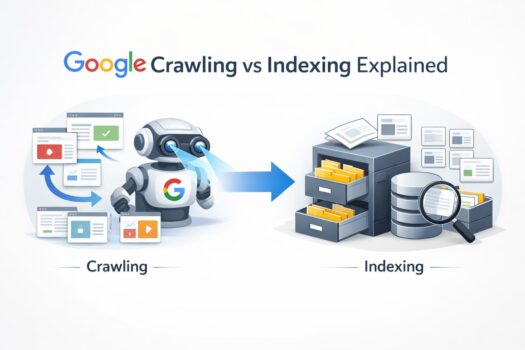
A simple way to understand the difference is to think of Google as a librarian. Crawling is when the librarian visits your book to see what it contains. Indexing is when the librarian decides whether to place that book on the shelf where readers can find it.
Many Indian businesses face a situation where Google has visited their pages, but those pages are not visible in search results. This usually means the pages were crawled but not indexed. Google saw them, but did not find enough value or clarity to include them in its search system.
Crawling answers the question “Does this page exist?”
Indexing answers the question “Is this page worth showing to users?”
Once this difference is clear, SEO efforts become more focused. Instead of only trying to get Google to visit pages, businesses start improving content quality, structure, and usefulness so Google chooses to index them.
Real Google Search Console Examples of Crawled but Not Indexed Pages
In real SEO projects, “crawled but not indexed” is one of the most common and confusing statuses seen in Google Search Console. It means Google has visited the page, but chose not to include it in its search index. This decision is usually quality-driven, not technical.
Below are real-world examples that Indian businesses frequently encounter.
Example 1: Blog Posts with Similar Topics
A service-based business publishes multiple blogs targeting similar keywords such as “digital marketing services in Delhi,” “best digital marketing company in Delhi,” and “top digital marketing agency Delhi.”
In Search Console:
- Status shows “Crawled, currently not indexed”
- Google selects one strong article and ignores the rest
Reason:
The content overlaps heavily and does not provide enough unique value across pages. Google crawls them but indexes only the most useful version.
Example 2: City-Based Service Pages
Many Indian businesses create dozens of city landing pages using the same content with only the city name changed.
In Search Console:
- Some city pages are indexed
- Others show “Duplicate, Google chose different canonical” or “Crawled, currently not indexed”
Reason:
Google identifies these pages as near-duplicates and indexes only a few representative ones.
Example 3: Thin Blog Content Published at Scale
A website publishes short blogs of 300 to 400 words just to target keywords.
In Search Console:
- Pages are crawled
- Indexing is delayed or denied
Reason:
The content lacks depth, original insights, or user value. Google sees no strong reason to store it in the index.
Example 4: Parameter and Filter URLs
Ecommerce and CMS-based websites often generate multiple URLs due to filters, sorting, or tracking parameters.
In Search Console:
- Filtered URLs appear as crawled
- Most remain unindexed
Reason:
Google considers these URLs low priority or duplicate variations of main pages.
Example 5: New Pages with Weak Internal Linking
A newly published page exists but is not linked from important sections like the homepage, category pages, or navigation.
In Search Console:
- Status shows “Discovered but not indexed” or “Crawled, currently not indexed”
Reason:
Google does not see the page as important enough without strong internal signals.
What These Examples Teach Businesses
These scenarios highlight a critical SEO lesson. Crawling is not approval. Google crawls many pages but indexes only those it believes add value to users.
Instead of asking “Why is Google not indexing my page?”, businesses should ask:
- Does this page add something new?
- Is it clearly different from existing pages?
- Is it important within my website structure?
Understanding these real Search Console signals helps businesses move from guesswork to informed SEO decisions.
Why Crawling Does Not Guarantee Indexing
One of the biggest misunderstandings in SEO is the belief that once Google crawls a page, it will automatically be indexed. In real-world practice, this is rarely true. Google crawls far more pages than it indexes. Indexing is a selective process, and Google applies multiple quality and relevance checks before making that decision.
For Indian businesses, this often shows up as pages sitting in Search Console for weeks or months with the status “Crawled, currently not indexed.” The issue is usually not technical access, but whether the page deserves a place in Google’s index.
Crawling Is Discovery, Indexing Is Evaluation
Crawling only answers one question for Google. Does this page exist and can it be accessed? Indexing answers a more important one. Is this page valuable enough to store and show to users?
Google may crawl a page simply because it found a link to it, but indexing requires the page to pass usefulness, clarity, and originality checks. This is why many pages are seen by Google but never accepted into its index.
Thin or Low-Value Content
One of the most common reasons crawling does not lead to indexing is thin content. Pages with very little information, generic explanations, or copied text provide no strong reason for Google to keep them.
This is especially common on:
- Short blogs written only to target keywords
- Service pages with repeated marketing language but no real details
- Location pages with only city names changed
If a page does not offer depth, insight, or user value, Google may crawl it but decide it is not worth indexing.
Duplicate and Near-Duplicate Pages
Google actively avoids indexing multiple pages that serve the same purpose. Even if each page is technically unique, similarity in structure and intent can prevent indexing.
Common duplicate scenarios on Indian websites include:
- City-wise service pages with similar content
- Product variants with minimal differences
- Blog posts targeting overlapping keywords
In such cases, Google crawls all pages but indexes only the one it considers most relevant, leaving the rest unindexed.
Incorrect Canonical and Technical Signals
Sometimes Google does not index a page because the website itself sends confusing signals. Incorrect canonical tags may point Google to another URL, telling it to ignore the current page.
Other technical issues include:
- Noindex tags added unintentionally
- Conflicting canonical and internal link signals
- JavaScript-heavy pages where content is not easily understood
Even when a page is crawled, these signals can prevent it from being indexed.
Low Internal Importance Signals
Google uses internal linking to understand which pages matter most on a website. If a page exists but is poorly linked, Google may treat it as low priority.
Common situations include:
- Pages accessible only through search or filters
- Blog posts not linked from category pages
- Orphan pages with no internal links
Google may crawl such pages occasionally but choose not to index them due to low perceived importance.
Lack of Clear Search Intent
Pages created without a clear user intent often struggle with indexing. If Google cannot clearly determine who the page is for or what problem it solves, it may avoid indexing it.
For example:
- Pages that mix multiple topics without focus
- Over-optimised SEO pages written for bots instead of users
- Content created only to target trending keywords
Google prioritises clarity of purpose over volume of content.
Quality Over Quantity Is the Real Filter
Modern indexing is not about how many pages a website publishes. It is about how many pages deserve to exist in search results. Indian businesses that publish large volumes of similar content often see lower indexing rates over time.
Google’s systems are designed to protect search quality. Crawling is easy. Indexing is earned.
Key Takeaway for Businesses
If crawling does not lead to indexing, the solution is rarely to request indexing repeatedly. The real fix lies in improving content depth, reducing duplication, strengthening internal links, and aligning pages with real user needs.
Once businesses understand this difference, SEO becomes less frustrating and far more effective.
Common Myths About Crawling and Indexing
Misunderstandings around crawling and indexing often lead businesses to take the wrong SEO actions. These myths usually come from outdated advice, partial information, or assumptions made without understanding how Google actually works. Clearing these myths helps businesses focus on what truly improves visibility.
Myth 1: Publishing a Page Means Google Will Index It
One of the most widespread beliefs is that once a page is published, Google will automatically index it. In reality, publishing only makes the page available online. Google may crawl it, but indexing depends on whether the page adds real value.
Many Indian websites have dozens of published pages that never appear in search because they do not meet Google’s quality expectations.
Myth 2: Submitting a Sitemap Guarantees Indexing
Sitemaps help Google discover URLs, but they do not force indexing. A sitemap is an invitation, not an approval. Google still evaluates each page individually.
Businesses often submit large sitemaps and expect instant visibility. When indexing does not happen, the problem is usually content quality or duplication, not the sitemap itself.
Myth 3: Using the URL Inspection Tool Forces Google to Index Pages
Requesting indexing in Google Search Console only asks Google to review the page sooner. It does not override quality filters.
Repeated indexing requests without improving content or structure rarely work. Many Indian website owners waste time re-submitting URLs instead of fixing the actual issues preventing indexing.
Myth 4: Crawled Pages Will Eventually Be Indexed Automatically
Crawling does not mean the page is waiting in line for indexing. If Google decides a page has low value, it may never be indexed, no matter how long it exists.
This is common with thin blogs, repetitive service pages, and auto-generated URLs. Time alone does not solve indexing problems.
Myth 5: More Pages Lead to Better Indexing
Some businesses believe publishing more pages increases visibility. In reality, low-quality volume often reduces overall indexing rates.
Websites that publish large numbers of similar pages frequently see many of them crawled but excluded. Google prefers fewer high-quality pages over many weak ones.
Myth 6: Paid Ads or Traffic Help with Indexing
Running ads or driving paid traffic does not influence crawling or indexing decisions. Google Ads and organic search operate independently.
This myth is especially common among new businesses that expect faster indexing because they are spending on advertising.
Myth 7: Indexing Problems Are Always Technical
While technical SEO issues can block indexing, most indexing problems are content-related. Pages are often excluded because they are unclear, repetitive, or not useful enough.
Assuming every indexing issue requires a developer fix can delay real improvements that content and structure changes could solve.
Why These Myths Matter
Believing these myths leads businesses to focus on shortcuts instead of fundamentals. Crawling and indexing are not mechanical processes that can be forced. They are quality-driven systems designed to protect search users.
Once businesses stop chasing myths and start improving clarity, usefulness, and structure, indexing issues reduce naturally.
How Businesses Can Improve Crawling and Indexing
Improving crawling and indexing is not about shortcuts or repeated indexing requests. It requires sending clear signals to Google about which pages matter, why they matter, and how they help users. Businesses that focus on structure, quality, and clarity consistently see better indexing outcomes over time.
Internal Linking Best Practices
Internal links are one of the strongest signals for crawling and indexing, yet they are often overlooked. Google uses internal links to discover pages and understand their importance within a website.
Best practices that work in real-world SEO include:
- Linking new pages from relevant, already indexed pages
- Ensuring important service and product pages are reachable within a few clicks
- Using descriptive anchor text that reflects the page topic
- Avoiding orphan pages that have no internal links pointing to them
For Indian business websites, linking blogs to service pages and vice versa significantly improves discovery and indexing consistency.
Content Quality Guidelines That Support Indexing
Google indexes pages that clearly help users. Content written only to target keywords often gets crawled but excluded.
To improve indexing likelihood:
- Create content that answers real user questions in depth
- Avoid repeating the same information across multiple pages
- Add original insights, examples, or experience-based explanations
- Match the page intent clearly, whether informational, commercial, or transactional
Businesses that shift from quantity-based publishing to value-based content creation usually see a noticeable improvement in indexing rates.
Technical SEO Hygiene
Even high-quality content can fail to get indexed if technical signals are confusing. Technical SEO hygiene ensures Google can properly read and interpret your pages.
Key areas to maintain include:
- Correct use of canonical tags to avoid duplication confusion
- Avoiding accidental noindex tags on important pages
- Ensuring pages are accessible and load reliably
- Minimising unnecessary URL parameters and duplicate URLs
Regular technical checks help prevent silent indexing issues that often go unnoticed.
Role of Google Search Console in Improving Indexing
Google Search Console is the most reliable tool to understand how Google sees your website. Businesses that actively use Search Console make better SEO decisions.
Practical uses include:
- Checking indexing status and exclusion reasons
- Identifying crawled but not indexed pages
- Submitting updated sitemaps for discovery support
- Using URL Inspection to verify changes after improvements
Search Console should be used as a diagnostic tool, not a panic button. Repeated indexing requests without improvement rarely work. Insight-driven actions do.
A Practical Mindset Shift for Businesses
The most important improvement businesses can make is changing how they think about SEO. Crawling and indexing are outcomes of quality, not targets to chase directly.
When businesses focus on building useful pages, linking them intelligently, and maintaining clean technical signals, Google naturally responds with better crawling and indexing behavior.
Crawling and Indexing Checklist for Website Owners
Use this checklist to regularly review whether your website is sending clear signals to Google. It helps identify why pages may be crawled but not indexed and what needs improvement.
Crawling Readiness Checklist
Ensure Google can easily discover and access your pages.
- Important pages are linked from at least one indexed page
- No critical pages are blocked in robots.txt
- Pages are accessible without login or form submission
- Website loads reliably without frequent server errors
- XML sitemap is updated and submitted in Search Console
- No excessive duplicate URLs created by filters or parameters
If Google cannot easily find or access a page, indexing will never happen.
Indexing Eligibility Checklist
Confirm whether your pages deserve to be included in Google’s index.
- Content is original and not copied from other pages
- Page provides clear value and answers a specific user intent
- Similar pages are consolidated or differentiated properly
- Canonical tags correctly point to the preferred version
- No accidental noindex tags on important URLs
- Page is internally linked as an important resource
Indexing is a quality decision. These checks help align your pages with that decision.
Content Quality Checklist
Evaluate whether your content meets Google’s expectations.
- Page has sufficient depth for the topic
- Content is written for users, not just keywords
- Information is accurate, updated, and trustworthy
- Examples, explanations, or insights add uniqueness
- Headings clearly reflect the page structure and intent
Pages that feel useful to users are far more likely to be indexed.
Internal Linking Checklist
Strengthen signals that help Google understand page importance.
- Important pages are linked from navigation or category pages
- Blogs link naturally to relevant service or product pages
- No orphan pages exist without internal links
- Anchor text is descriptive and contextually relevant
Internal linking improves both crawling frequency and indexing priority.
Google Search Console Monitoring Checklist
Use Search Console to guide decisions, not guesswork.
- Index Coverage report reviewed regularly
- Crawled but not indexed pages analysed individually
- URL Inspection used after meaningful improvements
- Sitemap errors checked and resolved
- Patterns in excluded pages identified and addressed
Search Console reveals how Google views your site. Ignoring it often leads to repeated SEO mistakes.
Final Self-Check for Website Owners
Before publishing or reviewing any page, ask:
- Would this page still be useful if SEO did not exist?
- Does it add something new or better than existing pages?
- Is it clearly important within my website structure?
If the answer is yes, crawling and indexing usually follow naturally.
Conclusion
Understanding the difference between Google crawling and indexing is not about learning technical terms. It is about making better decisions for your website. Crawling simply tells you that Google has visited a page. Indexing tells you whether Google believes that page deserves to appear in search results. Confusing these two often leads businesses to fix the wrong problems and chase visibility in the wrong ways.
For Indian businesses, the real shift happens when SEO moves from urgency to clarity. Instead of repeatedly requesting indexing or publishing more pages, long-term results come from improving content quality, strengthening internal linking, and maintaining clean technical signals. Google does not reward volume or shortcuts. It rewards usefulness, relevance, and consistency.
When crawling and indexing are viewed as outcomes rather than targets, SEO becomes more predictable and less frustrating. Businesses that focus on creating genuinely helpful pages and structuring their websites logically naturally earn better visibility over time.
The most successful SEO strategies are built on informed decisions, not assumptions. Once this foundation is clear, rankings, traffic, and growth follow as a result, not a promise.
What is crawling and indexing in SEO?
Crawling and indexing are two foundational processes that allow Google to show web pages in search results. Crawling is when Google discovers and visits pages using automated bots. Indexing happens after crawling, when Google evaluates the page and decides whether to store it in its search database. A page must be both crawled and indexed to appear in search results. Crawling alone does not guarantee visibility.
What is crawling, indexing, and ranking?
Crawling, indexing, and ranking are three sequential stages of how search engines work. Crawling is discovering pages. Indexing is analysing and storing those pages. Ranking is deciding which indexed pages appear first for a search query. Many businesses focus only on ranking, but ranking can only happen if a page is indexed. Without successful crawling and indexing, ranking is not possible.
Is crawling the same as indexing?
No, crawling and indexing are not the same. Crawling means Google has visited a page. Indexing means Google has accepted that page into its search system. A page can be crawled but not indexed if Google finds it low quality, duplicate, or unclear. Understanding this difference helps businesses diagnose why pages exist online but do not appear in search results.
What is the difference between crawled and indexed?
A crawled page is one that Google has visited and read. An indexed page is one that Google has stored and can show in search results. Crawling is about discovery, while indexing is about eligibility for visibility. Many websites have pages that are crawled but not indexed because Google does not see enough value to include them in its index.
What are the 3 C’s of SEO?
The 3 C’s of SEO generally refer to Content, Code, and Credibility. Content focuses on quality and relevance. Code refers to technical structure and accessibility. Credibility involves trust signals like links and authority. All three work together. Strong content without proper technical structure may not get indexed, and technically sound pages without credibility may not rank well.
What are the 4 types of SEO?
The four main types of SEO are On-page SEO, Technical SEO, Off-page SEO, and Content SEO. On-page focuses on page-level optimisation. Technical SEO ensures crawlability and indexing. Off-page SEO builds authority through links and mentions. Content SEO ensures usefulness and intent alignment. Successful SEO requires balance across all four, not focus on just one area.
Why does Google crawl but not index?
Google crawls many pages but indexes only those it considers valuable. Pages may not be indexed due to thin content, duplication, unclear intent, incorrect canonical tags, or low internal importance. Crawling simply confirms the page exists. Indexing is a quality-based decision. Improving usefulness, originality, and structure usually resolves this issue.
What happens first, crawling or indexing?
Crawling always happens before indexing. Google must first discover and read a page before it can decide whether to index it. If a page is not crawled, it cannot be indexed. However, being crawled does not guarantee indexing. Indexing depends on whether the page meets Google’s quality and relevance expectations.
How to check if something is indexed?
The most reliable way to check indexing is using Google Search Console’s URL Inspection tool. You can also search on Google using site:yourdomain.com/page-url. If the page appears, it is indexed. Search Console provides clearer insights by showing whether a page is indexed, excluded, or crawled but not indexed, along with reasons.
What is the golden rule of SEO?
The golden rule of SEO is to create content primarily for users, not search engines. Pages that genuinely solve problems, answer questions, and provide clarity are more likely to be indexed and ranked. SEO tactics change, but usefulness remains constant. When a page is valuable to users, search visibility usually follows naturally.
Why are pages not indexed?
Pages are often not indexed due to low-quality content, duplication, technical signals like noindex tags, weak internal linking, or unclear purpose. Google filters out pages that do not add value to search results. Most indexing problems are content-related rather than technical. Improving depth, clarity, and relevance is usually more effective than repeated indexing requests.
What is the 80/20 rule for SEO?
The 80/20 rule in SEO means that a small percentage of pages usually drive most of the traffic and results. Often, 20 percent of content delivers 80 percent of organic performance. This highlights the importance of focusing on high-impact pages, improving quality, and strengthening key sections rather than publishing large volumes of low-value content.