 Raj Kishore
What is SEO?
SEO (Search Engine Optimization) is the process of improving your website so that search engines like Google, Bing, and AI-powered search systems can understand your content, trust its quality, and recommend it to people searching for relevant information.
In simple words, SEO helps your website appear in front of the right audience without paying for every click through advertising. Instead of interrupting people with ads, SEO helps your content become the answer to what they are already looking for.
Whether you run a blog, an eCommerce store, a local business, a SaaS company, or a large enterprise website, SEO helps you attract high-quality visitors who are actively searching for your products, services, or information.
Unlike paid advertising, where traffic stops as soon as your budget ends, SEO focuses on building long-term visibility and sustainable organic traffic by creating valuable content, improving website performance, and earning trust from both users and search engines.
SEO in Simple Language
Imagine your website is a newly opened bookstore in a large city.
Even if you have the best collection of books, customers won’t visit if they don’t know your store exists or can’t find it.
SEO works like:
- A clear signboard that helps people locate your store.
- A helpful staff member who recommends the right books.
- Positive customer reviews that build trust.
- Well-organized shelves that make finding books easy.
- A clean and welcoming environment that encourages visitors to stay longer.
Similarly, SEO helps search engines understand what your website offers so they can confidently recommend it to users searching for related information.
Technical Definition of SEO
From a technical perspective, Search Engine Optimization is the practice of improving a website’s crawlability, indexability, relevance, usability, authority, and overall quality so search engines can efficiently discover, understand, evaluate, and rank its pages for relevant search queries.
Technical SEO involves optimizing various elements such as:
- Website architecture
- XML sitemaps
- Robots.txt
- Internal linking
- Structured data (Schema Markup)
- Core Web Vitals
- Mobile responsiveness
- HTTPS security
- Canonical tags
- Page speed
- JavaScript rendering
- Image optimization
Together, these improvements help search engines process your website more effectively while providing a better experience for users.
SEO from a Digital Marketing Perspective
From a marketing point of view, SEO is a customer acquisition strategy.
People search online because they have a question, a problem to solve, or an intention to buy something. SEO ensures your content appears at these important moments.
For example:
- A student searches for “best digital marketing courses.”
- A homeowner searches for “home loan interest rates.”
- A traveler searches for “Germany Opportunity Card requirements.”
- A business owner searches for “best CRM software.”
If your website provides the most helpful and trustworthy answer, SEO increases your chances of being discovered without paying for each visitor.
This makes SEO one of the highest-return digital marketing channels because it attracts users with existing intent rather than creating demand through interruption-based advertising.
SEO from a Business Perspective
For businesses, SEO is much more than improving search rankings.
It helps generate measurable business outcomes such as:
- Qualified leads
- Online sales
- Brand awareness
- Customer trust
- Lower customer acquisition costs
- Sustainable website traffic
- Higher return on marketing investment (ROI)
Unlike short-term campaigns, SEO compounds over time. A well-optimized article or landing page can continue attracting visitors, leads, and customers for months or even years with regular updates.
This makes SEO a long-term business asset rather than a temporary marketing tactic.
SEO in the Age of AI Search (2026)
SEO has evolved significantly over the last few years.
In 2026, optimizing only for traditional search engines is no longer enough.
People now search using AI-powered platforms such as:
- Google AI Overviews
- Google AI Mode
- ChatGPT
- Gemini
- Microsoft Copilot
- Perplexity AI
- Claude
These systems don’t simply display a list of links. Instead, they analyze information from multiple trusted sources and generate direct answers for users.
Modern SEO therefore focuses on making your content:
- Easy for AI systems to understand
- Factually accurate
- Well-structured
- Comprehensive
- Experience-driven
- Trustworthy
- Supported by credible sources
In addition to traditional rankings, websites now compete to become trusted references that AI assistants cite when answering user questions.
This shift has also introduced related disciplines such as:
- Generative Engine Optimization (GEO): Optimizing content so AI-powered search engines and assistants are more likely to reference and cite your website.
- Answer Engine Optimization (AEO): Structuring content to provide clear, concise, and authoritative answers that can appear in AI responses, featured snippets, voice search, and other answer-focused experiences.
As AI search continues to grow, successful SEO is no longer just about ranking first—it is about becoming the most trusted source of information wherever people search
Common SEO Terms Explained
| SEO Term | Simple Meaning |
| Search Engine | Platforms like Google, Bing, DuckDuckGo, and AI-powered search tools that help users find information. |
| Optimization | Improving your website so it performs better for users and search engines. |
| Organic Traffic | Visitors who come from unpaid search results rather than advertisements. |
| Ranking | The position of your webpage in search engine results for a specific keyword. |
| Search Intent | The reason or goal behind a user’s search query. |
| Crawling | The process where search engine bots discover and read webpages. |
| Indexing | Storing and organizing webpages in a search engine’s database so they can appear in search results. |
| Ranking Algorithm | The system search engines use to determine which pages deserve the highest positions. |
Real-World Example of SEO
Suppose someone searches:
Best running shoes for beginners
Google evaluates thousands or even millions of webpages within seconds.
Instead of showing random websites, it prioritizes pages that demonstrate strong quality signals, including:
- Helpful and original information that answers the user’s question.
- A trustworthy website with a good reputation and clear author information.
- Fast-loading pages that work well on mobile devices.
- A positive user experience with easy navigation and readable content.
- Content that closely matches what the searcher is looking for.
- Up-to-date information that reflects current products and recommendations.
- Relevant images, comparisons, FAQs, and buying advice.
- Strong topical authority supported by related content and internal links.
If your article provides the most complete, accurate, and user-focused answer, search engines are more likely to rank it higher.
That is SEO in action.
Key Takeaway
SEO is no longer just about adding keywords to a webpage or building backlinks. In 2026, successful SEO combines high-quality content, technical excellence, exceptional user experience, topical authority, and trust signals so both search engines and AI-powered platforms can confidently recommend your website. Businesses and creators who consistently publish genuinely helpful, experience-based content are the ones most likely to earn lasting visibility, organic traffic, and brand recognition across both traditional search results and AI-generated answers.
What Does SEO Stand For?
SEO stands for Search Engine Optimization. Although it is a simple three-word acronym, each word plays an important role in understanding how SEO works.
Let’s break it down.
Search
A search happens when someone types, speaks, or even uploads an image to find information online.
People search because they have a question, a problem to solve, or something they want to buy. Every search begins with a need or intention.
For example, someone might search for:
- Best laptops under ₹50,000
- How to apply for a Germany Opportunity Card
- SEO course for beginners
- Home loan interest rates
- Best restaurants near me
These search queries tell search engines exactly what users are looking for.
Modern search is no longer limited to typing keywords. In 2026, people search using:
- Text searches
- Voice commands
- Image searches
- AI conversations
- Video searches
Understanding what users are searching for—and why—is the foundation of successful SEO.
Engine
A search engine is an online system that helps users find the most relevant information from billions of webpages across the internet.
Popular search engines include:
- Bing
- DuckDuckGo
- Yahoo
- Baidu
- Yandex
Today’s search ecosystem also includes AI-powered answer engines and conversational search platforms such as Google AI Mode, Google AI Overviews, ChatGPT, Gemini, Microsoft Copilot, Perplexity AI, and Claude. These systems analyze trusted information from multiple sources to generate direct answers rather than simply displaying a list of links.
Behind the scenes, search engines perform three major tasks:
- Crawling – Discovering new and updated webpages.
- Indexing – Organizing and storing webpage information in a searchable database.
- Ranking – Determining which pages best answer a user’s search query.
All of this happens within fractions of a second whenever someone performs a search.
Optimization
Optimization means improving something so it performs better.
In SEO, optimization means making your website easier for both users and search engines to understand.
This includes improving:
- Content quality and originality
- Website speed
- Mobile responsiveness
- Internal linking
- Page structure
- User experience
- Technical SEO
- Website security
- Images and videos
- Structured data
- Trust and credibility
Optimization is not about tricking search engines or stuffing pages with keywords. It is about creating a better experience for your visitors while making it easier for search engines and AI systems to understand and trust your content.
Putting It All Together
When combined, Search Engine Optimization means:
The process of improving your website so search engines and AI-powered search platforms can discover, understand, trust, and recommend your content to people searching for relevant information.
The ultimate goal of SEO is not simply to rank higher. It is to connect the right people with the right content at the right time.
An Everyday Analogy to Understand SEO
Imagine you own a bookstore in a busy city.
Your bookstore has thousands of excellent books, but it is located on a quiet street where very few people know it exists.
To attract more visitors, you decide to:
- Install a clear and attractive signboard.
- Organize books into easy-to-find categories.
- Keep the store clean and well-lit.
- Hire knowledgeable staff to help customers.
- Encourage satisfied customers to leave positive reviews.
- Ensure the store is easy to reach with clear directions.
As a result, more people find your bookstore, enjoy their experience, and recommend it to others.
Your website works in much the same way.
| Bookstore | Website |
| Customers looking for books | Users searching online |
| Store signboard | Page titles and meta descriptions |
| Organized shelves | Clear website structure and navigation |
| Helpful staff | High-quality, useful content |
| Customer reviews | Backlinks, testimonials, and online mentions |
| Easy-to-find location | Strong technical SEO and crawlability |
| Happy customers returning | Positive user experience and engagement |
Without SEO, even the best website can remain hidden.
With effective SEO, your website becomes easier to discover, easier to understand, and more likely to be recommended by both search engines and AI-powered search systems.
Key Takeaway
Each word in Search Engine Optimization has a specific purpose:
- Search is about understanding what people are looking for.
- Engine is the technology that discovers, organizes, and ranks information.
- Optimization is the continuous process of improving your website to deliver the best possible experience for users and to help search engines confidently recommend your content.
When these three elements work together, SEO helps your website gain greater visibility, attract qualified organic traffic, build trust, and achieve long-term business growth.
How Does SEO Work?
Many beginners think SEO is simply about adding keywords to a webpage and waiting for Google to rank it. In reality, SEO is a continuous process that helps search engines discover, understand, evaluate, and recommend your content to users searching for relevant information.
Whenever someone searches on Google or another search platform, thousands—or even millions—of webpages compete to answer that query. Search engines analyze these pages within fractions of a second and display the results they believe will provide the best experience for the user.
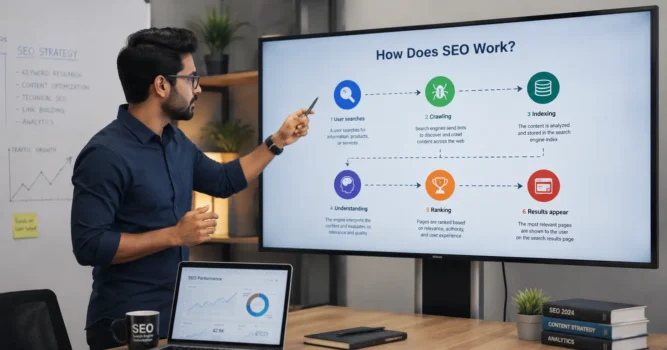
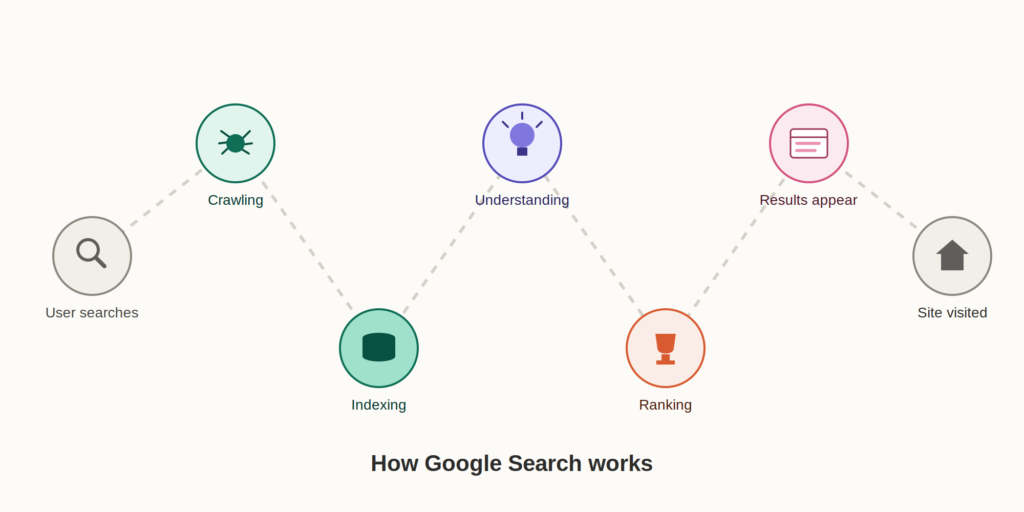
Modern SEO follows a sequence of six major stages:
User Search → Crawling → Indexing → Understanding → Ranking → Search Results
Let’s understand each step in detail.
Step 1: A User Searches for Something
Every SEO journey begins with a user searching for information.
People search because they have a question, a problem to solve, a product to buy, or a place to visit. Search engines aim to understand the meaning behind the search rather than just matching individual keywords.
What Is a Search Query?
A search query is the word, phrase, or question that a user enters into a search engine or AI-powered search platform.
Examples include:
- What is SEO?
- Best laptops under ₹60,000
- Germany Opportunity Card requirements
- How to reduce home loan EMI
- Digital marketing course near me
- Best CRM software for startups
Each search query represents a user’s goal or need.
Understanding Search Intent
Search intent is the reason behind a search.
Understanding intent is one of the most important aspects of modern SEO because search engines prioritize pages that satisfy the user’s objective.
The four primary types of search intent are:
| Search Intent | What the User Wants | Example Search |
| Informational | To learn something | What is SEO? |
| Navigational | To visit a specific website | Google Search Console |
| Commercial Investigation | To compare options before making a decision | Best SEO tools |
| Transactional | To take an action or make a purchase | Buy running shoes online |
Instead of asking, “Which keyword should I target?”, modern SEO asks:
“What problem is the user trying to solve?”
The better your content solves that problem, the greater your chances of earning visibility.
Real-World Example
Imagine someone searches:
Best running shoes for beginners
The search engine understands that the user is looking for buying guidance, not the history of running shoes.
As a result, it is more likely to show pages that include:
- Expert recommendations
- Product comparisons
- Buying guides
- Pros and cons
- User reviews
- Frequently asked questions
- Updated product information
Matching the user’s intent is far more important than simply repeating the keyword.
Step 2: Search Engines Crawl Websites
Before a webpage can appear in search results, search engines must first discover that it exists.
This process is known as crawling.
What Is Crawling?
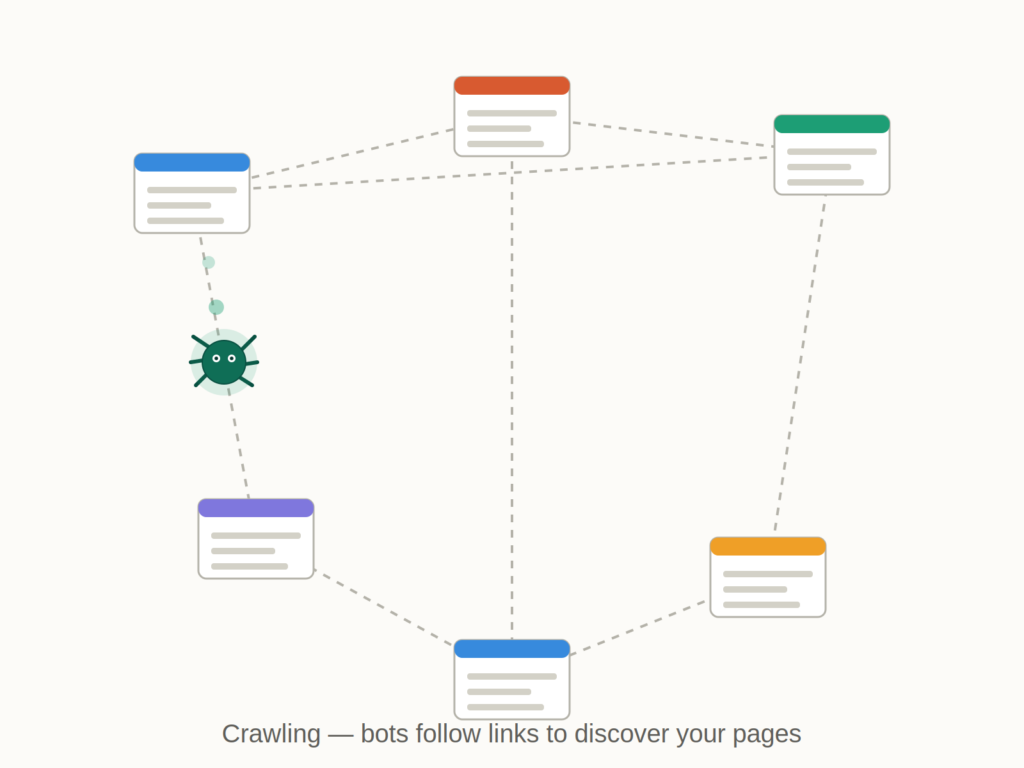
Crawling is the process where automated programs, commonly called crawlers, spiders, or bots, visit websites to discover new and updated pages.
Google’s crawler is known as Googlebot.
Other search engines use their own crawlers, such as Bingbot for Bing.
These bots continuously travel across the web by following links from one page to another, identifying new content and checking whether existing pages have changed.
How Crawlers Discover Pages
Search engines typically find webpages through:
- Internal links
- External backlinks
- XML sitemaps
- Previously indexed pages
- Website navigation
- URL submissions through search engine tools
If a page has no links pointing to it and is not included in a sitemap, it may never be discovered.
Simple Crawling Process
Website
↓
Search Engine Crawler (Googlebot)
↓
Discovers New or Updated Pages
↓
Sends Information for Indexing
Why Crawling Matters
If search engines cannot crawl your website, they cannot evaluate or rank your pages.
Common crawling issues include:
- Broken internal links
- Incorrect robots.txt rules
- Server errors
- Slow website performance
- Infinite URL parameters
- Poor website architecture
Ensuring your website is easy to crawl is one of the foundations of technical SEO.
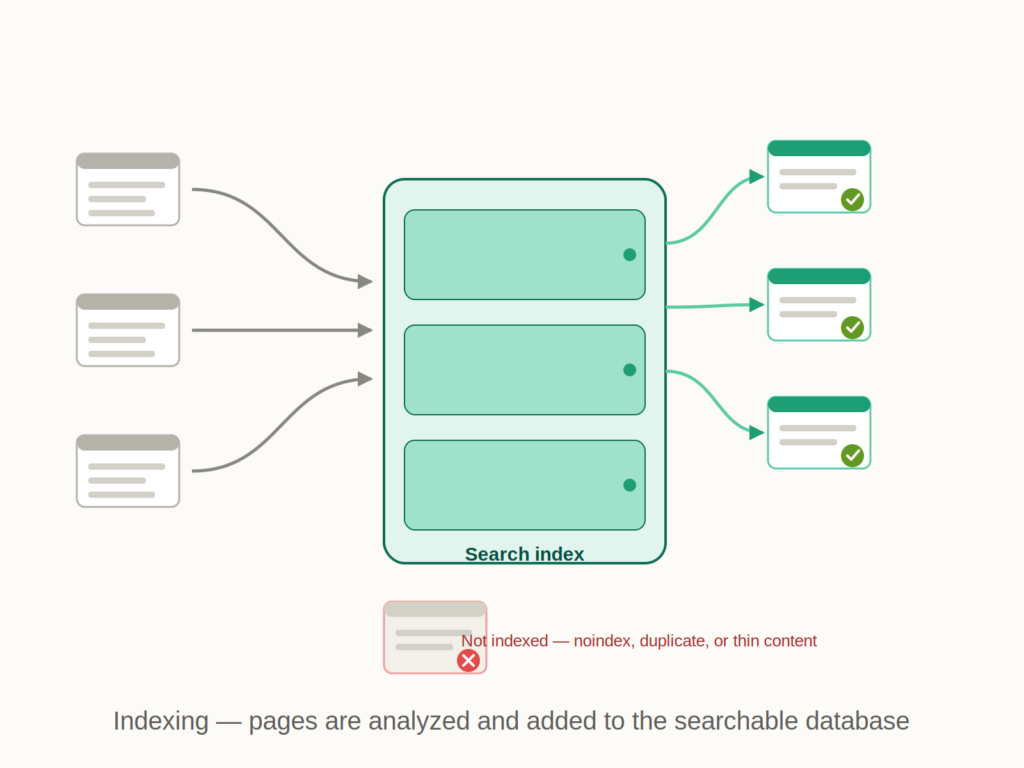
Step 3: Search Engines Index Your Pages
Once a crawler discovers a webpage, the next step is indexing.
What Is Indexing?
Indexing is the process of analyzing, organizing, and storing webpage information in a search engine’s database.
Think of Google’s index as a massive digital library.
Every indexed webpage becomes part of this library, making it eligible to appear in search results. However, being indexed does not guarantee that a page will rank well.
What Happens During Indexing?
Search engines examine many elements of a page, including:
- Page title
- Headings
- Main content
- Images
- Videos
- Internal links
- Structured data
- Metadata
- Canonical tags
- Mobile usability
This information helps search engines understand what the page is about.
What Does “Not Indexed” Mean?
If a page is not indexed, it cannot appear in organic search results because the search engine has not added it to its searchable database.
Common Reasons Pages Are Not Indexed
- The page is blocked by robots.txt.
- A noindex directive is present.
- Incorrect canonical tags point elsewhere.
- Duplicate or near-duplicate content.
- Thin or low-value content.
- Poor internal linking.
- Soft 404 errors.
- Server issues or timeouts.
- The page is newly published and has not been processed yet.
Indexing Checklist
Before publishing a page, ensure that:
- ✔ The page returns a 200 OK status.
- ✔ It is not blocked by robots.txt.
- ✔ It does not contain a noindex tag.
- ✔ The canonical URL is correct.
- ✔ It is included in the XML sitemap.
- ✔ It is linked from other relevant pages.
- ✔ The content is unique and useful.
- ✔ Images and structured data are implemented correctly where appropriate.
Step 4: Search Engines Understand Your Content
After indexing a page, search engines work to understand its meaning—not just its keywords.
Modern search engines use advanced natural language processing and other systems to interpret context and relationships within content.
They Look Beyond Keywords
Instead of counting how often a keyword appears, search engines try to understand:
- What topic the page covers.
- Which questions it answers.
- Who the content is intended for.
- Whether the information is complete and trustworthy.
Entities
An entity is a uniquely identifiable person, place, organization, product, event, or concept.
For example, on a page about SEO, entities might include:
- Search Engine Optimization
- Google Search Console
- Core Web Vitals
- Structured Data
Using relevant entities naturally helps search engines understand the context of your content.
Topics and Topical Depth
Search engines prefer content that covers a topic comprehensively rather than touching on it superficially.
For an SEO guide, readers may expect sections on:
- Keyword research
- On-page SEO
- Technical SEO
- Link building
- E-E-A-T
- Search intent
- AI search
- SEO tools
Covering related subtopics demonstrates topical authority.
Semantic Relationships
Search engines also understand relationships between concepts.
For example:
- SEO is related to content marketing.
- Google Search Console supports SEO analysis.
- XML sitemaps help with crawling and indexing.
These semantic connections help search engines determine how complete your content is.
Context
Context helps search engines understand the purpose of a page.
For example, the keyword “Apple” could refer to:
- The technology company.
- The fruit.
The surrounding content determines the intended meaning.
Structured Data
Structured data (Schema Markup) provides additional information about your content in a standardized format.
It helps search engines identify elements such as:
- Articles
- Products
- FAQs
- Reviews
- Recipes
- Events
- Organizations
While structured data does not guarantee richer search results, it can help search engines better interpret your content.
Images and Videos
Search engines also analyze visual content.
Optimized images and videos can improve visibility through image search, video search, and other search features.
Best practices include:
- Descriptive file names
- Helpful alt text
- Appropriate captions
- Compressed file sizes
- Relevant surrounding content
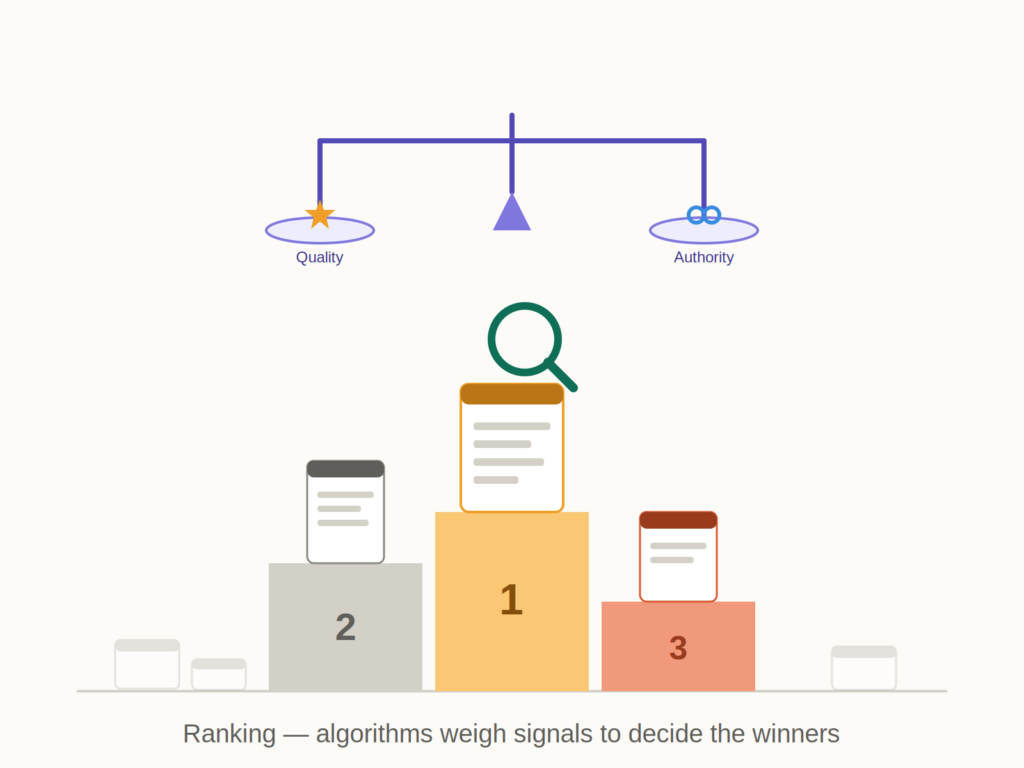
Step 5: Ranking Algorithms Evaluate Hundreds of Signals
After understanding your content, search engines determine whether it deserves to appear for a particular search.
This process involves evaluating many different signals rather than relying on a single ranking factor.
No one outside the search engines knows the exact weighting of these signals, and they can vary depending on the query. However, several broad categories consistently influence visibility.
Content Quality
Search engines prioritize content that is:
- Helpful
- Accurate
- Comprehensive
- Original
- Well-organized
- Easy to understand
Experience and Expertise
Content that demonstrates genuine experience and expertise is generally more useful to readers.
For example, an experienced SEO professional sharing real optimization examples often provides more practical value than content based solely on theory.
Authority
Authority develops over time through:
- High-quality content
- Relevant backlinks
- Positive brand reputation
- Consistent publishing
- Recognition within your industry
Freshness
Some searches benefit from the latest information.
Topics such as SEO updates, product launches, or visa rules often require regularly updated content.
Links
Internal links help search engines understand your website structure, while high-quality external backlinks can signal that others find your content valuable.
User Experience
A positive experience encourages users to stay engaged.
Important elements include:
- Fast loading speed
- Mobile-friendly design
- Clear navigation
- Readable content
- Accessibility
- Secure HTTPS connection
Intent Match
The best-performing pages closely align with what users are actually looking for.
If someone wants a beginner’s guide, a technical research paper may not satisfy that intent.
Helpful and Original Content
Search engines aim to reward content that provides unique value rather than repeating information already available elsewhere.
Including first-hand experience, examples, original analysis, or practical frameworks can make your content more useful.
Brand Trust
Users are more likely to trust websites that demonstrate transparency through:
- Author information
- Contact details
- Editorial standards
- References to reliable sources
- Positive reputation
Strong brands often build trust over time by consistently publishing accurate and helpful content.
Step 6: Search Engines Display the Most Relevant Results
Once search engines evaluate available pages, they present the results in the Search Engine Results Page (SERP).
The layout of a SERP varies depending on the search query.
Common SERP Features
Organic Results
These are the unpaid listings that appear because search engines consider them relevant to the user’s query.
Paid Advertisements
Sponsored listings may appear above or below organic results for commercial searches.
AI Overviews
For some queries, Google may generate AI-powered summaries that synthesize information from multiple sources. The appearance and availability of these experiences can vary by region, language, and query type.
Video Results
Videos from platforms such as YouTube and other websites may appear for queries where video content is especially helpful.
Image Results
Visual searches often display image packs that link to relevant webpages.
Local Pack
Location-based searches may show nearby businesses, maps, contact details, ratings, and operating hours.
Examples include:
- Restaurants near me
- Dentist in Delhi
- SEO agency in Mumbai
Knowledge Panels
Knowledge panels provide quick information about recognized entities such as people, organizations, places, and products.
People Also Ask (PAA)
This section contains related questions that users commonly ask about the same topic.
Answering these questions within your content can improve its usefulness and may increase visibility for related searches.
Bringing It All Together
SEO is a connected process where each stage builds on the previous one.
User Searches
↓
Search Engines Crawl Your Website
↓
Pages Are Indexed
↓
Content Is Understood
↓
Ranking Systems Evaluate Relevance and Quality
↓
The Most Helpful Results Appear in Search
↓
Users Visit Your Website
If any step is missing—for example, a page cannot be crawled, is not indexed, or does not satisfy user intent—it is much less likely to earn meaningful organic visibility.
Key Takeaway
SEO works by helping search engines discover, understand, evaluate, and present your content to the right audience. Success comes from optimizing every stage of this process: ensuring your pages can be crawled and indexed, creating content that genuinely satisfies user intent, providing a strong user experience, and building trust through expertise, authority, and transparency. Instead of focusing on a single ranking factor, modern SEO is about consistently delivering the best possible answer to users across traditional search and evolving AI-powered search experiences.
This section can be made even stronger by adding custom diagrams for crawling, indexing, ranking, and a full “How Google Search Works” flowchart. Original visuals often increase engagement, improve comprehension, and can differentiate your guide from text-only competitors.
Why SEO Matters More Than Ever in 2026
Search has changed more in the last few years than it did during the previous decade.
People no longer rely only on traditional search engines to find answers. Today, they ask questions through AI assistants, voice-enabled devices, image search, and conversational search experiences. They expect immediate, accurate, and trustworthy answers instead of simply browsing through a list of blue links.
For businesses, publishers, and content creators, this means SEO is no longer just about ranking on the first page of Google. It is about building a trusted online presence that search engines and AI-powered platforms are confident recommending.
Modern SEO combines high-quality content, technical excellence, user experience, topical authority, and brand trust to help your website become visible wherever people search.
Whether someone discovers your content through Google Search, an AI-generated answer, voice search, or another search experience, the goal remains the same—provide the most helpful answer for the user’s question.
How SEO Has Evolved Over the Years
SEO has never been static. As user behaviour and technology have evolved, so have search engines and SEO best practices.
Understanding this evolution helps explain why outdated SEO tactics no longer work and why modern SEO focuses on quality, trust, and user satisfaction.
SEO in 2005: The Keyword Era
During the early days of SEO, search engines relied heavily on keywords and backlinks to determine rankings.
Common practices included:
- Repeating the same keyword many times.
- Buying or exchanging backlinks.
- Publishing thin content with little value.
- Creating multiple pages targeting slight keyword variations.
- Optimizing mainly for search engines rather than users.
At the time, these tactics often produced quick ranking improvements. However, they also resulted in poor-quality search results for users.
SEO in 2015: Quality Content Becomes Essential
As search engines became more sophisticated, they shifted their focus from keywords alone to overall content quality and user experience.
SEO professionals began prioritizing:
- Comprehensive, well-researched content.
- Mobile-friendly websites.
- Natural keyword usage.
- Strong internal linking.
- High-quality backlinks earned through valuable content.
- Better website architecture.
- Improved page speed.
Google’s algorithm updates increasingly rewarded websites that genuinely helped users instead of those trying to manipulate rankings.
SEO in 2020: User Experience and E-E-A-T Take Center Stage
By 2020, SEO had expanded well beyond content optimization.
Search engines started evaluating many additional signals, including:
- Search intent
- Core Web Vitals
- Mobile usability
- Website security (HTTPS)
- Structured data
- User experience
- Expertise, Experience, Authoritativeness, and Trustworthiness (E-E-A-T)
- Topical authority
Businesses also began investing in content clusters instead of isolated articles, creating comprehensive resources around entire topics rather than individual keywords.
SEO After AI (2024–2026): From Ranking Pages to Building Trust
The rise of generative AI has transformed how people discover information.
Many users now ask conversational questions through AI-powered experiences such as:
- Google Search
- Google AI Overviews
- Google AI Mode
- ChatGPT
- Gemini
- Microsoft Copilot
- Perplexity AI
- Claude
- Voice assistants
Instead of only displaying a list of webpages, these systems often summarize information from multiple sources and guide users toward trusted content.
As a result, successful SEO today focuses on creating content that is:
- Helpful and original
- Experience-driven
- Factually accurate
- Well-structured
- Easy to understand
- Supported by credible evidence
- Updated regularly
- Published by trustworthy authors and brands
Rather than trying to “game” search algorithms, modern SEO is about consistently demonstrating expertise and earning trust over time.
SEO Today Is No Longer Just About Ranking Webpages
Many beginners still believe SEO means “getting to position one on Google.”
That was once the primary objective.
In 2026, visibility is much broader than a single ranking.
Your content may be discovered through:
- Traditional Google Search results.
- Google AI-generated experiences such as AI Overviews.
- AI assistants that help users explore information.
- Voice search responses.
- Image and video search.
- Local search results.
- Featured snippets.
- Knowledge panels.
- Social media discovery.
- Brand searches.
The websites that perform best across these experiences usually have several characteristics in common:
- They publish genuinely helpful content.
- They answer real user questions clearly.
- They demonstrate first-hand experience where appropriate.
- They maintain strong technical foundations.
- They build topical authority over time.
- They establish trust through transparent authorship and reliable information.
This is why modern SEO is increasingly aligned with overall website quality rather than isolated optimization techniques.
Traditional SEO vs Modern SEO
| Traditional SEO | Modern SEO |
| Focus on keywords | Focus on understanding user intent and solving real problems |
| Primary goal was higher rankings | Goal is visibility across search engines, AI experiences, voice search, images, videos, and local search |
| Heavy emphasis on backlinks | Emphasis on overall brand authority, reputation, and trust alongside quality links |
| Publishing articles for keywords | Creating comprehensive, helpful resources that fully answer user questions |
| Optimized mainly for search engines | Optimized for both users and search technologies |
| Page-level optimization | End-to-end experience optimization, including content, UX, accessibility, and technical performance |
| Success measured mainly by rankings | Success measured by qualified traffic, engagement, conversions, and brand visibility |
| One article per keyword | Topic clusters that build topical authority |
| Keyword density mattered more | Natural language, semantic relevance, and entities matter more |
| SEO treated as a standalone activity | SEO works together with content marketing, branding, PR, UX, and product experience |
What Modern SEO Really Means
SEO in 2026 is no longer about finding shortcuts to rank higher.
It is about becoming the website that people trust and want to return to.
The most successful websites focus on answering questions better than competitors, demonstrating real expertise, improving the user experience, and maintaining technical excellence.
When users trust your content, search engines are more likely to recommend it. When search engines consistently surface your content, your brand becomes more visible. Over time, this creates a cycle of trust, recognition, and sustainable organic growth.
Instead of asking:
“How do I rank for this keyword?”
Successful SEO professionals now ask:
- What problem is the user trying to solve?
- Can we create the most helpful resource available?
- Does our content demonstrate real experience?
- Is our website easy to use on every device?
- Have we built enough topical authority to be considered a trusted source?
- Would users recommend this page to someone else?
Answering these questions consistently is what drives long-term SEO success.
Key Takeaway
SEO has evolved from a keyword-focused discipline into a comprehensive strategy for building online trust. While search engines continue to evolve and AI changes how information is presented, the core principle remains the same: create accurate, useful, user-focused content supported by a technically sound website and a credible brand. Businesses that invest in expertise, helpful content, and exceptional user experience are best positioned to earn lasting visibility across both traditional search and emerging AI-powered search experiences.
How Search Engines Decide Which Website Ranks First
Every time someone searches on Google, Bing, or another search engine, thousands—or even millions—of webpages may be eligible to appear in the search results.
Yet, only a handful make it to the first page, and even fewer secure the top positions.
So, how do search engines decide which website ranks first?
The simple answer is that there is no single ranking factor.
Search engines use sophisticated ranking systems that evaluate hundreds of signals to determine which webpage is most likely to satisfy the user’s search intent. These systems continuously evolve to reward websites that provide the best combination of relevance, quality, trust, usability, and overall user experience.
Instead of looking for tricks or shortcuts, website owners should focus on creating content that genuinely helps users while ensuring their website is technically sound and trustworthy.
Let’s explore the most important factors that influence search rankings.
Content Relevance
The first question a search engine asks is:
Does this page answer the user’s question?
If the answer is no, the page is unlikely to rank well, regardless of how authoritative the website may be.
Content relevance means your webpage closely matches the topic the user is searching for.
For example, if someone searches:
How does SEO work?
A page explaining only “What is Digital Marketing?” is not relevant, even if it contains the word “SEO.”
A highly relevant page should:
- Clearly answer the user’s query.
- Cover the topic comprehensively.
- Use natural language instead of keyword stuffing.
- Include related concepts and supporting information.
- Be easy to understand.
Modern search engines understand context, not just exact keyword matches. This means content should focus on solving the user’s problem rather than repeating keywords unnaturally.
Expert Tip: Before creating a page, ask yourself, “If I were the searcher, would this page completely answer my question?”
Search Intent
Even highly relevant content may fail to rank if it does not match search intent.
Search intent refers to the reason behind a user’s search.
Someone searching for:
Best DSLR camera under ₹50,000
is likely comparing products before making a purchase.
They expect:
- Product comparisons
- Features
- Pros and cons
- Buying advice
- Pricing information
If your page only explains the history of DSLR cameras, it does not satisfy that intent.
The four primary search intents are:
| Search Intent | User Goal | Example |
| Informational | Learn something | What is SEO? |
| Navigational | Visit a specific website | Google Analytics login |
| Commercial Investigation | Compare options | Best SEO tools |
| Transactional | Take action | Buy iPhone online |
Search engines prioritize pages that best satisfy the intent behind each query rather than simply matching keywords.
Topical Authority
Search engines increasingly evaluate how deeply a website covers a subject.
This is known as topical authority.
Instead of publishing one isolated article, successful websites create interconnected resources covering every important aspect of a topic.
For example, an SEO website might include guides on:
- What is SEO?
- Keyword Research
- On-Page SEO
- Technical SEO
- Link Building
- Local SEO
- Ecommerce SEO
- SEO Audit
- Google Search Console
- Core Web Vitals
These pages are linked together, helping both users and search engines understand that the website has broad expertise.
Topical authority is built over time through consistent, high-quality publishing rather than a single article.
Backlinks
Backlinks remain an important ranking signal, but their role has evolved significantly.
A backlink is a link from another website pointing to your content.
Search engines treat high-quality backlinks as signals that other websites consider your content useful or trustworthy.
However, quality is far more important than quantity.
A few links from respected, relevant websites are generally more valuable than hundreds of low-quality or spammy links.
Natural backlinks are often earned by publishing:
- Original research
- Industry studies
- Helpful guides
- Unique insights
- Free tools
- Infographics
- Data-driven content
Attempting to manipulate rankings through paid or artificial link schemes can violate search engine guidelines and may lead to reduced visibility.
Website Trust
Search engines aim to recommend websites users can rely on.
Trust is built through transparency, accuracy, and consistency.
Signals that contribute to website trust include:
- Clear author information
- Contact details
- About Us page
- Editorial policies
- Privacy Policy
- HTTPS security
- Reliable sources and references
- Positive online reputation
- Accurate and updated information
For websites covering health, finance, legal, or other high-impact topics, trust signals become even more important.
User Experience (UX)
Even excellent content can struggle to perform if visitors have a poor experience using the website.
Search engines want users to enjoy interacting with the pages they recommend.
Important user experience factors include:
- Fast loading pages
- Mobile-friendly design
- Easy navigation
- Readable typography
- Logical heading structure
- Accessible design
- Minimal intrusive pop-ups
- Secure browsing experience
A positive user experience encourages visitors to stay longer, explore more pages, and return in the future.
Technical SEO
Technical SEO ensures search engines can efficiently discover, crawl, understand, and index your content.
Without a strong technical foundation, even outstanding content may never reach its full ranking potential.
Key technical SEO elements include:
- Crawlability
- Indexability
- XML sitemap
- Robots.txt
- Canonical tags
- Structured data
- HTTPS
- Mobile responsiveness
- Core Web Vitals
- Internal linking
- Redirect management
- Broken link fixes
Technical SEO acts as the infrastructure that supports every other SEO effort.
Brand Signals
Strong brands often enjoy greater visibility because users recognize and trust them.
While search engines do not publish a checklist of “brand signals,” a well-established brand typically demonstrates characteristics such as:
- Consistent publishing
- Positive customer reviews
- Industry recognition
- Media mentions
- Branded searches
- Social engagement
- Expert authors
- High-quality customer experience
Building a respected brand increases user confidence and supports long-term SEO success.
Content Freshness
Some topics require regularly updated information.
For example:
- Google algorithm updates
- Tax rules
- Immigration policies
- Product launches
- Technology trends
- Sports results
For these topics, search engines may prioritize recently updated pages that reflect the latest developments.
However, not every topic requires frequent updates.
An evergreen guide explaining “What is SEO?” may remain useful for years with periodic improvements rather than complete rewrites.
The goal is not to update content unnecessarily but to ensure it remains accurate, relevant, and helpful.
E-E-A-T (Experience, Expertise, Authoritativeness, and Trustworthiness)
One of the most important concepts in modern SEO is E-E-A-T.
Although E-E-A-T is not a direct ranking factor by itself, it reflects qualities that search engines seek when evaluating the overall quality and credibility of content.
Experience
Does the content demonstrate first-hand knowledge?
Examples include:
- Real case studies
- Practical examples
- Personal testing
- Screenshots
- Original insights
Expertise
Does the author have demonstrated knowledge of the subject?
Expertise can be shown through:
- Professional qualifications
- Industry experience
- Detailed explanations
- Accurate information
Authoritativeness
Is the website recognized as a reliable source within its field?
Authority develops through:
- High-quality content
- Industry recognition
- Relevant backlinks
- Expert contributors
Trustworthiness
Can users trust the information provided?
Trust is strengthened by:
- Transparent authorship
- Accurate facts
- Reliable references
- Secure website
- Clear contact information
- Honest editorial practices
Websites that consistently demonstrate E-E-A-T are more likely to earn long-term trust from both users and search engines.
Which Factors Matter Most?
There is no universal formula because rankings depend on the search query.
For example:
- A breaking news story may prioritize freshness.
- A medical article may require exceptional trust and expertise.
- A local business search may emphasize proximity and reviews.
- A product search may focus on comparisons, reviews, and buying information.
The most successful websites perform well across multiple areas rather than relying on a single optimization tactic.
Comparison Table: Traditional SEO Signals vs Modern SEO Expectations
| Traditional Focus | Modern SEO Focus |
| Matching exact keywords | Understanding user intent and context |
| Publishing individual pages | Building comprehensive topical authority |
| Acquiring as many backlinks as possible | Earning high-quality, relevant backlinks and building brand reputation |
| Optimizing for desktop users | Delivering an excellent experience across all devices |
| Creating content for search engines | Creating content for people first |
| Ranking for keywords | Becoming a trusted source across search and AI experiences |
| Updating only when rankings drop | Keeping important content accurate and current |
| Measuring success by rankings alone | Measuring success through visibility, engagement, conversions, and customer trust |
Key Takeaway
Search engines do not rank websites based on a single metric. Instead, they evaluate a combination of content relevance, search intent, topical authority, technical performance, user experience, trust, and overall quality to determine which pages best serve users.
The most effective SEO strategy is not about chasing individual ranking factors. It is about consistently creating valuable content, demonstrating real expertise, maintaining a technically sound website, and building a trusted brand over time. When these elements work together, your website is better positioned to earn sustainable visibility in both traditional search results and modern AI-powered search experiences.
Expert recommendation to outperform competing guides: Add a “Ranking Factors Pyramid” infographic immediately after this section. Structure it from bottom to top as:
- Technical Foundation
- Content Quality
- User Experience
- Authority & Brand
- E-E-A-T
- Search Intent Match (Top Layer)
This visual reinforces that no single factor guarantees rankings—strong SEO comes from excelling across multiple interconnected areas.
Types of SEO Explained
SEO is not a single activity. It is a combination of different optimization strategies that work together to improve your website’s visibility, usability, and credibility.
Each type of SEO focuses on a specific aspect of your website. Some improve your content, others strengthen your website’s technical foundation, while others help build your brand’s authority across the web.
Understanding these different types of SEO helps you create a complete optimization strategy instead of focusing on just one area.
The major types of SEO include:
- On-Page SEO
- Off-Page SEO
- Technical SEO
- Local SEO
- Ecommerce SEO
- Enterprise SEO
- International SEO
- Mobile SEO
- Video SEO
- Image SEO
- Voice Search SEO
- AI SEO (Generative Engine Optimization – GEO)
- Answer Engine Optimization (AEO)
Let’s explore each one in detail.
On-Page SEO
On-Page SEO refers to optimizing the content and HTML elements of individual webpages so search engines can better understand them and users can easily consume the information.
Unlike Off-Page SEO, everything in On-Page SEO is within your control.
Its primary objective is to ensure every webpage provides the most helpful, relevant, and well-structured answer for a specific search intent.
Key Elements of On-Page SEO
Page Title (Title Tag)
The page title is one of the first things users notice in search results.
A good title should:
- Clearly describe the page
- Include the primary keyword naturally
- Encourage users to click
- Be concise and compelling
Example:
✔ What is SEO? Complete Beginner’s Guide (2026)
Meta Description
A meta description summarizes your webpage in search results.
Although it is not a direct ranking factor, a well-written meta description can improve click-through rates by clearly explaining what users can expect.
High-Quality Content
Content is the foundation of On-Page SEO.
Your content should:
- Answer the user’s question completely
- Demonstrate expertise and experience
- Include original insights
- Be accurate and up to date
- Be easy to read
Rather than aiming for a specific word count, focus on covering the topic thoroughly and satisfying the user’s intent.
Heading Structure
Organize your content using logical headings:
- H1
- H2
- H3
- H4
A clear hierarchy improves readability for users and helps search engines understand the structure of your page.
Internal Linking
Internal links connect related pages within your website.
Benefits include:
- Helping search engines discover content
- Distributing page authority
- Improving navigation
- Encouraging users to explore additional resources
For example, a “What is SEO?” guide can link to:
- Keyword Research
- Technical SEO
- Local SEO
- Link Building
- Google Search Console
Image Optimization
Images enhance the user experience and can also appear in image search results.
Best practices include:
- Descriptive file names
- Helpful alt text
- Appropriate image sizes
- Modern file formats
- Compression without sacrificing quality
Keyword Optimization
Keywords help search engines understand the main topic of a page.
Instead of repeating the same phrase excessively, use keywords naturally within:
- Titles
- Headings
- Introduction
- Body content
- Image alt text
- Internal links
Always prioritize readability over keyword density.
Entity Optimization
Modern search engines understand entities such as people, organizations, products, places, and concepts.
Including relevant entities helps search engines understand the broader context of your content.
For example, an SEO article may naturally reference:
- Google Search Console
- Core Web Vitals
- Schema Markup
- E-E-A-T
Schema Markup
Schema Markup (structured data) helps search engines interpret your content more accurately.
Common schema types include:
- Article
- FAQ
- Product
- Review
- Organization
- Local Business
- Breadcrumb
Structured data can improve how your pages appear in search, although it does not guarantee enhanced search features.
Readability
Content should be easy for people to read and understand.
Improve readability by using:
- Short paragraphs
- Clear headings
- Bullet points
- Simple language
- Tables
- Visual examples
Readable content generally creates a better experience for users.
Off-Page SEO
Off-Page SEO includes activities performed outside your website that strengthen its reputation, authority, and visibility.
It helps search engines understand whether other people trust your content.
Backlinks
Backlinks are links from other websites pointing to your content.
Quality backlinks from reputable websites can reinforce your site’s credibility.
Digital PR
Digital PR focuses on earning mentions and links through:
- News coverage
- Industry publications
- Research reports
- Expert interviews
- Original studies
Brand Mentions
Even when a website mentions your brand without linking to it, those mentions can contribute to your overall online presence and reputation.
Customer Reviews
Positive reviews improve credibility and are especially important for local businesses.
Reviews on platforms such as Google Business Profile and industry-specific review sites help build trust with potential customers.
Social Visibility
While social engagement itself is not a direct ranking factor, sharing valuable content through social media can increase brand awareness, attract visitors, and encourage others to reference or link to your work.
Author Mentions
Publishing expert content and contributing to respected industry websites can strengthen your professional reputation.
Building recognition as an expert supports long-term brand authority.
Community Participation
Participating in relevant communities allows you to share expertise and answer questions.
Examples include:
- Professional forums
- Industry events
- Webinars
- Podcasts
- Online communities
The focus should always be on providing value rather than self-promotion.
Technical SEO
Technical SEO ensures search engines can efficiently discover, understand, and index your website.
Even exceptional content may struggle to perform if technical issues prevent search engines from accessing it.
Technical SEO Checklist
- Crawlability
- Indexing
- Robots.txt
- XML Sitemap
- Canonical Tags
- HTTPS Security
- Core Web Vitals
- JavaScript Rendering
- Pagination
- Redirect Management
- 404 Error Handling
- Structured Data
A technically healthy website creates a stronger foundation for every other SEO effort.
Local SEO
Local SEO helps businesses appear in location-based searches.
It is particularly valuable for businesses serving customers in a specific city or region.
Examples include:
- Dentists
- Restaurants
- Lawyers
- Clinics
- Gyms
- Retail stores
Important Local SEO Factors
- Optimized Google Business Profile
- Accurate business information (Name, Address, Phone Number)
- Customer reviews
- Local citations
- Google Maps visibility
- Location-specific landing pages
For example, when someone searches:
“Best dentist near me”
search engines often display local business listings before traditional organic results.
Ecommerce SEO
Ecommerce SEO focuses on improving the visibility of online stores and product pages.
Key optimization areas include:
- Category pages
- Product pages
- Product descriptions
- Faceted navigation
- Product schema
- Merchant listings
- Product reviews
- Internal linking
The objective is to help shoppers discover products while improving their overall shopping experience.
Enterprise SEO
Enterprise SEO is designed for large organizations that manage extensive websites, often containing thousands or millions of pages.
Challenges include:
- Large-scale content management
- Technical complexity
- Automation
- Governance
- Multiple stakeholders
- International websites
Enterprise SEO relies on scalable processes, templates, and automation to maintain consistency across large websites.
International SEO
International SEO helps websites serve users across multiple countries or languages.
Important considerations include:
- hreflang implementation
- Language targeting
- Country targeting
- Localized content
- Currency and regional preferences
International SEO ensures users receive the most appropriate version of your website.
Mobile SEO
Most users now browse the web using smartphones.
Mobile SEO focuses on delivering an excellent experience across mobile devices.
Important factors include:
- Responsive design
- Fast loading speed
- Easy navigation
- Touch-friendly buttons
- Readable text
- Mobile usability
A positive mobile experience benefits both users and search performance.
Video SEO
Videos are increasingly prominent in search results.
Video SEO improves the discoverability of video content.
Best practices include:
- Optimized titles
- Descriptive video descriptions
- Video schema
- Accurate captions
- Custom thumbnails
- Chapters
- High-quality audio
Publishing useful videos alongside supporting articles can expand your search visibility.
Image SEO
Image SEO helps visual content appear in image search while improving accessibility.
Key practices include:
- Descriptive file names
- Helpful alt text
- Compression
- Modern formats
- Image schema where appropriate
- Relevant surrounding content
Optimized images also contribute to faster page loading and a better user experience.
Voice Search SEO
Voice searches are typically longer and more conversational than typed searches.
Examples include:
- What is the best SEO course for beginners?
- How do I improve my website ranking?
- Which laptop is best under ₹60,000?
To optimize for voice search:
- Write in natural language.
- Answer questions directly.
- Include FAQ sections.
- Target conversational phrases.
- Structure content clearly.
AI SEO / Generative Engine Optimization (GEO)
Generative Engine Optimization (GEO) is the practice of creating content that AI-powered search experiences can accurately understand, evaluate, and reference when generating responses.
As AI-assisted search grows, visibility is no longer limited to traditional search rankings. Users increasingly ask questions through conversational interfaces and expect synthesized answers.
AI systems such as ChatGPT, Gemini, Perplexity, Claude, and AI-powered search features analyze multiple sources to produce responses. While the exact methods each system uses differ and are not fully public, they generally favor content that is clear, well-structured, accurate, and trustworthy.
How to Improve Visibility for AI Search
Focus on creating content that:
- Demonstrates first-hand experience where appropriate.
- Provides original insights instead of repeating existing information.
- Covers topics comprehensively.
- Uses clear headings and logical structure.
- Includes factual, verifiable information.
- Explains concepts in plain language.
- Builds topical authority across related subjects.
- Clearly identifies authors and their expertise.
- Is updated regularly when information changes.
Citation Optimization
Some AI-powered experiences may reference or cite external sources when generating answers.
Although there is no guaranteed method to earn citations, you can improve your chances by publishing content that is:
- Accurate
- Well-researched
- Original
- Clearly organized
- Supported by reliable evidence
- Easy to understand
- Consistently maintained
The goal is not to optimize for a specific AI model but to become a trustworthy source that multiple search systems can confidently rely on.
Answer Engine Optimization (AEO)
Answer Engine Optimization (AEO) focuses on helping search engines and AI-powered answer systems quickly identify concise, authoritative answers to user questions.
Rather than targeting only traditional search rankings, AEO aims to increase visibility in answer-focused search experiences.
Common AEO Opportunities
- Featured Snippets
- AI-generated search experiences
- Voice assistant responses
- Knowledge panels
- Frequently Asked Questions (FAQs)
- Rich results supported by structured data
Best Practices for AEO
- Answer important questions early in the page.
- Use descriptive headings.
- Write concise definitions before adding detailed explanations.
- Include FAQ sections.
- Use structured data where appropriate.
- Organize content logically.
- Support claims with reliable information.
Well-structured, easy-to-understand content benefits both traditional SEO and modern answer-focused search experiences.
Comparison Table: Different Types of SEO
| SEO Type | Primary Goal | Key Focus Areas |
| On-Page SEO | Improve individual webpages | Content, titles, headings, keywords, internal links, schema |
| Off-Page SEO | Build authority | Backlinks, digital PR, brand reputation, reviews |
| Technical SEO | Improve website infrastructure | Crawling, indexing, speed, security, structured data |
| Local SEO | Increase local visibility | Google Business Profile, reviews, maps, citations |
| Ecommerce SEO | Optimize online stores | Product pages, category pages, merchant listings |
| Enterprise SEO | Manage large websites | Automation, governance, scalability |
| International SEO | Serve global audiences | hreflang, language and country targeting |
| Mobile SEO | Improve mobile experience | Responsive design, speed, usability |
| Video SEO | Increase video visibility | Titles, thumbnails, captions, schema |
| Image SEO | Improve image discoverability | Alt text, compression, image schema |
| Voice Search SEO | Optimize for spoken queries | Natural language, conversational answers, FAQs |
| AI SEO (GEO) | Improve visibility in AI-powered search experiences | Comprehensive content, topical authority, trustworthiness |
| Answer Engine Optimization (AEO) | Increase visibility in answer-focused search features | Featured snippets, FAQs, structured data, concise answers |
Key Takeaway
No single type of SEO is enough to achieve long-term success. A website may have excellent content but still struggle if it has technical issues. Likewise, a technically perfect website may fail if it lacks useful content or credibility.
The strongest SEO strategies combine high-quality content, technical excellence, brand authority, positive user experiences, and clear information architecture. As search continues to evolve with AI and answer-driven experiences, websites that consistently provide accurate, trustworthy, and user-focused information will be best positioned to earn visibility across both traditional search engines and emerging AI-powered search platforms.
This section is designed to support both traditional SEO and newer concepts like GEO and AEO while staying grounded in publicly understood search practices. It also creates natural opportunities to internally link to dedicated guides for each SEO type.
Here’s a comprehensive section that bridges traditional SEO with AI-powered search while staying aligned with current public understanding of how search engines and AI systems work.
SEO vs GEO vs AEO — What Is the Difference?
Search is evolving rapidly.
For many years, Search Engine Optimization (SEO) was the primary way to improve a website’s visibility in search results. Today, people also discover information through AI-powered search experiences, conversational assistants, and answer engines.
This evolution has introduced two newer concepts:
- Generative Engine Optimization (GEO)
- Answer Engine Optimization (AEO)
Although these terms are closely related, they are not replacements for SEO. Instead, they build upon a strong SEO foundation.
If your website isn’t discoverable, crawlable, trustworthy, and helpful, neither GEO nor AEO can compensate for weak SEO fundamentals.
Let’s understand how they differ.
What is SEO?
SEO (Search Engine Optimization) is the practice of improving a website so traditional search engines can discover, understand, index, and rank its pages for relevant searches.
The primary objective of SEO is to increase organic visibility and attract qualified visitors from search engines.
SEO focuses on areas such as:
- Content quality
- Keyword research
- Search intent
- Technical SEO
- Internal linking
- User experience
- Backlinks
- Website authority
- E-E-A-T
Typical SEO success is measured by:
- Organic traffic
- Keyword rankings
- Click-through rate (CTR)
- Leads and conversions
What is GEO?
Generative Engine Optimization (GEO) is the practice of creating content that AI-powered search experiences can accurately understand, interpret, and potentially reference when generating responses.
Instead of optimizing only for a list of search results, GEO focuses on helping your content become a reliable source within AI-assisted information retrieval.
AI-powered experiences may include:
- Google AI-generated search experiences
- ChatGPT
- Gemini
- Microsoft Copilot
- Perplexity AI
- Claude
These systems can differ significantly in how they retrieve, synthesize, and present information. Their internal methods are not fully public and continue to evolve.
Rather than trying to optimize for a single AI platform, GEO emphasizes creating content that is:
- Accurate
- Well-structured
- Original
- Comprehensive
- Easy to understand
- Supported by evidence where appropriate
- Published by credible authors and organizations
The stronger your expertise and topical authority, the more useful your content becomes across both traditional search and AI-powered experiences.
Citation Optimization in GEO
Many AI-powered search experiences may reference or link to external sources when providing answers.
Although no website can guarantee being cited, you can improve your chances by publishing content that:
- Answers questions clearly.
- Demonstrates first-hand experience where appropriate.
- Covers topics comprehensively.
- Uses descriptive headings.
- Includes factual and verifiable information.
- Is updated regularly.
- Builds topical authority over time.
- Clearly identifies authors and their expertise.
Think of GEO as creating content that AI systems can confidently understand and, where applicable, reference.
What is AEO?
Answer Engine Optimization (AEO) focuses on helping search engines and AI-powered systems identify clear, concise answers to user questions.
Instead of targeting only webpage rankings, AEO aims to increase visibility in answer-focused search experiences.
Examples include:
- Featured Snippets
- AI-generated search summaries
- Voice assistant responses
- Knowledge panels
- Frequently Asked Questions (FAQs)
- Rich results enabled by structured data
AEO emphasizes:
- Direct answers
- Well-organized content
- Question-and-answer formats
- Structured headings
- FAQ sections
- Schema Markup
- Concise definitions followed by detailed explanations
AEO is especially valuable for informational searches where users want quick, reliable answers.
SEO vs GEO vs AEO Comparison
| Feature | SEO | GEO | AEO |
| Primary Goal | Improve visibility in traditional search results | Improve visibility across AI-powered search experiences | Help answer engines surface clear answers |
| Focus | Ranking webpages | Creating AI-friendly, trustworthy content | Providing concise, authoritative answers |
| Target Platforms | Google Search, Bing, DuckDuckGo and other search engines | AI-powered search experiences and assistants | Featured snippets, voice assistants, AI summaries, knowledge panels |
| Content Style | Comprehensive, search intent-focused content | Well-structured, original, experience-driven content | Question-and-answer format with concise explanations |
| Technical Elements | Technical SEO, internal linking, metadata, schema | Strong SEO foundation plus clear structure and topical authority | FAQs, structured data, headings, answer-focused formatting |
| Success Metrics | Organic traffic, rankings, conversions | Broader visibility, brand recognition, and potential AI references | Visibility in answer-focused search features and improved user engagement |
| Best For | Websites seeking long-term organic traffic | Brands building authority in AI-assisted search | Websites that answer common questions clearly and efficiently |
When Does SEO Matter?
SEO remains the foundation of online visibility.
It is essential when your goal is to:
- Increase organic website traffic.
- Improve keyword rankings.
- Generate leads.
- Grow an online business.
- Build long-term search visibility.
- Improve website performance.
- Increase conversions.
Without strong SEO, your website may struggle to gain visibility regardless of how useful its content is.
When Does GEO Matter?
GEO becomes increasingly important as more people use AI-assisted search experiences to explore topics and gather information.
It is particularly valuable when you want to:
- Build topical authority.
- Publish original research or expert insights.
- Become a trusted information source.
- Increase your brand’s visibility across emerging AI search experiences.
- Future-proof your content strategy.
GEO is especially effective for websites that consistently publish accurate, in-depth, experience-based content.
When Does AEO Matter?
AEO is most useful when users ask direct questions and expect quick answers.
It works well for content such as:
- Definitions
- Tutorials
- Step-by-step guides
- FAQs
- Comparison articles
- How-to content
- Local business information
AEO improves the chances that your content can be surfaced in answer-focused search experiences by making it easier to identify and understand.
How SEO, GEO, and AEO Work Together
Many people think they must choose one approach.
In reality, the strongest digital strategy combines all three.
Think of them as a pyramid.
AEO
(Answer-focused content)
▲
GEO
(AI-friendly authoritative content)
▲
SEO
(Technical foundation + Helpful Content + UX)
- SEO provides the technical and content foundation.
- GEO strengthens your visibility across AI-powered search experiences through comprehensive, trustworthy content.
- AEO helps your content answer questions clearly and efficiently.
When combined, they create a stronger overall search strategy that serves users across traditional search engines, AI-assisted search, and answer-focused experiences.
Which Strategy Should You Focus On in 2026?
The answer is all three—but in the right order.
- Build a technically strong website with excellent SEO fundamentals.
- Publish original, comprehensive content that demonstrates expertise and topical authority (GEO).
- Structure that content so important questions are answered clearly and concisely (AEO).
Trying to optimize for AI without first establishing a strong SEO foundation is like building the roof of a house before laying the foundation.
Key Takeaway
SEO, GEO, and AEO are complementary strategies rather than competing approaches. SEO helps search engines discover and rank your website, GEO focuses on creating trustworthy content that works well across AI-powered search experiences, and AEO improves your ability to answer user questions clearly in answer-focused search features. Together, they create a future-ready search strategy that maximizes visibility wherever people search for information.
To further differentiate your guide, consider adding a “Search Evolution Framework” after this section:
Traditional Search → AI-Assisted Search → Answer Engines → AI Agents
Then explain how SEO → GEO → AEO supports each stage. This gives readers a strategic mental model that most competing articles do not provide.
Here’s a more comprehensive version of this section that goes beyond what most SEO guides cover by explaining how the three pillars work together rather than treating them as separate disciplines.
The Three Pillars of SEO
Every successful SEO strategy is built on three fundamental pillars:
- Content
- Authority
- Technical SEO
Think of these pillars as the foundation of a strong building.
If one pillar is weak, the entire SEO strategy becomes unstable.
For example:
- Outstanding content may never rank if search engines cannot crawl or index your website.
- A technically perfect website may struggle if it contains thin or unhelpful content.
- A website with excellent content and technical SEO may still find it difficult to compete if it lacks credibility and authority.
The highest-ranking websites usually perform well across all three pillars instead of focusing on just one.
The SEO Triangle
A simple way to understand these pillars is through the SEO Triangle.
CONTENT
(Helpful, Relevant & Original)
/ \
/ \
AUTHORITY ——– TECHNICAL SEO
(Trust, Reputation, (Crawlability,
Backlinks, Brand) Speed, Indexing)
At the center of this triangle is the user.
When all three pillars work together, they create an excellent user experience, which is the ultimate goal of modern SEO.
Pillar 1: Content
Content is the most visible part of SEO and often the first thing users interact with.
Without valuable content, search engines have nothing meaningful to rank.
However, modern SEO is no longer about publishing the largest number of articles or inserting keywords repeatedly. Instead, it focuses on creating content that genuinely helps users solve problems, answer questions, or make informed decisions.
What Makes High-Quality SEO Content?
Effective content should:
- Match the user’s search intent.
- Demonstrate first-hand experience where appropriate.
- Be accurate and factually correct.
- Cover the topic comprehensively.
- Include original insights or analysis.
- Be well-structured with logical headings.
- Use simple, readable language.
- Be updated regularly when information changes.
Content Is More Than Blog Posts
Many people think SEO content only means articles.
In reality, content includes:
- Landing pages
- Product pages
- Category pages
- Blog posts
- Videos
- Images
- Infographics
- FAQs
- Case studies
- Research reports
- Interactive tools
- Calculators
Every page that helps users achieve a goal contributes to your SEO strategy.
Why Content Matters
Search engines aim to recommend pages that provide the best answer to a user’s question.
If your content is more useful, complete, and trustworthy than competing pages, it is more likely to earn visibility over time.
Pillar 2: Authority
Authority reflects how trustworthy and credible your website appears within its industry.
Even excellent content may struggle to compete if search engines have little reason to trust the website publishing it.
Authority develops gradually through consistent quality and positive recognition.
How Websites Build Authority
Important authority signals include:
- High-quality backlinks
- Brand mentions
- Positive customer reviews
- Expert authors
- Industry recognition
- Media coverage
- Original research
- Helpful resources
- Strong topical authority
- Consistent publishing
Authority cannot be built overnight.
It grows as more people reference, recommend, and trust your content.
Brand Authority Is Becoming Increasingly Important
Modern search engines evaluate websites in context.
They consider whether your brand demonstrates expertise, consistency, and credibility over time.
For example, a website that regularly publishes detailed SEO research, practical tutorials, and expert commentary is more likely to be viewed as an authoritative source than a website publishing occasional, generic articles.
Building authority means becoming a trusted resource rather than simply acquiring backlinks.
Pillar 3: Technical SEO
Technical SEO provides the infrastructure that allows search engines to discover, understand, and access your content efficiently.
Think of it as the foundation beneath your website.
Even the best content cannot perform well if search engines cannot crawl, index, or properly interpret it.
Important Technical SEO Elements
A technically optimized website should include:
- Clean website architecture
- Crawlable pages
- Proper indexing
- XML sitemap
- Robots.txt
- Canonical tags
- HTTPS security
- Fast loading speed
- Mobile responsiveness
- Core Web Vitals
- Structured data
- Internal linking
- Redirect management
- Proper handling of 404 errors
Technical SEO improves both search engine accessibility and the overall user experience.
How the Three Pillars Work Together
Imagine three different websites.
Website A
- Excellent content
- Poor technical SEO
- Low authority
Result:
Search engines may struggle to crawl or index the website, limiting its visibility despite the quality of its content.
Website B
- Excellent technical SEO
- Weak content
- Low authority
Result:
The website loads quickly and functions well, but users find little value because the content does not fully answer their questions.
Website C
- Excellent content
- Excellent technical SEO
- Strong authority
Result:
Search engines can easily discover the website, understand its content, trust its credibility, and confidently recommend it to users.
This is the combination that supports long-term SEO success.
Comparison Table: The Three SEO Pillars
| SEO Pillar | Primary Purpose | Key Elements | Common Mistakes |
| Content | Help users and answer search intent | Helpful content, keywords, entities, topical authority, readability, multimedia | Thin content, duplicate content, keyword stuffing, outdated information |
| Authority | Build trust and credibility | High-quality backlinks, brand mentions, reviews, expert authors, digital PR | Buying low-quality links, ignoring reputation, inconsistent publishing |
| Technical SEO | Help search engines crawl, index, and understand your website | Crawlability, indexing, Core Web Vitals, HTTPS, structured data, XML sitemap, mobile optimization | Broken links, slow pages, indexing issues, incorrect canonical tags, poor site structure |
Which Pillar Is the Most Important?
A common question beginners ask is:
Which SEO pillar should I focus on first?
The answer depends on your website.
If search engines cannot access your pages, technical SEO should be your first priority.
If your website is technically healthy but contains weak content, improving content quality will likely have the greatest impact.
If you already have excellent content but struggle to compete with established websites, building authority through high-quality resources, digital PR, and industry recognition becomes increasingly important.
Rather than choosing one pillar, aim to strengthen all three together.
The Fourth Element That Connects Everything: User Experience
Although SEO is traditionally described using three pillars, there is one element that influences them all:
User Experience (UX).
A positive user experience includes:
- Fast loading pages
- Mobile-friendly design
- Clear navigation
- Readable content
- Logical page structure
- Accessible design
- Helpful visuals
- Easy-to-use interfaces
Great content attracts visitors.
Technical SEO helps search engines access your website.
Authority builds trust.
User experience ensures visitors stay, engage, and return.
Together, these elements create sustainable SEO success.
Key Takeaway
The three pillars of SEO—Content, Authority, and Technical SEO—are interconnected and equally important. Content answers users’ questions, authority builds credibility, and technical SEO ensures search engines can efficiently discover and understand your website. Businesses that invest in all three pillars consistently outperform those that focus on only one aspect of optimization. In 2026 and beyond, the most successful SEO strategies combine these pillars with exceptional user experience, topical expertise, and long-term brand trust.
Expert recommendation to outperform competing guides: After this section, add a “SEO House Framework” visual:
- Roof: Business Growth (Traffic, Leads, Sales)
- Pillar 1: Content
- Pillar 2: Authority
- Pillar 3: Technical SEO
- Foundation: User Experience + E-E-A-T + Search Intent
This framework is more actionable than the common triangle diagram because it connects SEO activities directly to business outcomes.
Complete SEO Workflow: From Keyword Research to Rankings
Successful SEO is not a one-time task—it is an ongoing process.
Many beginners believe SEO ends after publishing an article. In reality, publishing is only the halfway point. The pages that consistently rank at the top of search results usually follow a structured workflow that begins with understanding what users are searching for and continues with monitoring, improving, and updating content over time.
Think of SEO as a continuous cycle rather than a checklist. Each stage builds on the previous one, helping search engines discover, understand, trust, and recommend your content.
The Complete SEO Workflow
Keyword Research
↓
Search Intent Analysis
↓
Content Planning
↓
Content Writing
↓
On-Page Optimization
↓
Publishing
↓
Crawling & Indexing
↓
Internal Linking
↓
Content Promotion
↓
Authority & Backlinks
↓
Performance Monitoring
↓
Content Updates & Improvement
↓
Repeat the Process
Let’s understand each stage in detail.
Step 1: Keyword Research
Every successful SEO campaign begins with understanding what people are searching for.
Keyword research is the process of discovering the words, phrases, and questions your target audience uses in search engines and AI-powered search experiences.
However, modern keyword research is no longer just about finding high search-volume keywords. It is about identifying the topics your audience cares about and the problems they want to solve.
What to Identify During Keyword Research
Look for:
- Primary keywords
- Secondary keywords
- Long-tail keywords
- Question-based keywords
- Local keywords
- Commercial keywords
- Informational keywords
- Related entities and topics
Example
Suppose your primary keyword is:
What is SEO
Related opportunities may include:
- How does SEO work?
- Types of SEO
- On-Page SEO
- Technical SEO
- SEO for beginners
- SEO tools
- SEO checklist
- SEO ranking factors
Instead of creating isolated articles, these related topics can form a comprehensive content cluster.
Helpful Keyword Research Tools
- Google Search suggestions
- Google Search Console
- Google Trends
- Google Keyword Planner
- Semrush
- Ahrefs
- Moz Keyword Explorer
- AnswerThePublic
- AlsoAsked
Expert Tip: Don’t choose a keyword only because it has a high search volume. Choose topics that align with your audience’s needs and your expertise.
Step 2: Understand Search Intent
After selecting a keyword, the next step is understanding why someone searched for it.
Search engines prioritize pages that satisfy the user’s intent rather than simply matching keywords.
Common Search Intent Types
| Intent | User Goal | Example |
| Informational | Learn something | What is SEO? |
| Navigational | Find a specific website | Google Search Console |
| Commercial Investigation | Compare options | Best SEO tools |
| Transactional | Take action | Buy SEO course |
Why Search Intent Matters
Imagine someone searches:
Best DSLR camera under ₹60,000
The user expects:
- Product recommendations
- Comparisons
- Features
- Pros and cons
- Buying advice
A page explaining camera history is unlikely to satisfy that intent.
Before creating content, ask:
- What does the user really want?
- What questions should this page answer?
- What format best serves the query?
Matching intent is one of the strongest foundations of successful SEO.
Step 3: Plan Your Content
Content planning transforms keywords into a structured resource that answers the user’s questions logically and comprehensively.
Instead of writing immediately, create an outline that covers the topic from beginner to advanced level.
A Good Content Plan Should Include
- Primary keyword
- Supporting keywords
- Related entities
- User questions
- Competitor content analysis
- Headings (H2, H3, H4)
- Internal linking opportunities
- Visuals
- FAQs
- Call-to-action (CTA)
Planning before writing reduces gaps and creates a better reading experience.
Step 4: Write Helpful, People-First Content
Writing is where your research becomes useful content.
Your goal is not to impress search engines but to genuinely help readers.
Best Practices
- Answer the main question early.
- Use simple, clear language.
- Include practical examples.
- Demonstrate first-hand experience where appropriate.
- Support important claims with reliable sources.
- Break up long sections with headings, lists, tables, and visuals.
- Avoid keyword stuffing.
- Add original insights instead of repeating existing content.
Write for People First
Ask yourself:
- Would someone bookmark this page?
- Does it solve the user’s problem?
- Is it more helpful than competing pages?
If the answer is yes, you are moving in the right direction.
Step 5: Optimize the Page
Once the content is written, optimize it so search engines can understand it more effectively without compromising readability.
On-Page Optimization Checklist
- Optimized title tag
- Compelling meta description
- Clear heading hierarchy
- Natural keyword placement
- Internal links
- External references where appropriate
- Optimized images
- Alt text
- Structured data
- Mobile-friendly formatting
- Readable URLs
Optimization should improve the user experience—not manipulate rankings.
Step 6: Publish the Content
Publishing is the point at which your content becomes accessible to users and search engines.
Before clicking Publish, perform a final quality review.
Pre-Publishing Checklist
- Grammar and spelling checked
- All links working correctly
- Images optimized
- Structured data validated
- Page loads properly on mobile
- Clear call-to-action included
- Author information displayed
- Content reviewed for accuracy
Publishing a polished page helps create a strong first impression.
Step 7: Ensure the Page Can Be Indexed
Publishing alone does not guarantee that a page will appear in search results.
Search engines must first discover, crawl, and index it.
Check That
- The page returns a 200 OK status.
- It is not blocked by robots.txt.
- It is not marked with a noindex directive.
- The canonical URL is correct.
- It is included in the XML sitemap.
- It is linked from other pages.
You can also use Google Search Console to verify indexing status and request indexing for important pages.
Step 8: Add Internal Links
Internal links connect related pages across your website.
They help users discover additional resources while helping search engines understand your website’s structure.
For example, this guide could link to:
- Keyword Research Guide
- Technical SEO
- On-Page SEO
- Local SEO
- SEO Audit Checklist
- Google Search Console Tutorial
Effective internal linking strengthens topical authority and improves navigation.
Step 9: Promote Your Content
Publishing great content is only the beginning.
Promotion helps more people discover your work.
Promotion Channels
- Email newsletters
- X (formerly Twitter)
- Industry communities
- Online forums
- Webinars
- Podcasts
- Newsletters
- Digital PR campaigns
The goal is to introduce your content to audiences who will genuinely benefit from it.
Step 10: Earn High-Quality Backlinks
Backlinks remain an important way to build authority, but they should be earned—not manufactured.
The best backlinks typically come from content that others naturally want to reference.
Examples include:
- Original research
- Industry reports
- Free tools
- Templates
- Comprehensive guides
- Case studies
- Infographics
Avoid tactics that attempt to manipulate rankings through low-quality or purchased links.
Step 11: Monitor Performance
SEO does not end after publication.
Regular monitoring helps you understand how your content performs and where improvements are needed.
Important Metrics
- Organic traffic
- Keyword rankings
- Click-through rate (CTR)
- Impressions
- Engagement
- Conversions
- Bounce rate (used carefully alongside other engagement metrics)
- Core Web Vitals
- Indexing status
Recommended Tools
- Google Search Console
- Google Analytics 4
- Semrush
- Ahrefs
- Bing Webmaster Tools
Monitoring allows you to make informed decisions based on real performance data.
Step 12: Update and Improve Content Regularly
The highest-ranking pages are rarely “finished.”
They evolve over time.
Regular updates help keep your content useful, accurate, and competitive.
Update Your Content By
- Adding new information
- Improving explanations
- Updating screenshots
- Refreshing statistics
- Expanding FAQs
- Fixing broken links
- Improving readability
- Adding recent examples
- Enhancing internal linking
- Updating structured data where needed
Content maintenance is often just as important as creating new content.
SEO Is a Continuous Cycle
The SEO workflow does not stop after one publication.
Every new insight, algorithm change, user behavior shift, or industry update presents an opportunity to improve your existing content.
Successful SEO teams continuously repeat this cycle:
Research
↓
Create
↓
Optimize
↓
Publish
↓
Promote
↓
Measure
↓
Improve
↓
Grow
This iterative approach helps websites remain relevant and competitive over the long term.
SEO Workflow Checklist
| Stage | Primary Goal | Key Activities |
| Keyword Research | Discover opportunities | Research keywords, questions, and related topics |
| Search Intent | Understand users | Identify what searchers expect to find |
| Content Planning | Organize ideas | Create outlines, content clusters, and internal linking plans |
| Writing | Help users | Produce accurate, comprehensive, people-first content |
| Optimization | Improve discoverability | Optimize titles, headings, images, schema, and links |
| Publishing | Make content live | Perform final quality checks and publish |
| Indexing | Ensure discoverability | Verify crawling and indexing status |
| Internal Linking | Build topical authority | Connect related pages throughout the site |
| Promotion | Increase awareness | Share through email, social media, PR, and communities |
| Backlinks | Strengthen authority | Earn high-quality references from trusted websites |
| Monitoring | Measure success | Track traffic, rankings, CTR, and conversions |
| Updates | Maintain relevance | Refresh content based on new information and performance insights |
Key Takeaway
SEO is a continuous optimization process—not a one-time project. From researching the right topics to understanding search intent, creating valuable content, optimizing technical elements, earning authority, and regularly updating pages, every step contributes to long-term organic success. Websites that consistently follow this workflow are better positioned to build topical authority, earn user trust, and maintain visibility across both traditional search engines and evolving AI-powered search experiences.
Expert insight to outperform competing guides: Add a second framework called “The SEO Flywheel.” Instead of ending with “Rankings,” show the cycle continuing:
Research → Publish → Rank → Gain Traffic → Earn Backlinks → Build Authority → Higher Rankings → More Traffic → Better Brand Recognition → More Searches → More Data → Better Content → Repeat.
This demonstrates that sustainable SEO compounds over time, making it easier for readers to understand why SEO is a long-term investment rather than a one-time task.
Here’s a comprehensive section that goes beyond simply defining search intent by explaining how it influences rankings, conversions, content strategy, and AI-powered search.
Understanding Search Intent in SEO
One of the biggest reasons webpages fail to rank is not because they have poor content—but because they don’t satisfy the user’s search intent.
You can write the most detailed article, optimize it perfectly, and build high-quality backlinks. However, if your content doesn’t answer what the searcher is actually looking for, search engines are unlikely to rank it well.
Modern SEO is no longer about matching keywords alone. It is about understanding why someone performed a search and delivering the most helpful answer.
This is known as search intent (also called user intent).
What Is Search Intent?
Search intent is the purpose or goal behind a user’s search query.
In simple words, it answers the question:
“What does the user want to achieve by searching this keyword?”
Someone searching for:
What is SEO?
wants to learn about SEO.
Someone searching for:
Best SEO agency in Delhi
is likely comparing agencies before making a decision.
Someone searching for:
Buy iPhone 17 online
is ready to purchase.
Although these searches contain keywords, the user’s expectations are completely different.
Search engines work hard to understand this intent and rank pages that best satisfy it.
Why Search Intent Is Important for SEO
Google and other search engines aim to provide the most relevant answer—not necessarily the longest article or the page with the highest keyword density.
When your content matches the user’s intent:
- Users find the information they need.
- Visitors stay on your page longer.
- Engagement generally improves.
- Trust increases.
- Conversions are more likely.
- Your page has a better chance of earning sustainable visibility.
If your content doesn’t match the user’s expectations, visitors often leave quickly to find a better answer elsewhere.
The Six Main Types of Search Intent
Although search intent exists on a spectrum, most searches fall into one of these six categories.
1. Informational Intent
Informational searches occur when users want to learn or understand something.
They are looking for answers, explanations, tutorials, definitions, or step-by-step guidance.
Common Informational Keywords
- What is…
- How to…
- Why…
- When…
- Guide
- Tutorial
- Tips
- Meaning
Examples
- What is SEO?
- How does Google Search work?
- How to improve website speed
- What is a sitemap?
- SEO checklist for beginners
Best Content Format
- Comprehensive guides
- Blog posts
- Tutorials
- FAQs
- Videos
- Infographics
Goal
Educate the user.
2. Commercial Investigation Intent
Commercial searches happen when users are researching options before making a decision.
They are interested in products or services but are not yet ready to buy.
Common Commercial Keywords
- Best
- Top
- Reviews
- Comparison
- Alternatives
- Pros and cons
- Features
Examples
- Best SEO tools
- Ahrefs vs Semrush
- Best CRM software
- Top web hosting providers
- SEO agency reviews
Best Content Format
- Comparison articles
- Product reviews
- Buying guides
- Feature comparisons
- Expert recommendations
Goal
Help users evaluate their options so they can make informed decisions.
3. Transactional Intent
Transactional searches indicate that the user is ready to take action.
The action might be purchasing a product, requesting a quote, signing up, booking a service, or downloading software.
Common Transactional Keywords
- Buy
- Order
- Book
- Download
- Register
- Subscribe
- Pricing
- Free trial
Examples
- Buy laptop online
- Book hotel in Goa
- SEO course enrollment
- CRM software pricing
- Download SEO checklist
Best Content Format
- Product pages
- Landing pages
- Pricing pages
- Service pages
- Checkout pages
Goal
Encourage the desired conversion while making the process easy and trustworthy.
4. Navigational Intent
Navigational searches occur when users already know the website, brand, or page they want to visit.
Instead of typing the full website address, they search for the brand directly.
Examples
- Google Search Console
- YouTube Studio
- Amazon India
- Semrush login
- ChatGPT
Best Content Format
Usually, the official website or specific destination page is the most relevant result.
Goal
Help users quickly reach the website they already intend to visit.
5. Local Intent
Local searches are performed when users want information about businesses, products, or services in a specific geographic area.
These searches often include a location or imply one.
Examples
- Dentist near me
- SEO agency in Mumbai
- Best restaurants in Bengaluru
- Hotels in Jaipur
- Digital marketing course near me
Best Content Format
- Local landing pages
- Google Business Profile
- Location-specific service pages
- Maps listings
- Customer reviews
Goal
Connect users with relevant local businesses and services.
6. Comparison Intent
Comparison searches focus on evaluating two or more products, services, tools, or solutions.
Although comparison queries are often part of commercial investigation, they are important enough to deserve their own optimization strategy.
Examples
- WordPress vs Wix
- SEO vs PPC
- Shopify vs WooCommerce
- ChatGPT vs Gemini
- iPhone vs Samsung
Best Content Format
- Side-by-side comparison tables
- Pros and cons
- Feature comparisons
- Pricing comparisons
- Recommendations for different use cases
Goal
Help users understand the strengths and limitations of each option before making a decision.
Search Intent Examples
| Search Query | Search Intent | Best Content Type |
| What is SEO? | Informational | Beginner’s guide |
| Best SEO tools | Commercial Investigation | Comparison article |
| Buy SEO course | Transactional | Sales page |
| Google Search Console | Navigational | Official website or tutorial |
| SEO agency near me | Local | Local service page |
| ChatGPT vs Gemini | Comparison | Detailed comparison guide |
How Search Engines Identify Search Intent
Modern search engines analyze many signals to determine what users expect from a search query.
These signals may include:
- The words used in the query.
- Historical search behavior.
- The types of pages users engage with.
- The freshness required for the topic.
- Geographic context for local searches.
- Relationships between concepts and entities.
Rather than matching keywords alone, search engines aim to understand the broader meaning and purpose behind each search.
How to Identify Search Intent Before Creating Content
Before writing any article, ask yourself these questions:
- What question is the user trying to answer?
- What problem are they trying to solve?
- Are they researching or ready to buy?
- What type of content currently appears in search results?
- What additional value can I provide that competing pages do not?
These questions help ensure your content aligns with user expectations from the start.
Common Search Intent Mistakes
Many websites fail to rank because they optimize for keywords instead of user intent.
Here are some common mistakes to avoid.
Targeting the Wrong Intent
Creating a sales page for an informational keyword often leads to poor user satisfaction.
For example:
Searching:
What is SEO?
and landing on a page that immediately tries to sell an SEO course is unlikely to meet the user’s needs.
Mixing Multiple Intents on One Page
Trying to satisfy informational, transactional, and navigational intent all at once can confuse both users and search engines.
Each page should have one primary objective.
Ignoring Current Search Results
Before creating content, review the existing search results.
If the top-ranking pages are detailed tutorials, publishing a short opinion piece may not satisfy user expectations.
Writing Only for Keywords
Repeating keywords without answering the user’s actual questions creates a poor experience.
Modern SEO rewards content that solves problems rather than simply matching search terms.
Failing to Update Intent
Search intent can evolve over time.
For example, a keyword that once displayed mostly blog posts may later show videos, AI-generated summaries, or product comparisons.
Reviewing search results periodically helps ensure your content continues to match user expectations.
Best Practices for Matching Search Intent
To improve your chances of ranking:
- Understand what the user wants before writing.
- Study the current search results.
- Choose the right content format.
- Answer the main question early.
- Cover related questions comprehensively.
- Include helpful examples, visuals, and FAQs.
- Keep important information updated.
- Focus on solving the user’s problem rather than simply targeting a keyword.
Key Takeaway
Search intent is one of the most important concepts in modern SEO because it connects user expectations with the content you create. Whether someone wants to learn, compare, buy, navigate to a specific website, or find a local business, your page should align with that purpose. By understanding and satisfying search intent, you create a better experience for users, strengthen your content strategy, and improve your chances of earning long-term visibility across both traditional search engines and AI-powered search experiences.
Expert insight to outperform competing guides: Add a “Search Intent Decision Tree” immediately after this section:
User Searches → Wants to Learn? → Informational → Create Guide
User Searches → Wants to Compare? → Commercial/Comparison → Create Comparison Article
User Searches → Wants to Buy? → Transactional → Create Landing/Product Page
User Searches → Wants a Brand? → Navigational → Optimize Brand Page
User Searches → Wants Nearby? → Local → Create Local Landing Page + Optimize Google Business Profile
This visual gives readers a practical framework they can apply before creating any new content.
What Are Keywords and Why Are They Important?
Keywords are one of the foundations of SEO, but their role has changed significantly over the years.
In the early days of SEO, many websites could rank simply by repeating the same keyword multiple times on a page. Today, search engines are much smarter. They understand context, topics, relationships between concepts, and the intent behind a search—not just individual words.
This means successful SEO is no longer about finding a keyword and using it as many times as possible. Instead, it is about understanding what your audience is searching for, why they are searching, and creating content that completely answers their questions.
Modern keyword research combines keywords, entities, search intent, topical authority, and semantic relevance to create content that is useful for both users and search engines.
What Is a Keyword?
A keyword is a word, phrase, or question that people enter into a search engine or AI-powered search platform when looking for information, products, services, or solutions.
Keywords help search engines understand what your content is about and determine when it may be relevant to a user’s search.
For example:
| User Search | Keyword |
| What is SEO? | what is SEO |
| Best laptops under ₹60,000 | best laptops under ₹60,000 |
| Germany Opportunity Card requirements | Germany Opportunity Card requirements |
| Digital marketing course online | digital marketing course online |
Every webpage should target a primary topic and naturally cover related concepts that help answer the user’s query.
Why Are Keywords Important?
Keywords act as a bridge between what users are searching for and the content you create.
When you understand the language your audience uses, you can create content that matches their expectations.
Keywords help you:
- Understand what your audience wants.
- Discover content opportunities.
- Organize your content strategy.
- Match user search intent.
- Improve topical relevance.
- Reach qualified organic visitors.
- Build content clusters around related topics.
However, keywords alone do not guarantee rankings. They work best when combined with helpful content, strong technical SEO, positive user experience, and website authority.
Types of Keywords in SEO
Not all keywords serve the same purpose.
Modern SEO uses different keyword types to create comprehensive, user-focused content.
Primary Keywords
A primary keyword is the main search phrase a page is designed to target.
It represents the core topic of the page.
Example
Primary Keyword:
What is SEO
Possible page title:
What Is SEO? A Complete Beginner’s Guide (2026)
The primary keyword should naturally appear in important areas such as:
- Title tag
- H1 heading
- Introduction
- URL (where appropriate)
- Meta description
- Relevant headings
- Conclusion
The goal is clarity—not repetition.
Every page should generally focus on one primary topic.
Secondary Keywords
Secondary keywords are closely related search phrases that support the main topic.
They help broaden the page’s coverage without requiring separate articles for every variation.
Example
Primary Keyword:
What is SEO
Secondary Keywords:
- How does SEO work?
- SEO meaning
- SEO explained
- Benefits of SEO
- Types of SEO
- Beginner SEO guide
These keywords naturally fit into different sections of the same article.
They allow you to answer additional user questions while strengthening topical relevance.
Semantic Keywords
Semantic keywords are words and phrases that are conceptually related to your main topic.
They help search engines understand context rather than relying only on exact keyword matches.
Example
If your page is about SEO, semantically related terms may include:
- Organic traffic
- Search engine
- Google Search Console
- Crawling
- Indexing
- Ranking
- Metadata
- Backlinks
- Core Web Vitals
- Search intent
Including relevant semantic terms naturally creates richer, more comprehensive content.
Semantic optimization is about explaining a topic thoroughly—not forcing related words into your content.
Entities
Entities are one of the most important concepts in modern SEO.
An entity is a uniquely identifiable person, place, organization, product, event, or concept that search engines recognize independently of keywords.
Examples include:
- Search Engine Optimization
- Google Search Console
- Bing
- Core Web Vitals
- Schema Markup
Unlike keywords, entities help search engines understand relationships between concepts.
For example, a comprehensive SEO guide may naturally reference:
- Google Search Console
- XML Sitemaps
- Robots.txt
- Structured Data
- E-E-A-T
- Internal Linking
These entities reinforce the overall topic and improve contextual understanding.
As search engines become more sophisticated, entity optimization has become increasingly important for building topical authority.
Long-Tail Keywords
Long-tail keywords are longer, more specific search phrases.
Although they often have lower search volume than broader keywords, they usually reflect clearer intent and can attract highly qualified visitors.
Examples
| Broad Keyword | Long-Tail Keyword |
| SEO | What is SEO for beginners? |
| Laptop | Best laptop under ₹60,000 for students |
| CRM | Best CRM software for small businesses |
| WordPress | How to speed up a WordPress website |
Long-tail keywords often:
- Face less competition.
- Match user intent more closely.
- Convert better because the search is more specific.
- Help new websites compete for relevant traffic.
For beginners, targeting long-tail keywords is often a practical way to build topical authority.
Question Keywords
Many searches are phrased as questions.
These are known as question keywords.
Examples include:
- What is SEO?
- How does SEO work?
- Why is SEO important?
- When should I update my content?
- Which SEO tools are best?
Question keywords are valuable because they align naturally with informational search intent and frequently appear in FAQ sections, tutorials, and how-to guides.
They also encourage clear, direct answers that improve the overall user experience.
How Different Keyword Types Work Together
Imagine you are writing an article about SEO.
Instead of repeating the phrase “What is SEO” throughout the page, you would naturally include related keyword types.
| Keyword Type | Example |
| Primary Keyword | What is SEO |
| Secondary Keyword | How does SEO work |
| Semantic Keywords | Organic traffic, indexing, crawling, ranking |
| Entities | Google Search Console, Core Web Vitals, Schema Markup |
| Long-Tail Keyword | What is SEO for beginners |
| Question Keyword | Why is SEO important? |
Together, these elements create a page that is more useful, comprehensive, and easier for search engines to understand.
The Myth of LSI Keywords
You may have come across the term LSI keywords in older SEO articles.
LSI stands for Latent Semantic Indexing, a mathematical technique developed decades ago for identifying relationships between terms in large collections of text.
Are LSI Keywords a Google Ranking Factor?
There is no public evidence that Google uses Latent Semantic Indexing as a ranking system, and Google’s search systems have evolved far beyond this older technology.
The phrase “LSI keywords” is commonly used in the SEO industry to describe related or contextually relevant words, but this terminology is technically inaccurate.
Instead of searching for so-called LSI keywords, focus on:
- Covering the topic comprehensively.
- Answering related user questions.
- Including relevant entities naturally.
- Demonstrating topical authority.
- Writing for people rather than search engines.
This approach aligns much better with how modern search engines interpret content.
Best Practices for Using Keywords Naturally
To create people-first content:
- Choose one primary topic for each page.
- Match the keyword with the correct search intent.
- Use related keywords naturally throughout the content.
- Include relevant entities where they improve understanding.
- Answer important user questions.
- Avoid repeating the same keyword unnecessarily.
- Write in clear, conversational language.
- Organize content using descriptive headings.
- Build topic clusters through internal linking.
Remember, your objective is to help users—not to achieve a specific keyword density.
Common Keyword Mistakes to Avoid
Many beginners make the following mistakes:
Keyword Stuffing
Repeating the same keyword unnaturally makes content difficult to read and provides little value to users.
Ignoring Search Intent
Choosing a keyword without understanding what users actually expect often results in content that fails to satisfy their needs.
Creating Multiple Pages for Similar Keywords
Publishing separate pages for every slight keyword variation can create unnecessary duplication and dilute topical authority.
Instead, consider covering closely related keywords within a single comprehensive resource when they share the same intent.
Focusing Only on Search Volume
High search volume does not always mean high value.
A lower-volume keyword with strong commercial or informational intent may be far more beneficial than a broad keyword that is difficult to rank for.
Ignoring Entities and Related Topics
Modern search engines evaluate the overall context of a page.
Limiting your content to one repeated keyword without discussing related concepts can reduce its usefulness and depth.
Keyword Research in the AI Search Era
As AI-powered search experiences continue to evolve, keyword research is also changing.
Rather than targeting isolated phrases, successful SEO strategies increasingly focus on:
- Understanding user intent.
- Building topical authority.
- Covering related entities.
- Answering follow-up questions.
- Creating comprehensive resources.
- Demonstrating expertise and trust.
Keywords remain important, but they now form part of a much broader content strategy centered on helping users solve real problems.
Key Takeaway
Keywords are still an essential part of SEO because they reveal what people are searching for. However, modern optimization goes beyond matching keywords. The most effective content combines a clear primary topic, supporting keywords, semantic relevance, recognized entities, and a deep understanding of search intent. By focusing on comprehensive, people-first content instead of outdated tactics like keyword stuffing or chasing “LSI keywords,” you create resources that are more valuable to readers and easier for search engines to understand and recommend.
Expert recommendation to outperform competing guides: Add a “Keyword Ecosystem” diagram after this section:
Primary Keyword
│
┌──────────────────┼──────────────────┐
│ │ │
Secondary Keywords Long-Tail Keywords Question Keywords
│ │ │
└──────────────┬───┴──────────────────┘
│
Semantic Keywords
│
│
Related Entities
│
▼
Comprehensive, Topically Rich Content
This visual helps readers understand that modern SEO is built around topics and intent, not isolated keywords.
What Are Entities in Modern SEO?
One of the biggest differences between traditional SEO and modern SEO is the shift from keywords to entities.
Many SEO guides still focus almost entirely on keywords, but modern search engines understand much more than individual words. They recognize people, places, organizations, products, events, and concepts along with the relationships between them.
This is why entity optimization has become one of the most important aspects of SEO in 2026.
If keywords tell search engines what words appear on a page, entities help them understand what the page is actually about.
What Is an Entity in SEO?
An entity is a uniquely identifiable person, place, organization, product, event, or concept that search engines can recognize independently of the exact words used on a webpage.
Unlike keywords, entities have a specific meaning.
For example:
- Apple could mean the fruit.
- Apple could also refer to the technology company.
Search engines use context to determine which entity is being discussed.
If your article includes terms like:
- iPhone
- MacBook
- Tim Cook
- iOS
it becomes clear that Apple refers to the technology company rather than the fruit.
This ability to understand meaning rather than simply matching keywords is one of the reasons search results have become much more accurate.
How Search Engines Understand Entities
Modern search engines don’t simply scan webpages looking for repeated keywords.
Instead, they try to answer questions such as:
- Who is this page about?
- What products are mentioned?
- Which organizations are involved?
- What locations are referenced?
- Which concepts are related?
- How are these entities connected?
By understanding these relationships, search engines build a much richer understanding of your content.
Google’s Knowledge Graph
One of the technologies that helps Google understand entities is the Knowledge Graph.
The Knowledge Graph is a large database of interconnected entities and their relationships.
Instead of storing only webpages, it stores information about real-world things and how they relate to one another.
For example:
│
├── Search Engine
├── Google Search Console
├── Google Analytics
├── Android
├── YouTube
└── Alphabet Inc.
When Google encounters content mentioning these entities together, it can better understand the overall topic.
This is one reason why comprehensive, well-connected content often performs better than pages focused on repeating a single keyword.
Real-World Entities
Entities represent real-world objects or concepts that can be uniquely identified.
Some common categories include:
People
Examples:
- Sundar Pichai
- Tim Berners-Lee
- Rand Fishkin
- Marie Haynes
Search engines understand these individuals as distinct entities with known relationships to companies, industries, and topics.
Brands
Examples:
- Microsoft
- Ahrefs
- Semrush
- Shopify
- WordPress
Brands often have relationships with products, founders, technologies, and industries.
Places
Examples:
- New York
- Delhi
- Germany
- Silicon Valley
Location entities help search engines understand geographic relevance, especially for local SEO.
Products
Examples:
- iPhone
- Google Search Console
- Microsoft Copilot
- ChatGPT
- Google Analytics 4
Products often connect to manufacturers, brands, categories, and related technologies.
Concepts
Concepts are abstract ideas rather than physical objects.
Examples include:
- Search Engine Optimization
- Artificial Intelligence
- Machine Learning
- Core Web Vitals
- Search Intent
- Structured Data
- E-E-A-T
Although concepts cannot be touched or seen, search engines recognize them as meaningful entities.
How Entities Are Connected
One entity rarely exists in isolation.
Instead, entities form networks of relationships.
For example, consider an article about SEO.
Instead of mentioning only:
SEO
A comprehensive article may naturally discuss:
- Search engines
- Google Search Console
- Crawling
- Indexing
- Ranking
- XML Sitemap
- Robots.txt
- Structured Data
- Core Web Vitals
- E-E-A-T
- Internal Linking
- Backlinks
- Search Intent
- Organic Traffic
Together, these entities reinforce the topic and help search engines understand that the page covers SEO comprehensively.
Keywords vs Entities
Many beginners confuse keywords with entities.
Although they work together, they serve different purposes.
| Keywords | Entities |
| Words or phrases people search for | Real-world people, places, products, organizations, or concepts |
| Focus on matching search queries | Focus on understanding meaning and context |
| Help identify the page topic | Help explain what the topic actually represents |
| Can have multiple meanings | Have unique identities and relationships |
| Example: “Apple” | Example: Apple Inc. or the apple fruit |
Keywords help users find your page.
Entities help search engines understand your page.
Modern SEO needs both.
Why Entities Matter More Than Keyword Stuffing
In the past, some websites tried to rank by repeating the same keyword dozens of times.
For example:
SEO services… SEO company… SEO agency… SEO expert…
Modern search engines recognize that repeating a keyword does not necessarily create useful content.
Instead, they evaluate whether your page demonstrates a complete understanding of the topic.
Imagine two articles targeting:
What is SEO?
Article A
Repeats:
- SEO
- SEO
- SEO
- SEO
throughout the page.
Article B
Explains:
- Search engines
- Crawling
- Indexing
- Search intent
- Google Search Console
- Core Web Vitals
- Backlinks
- Structured Data
- Internal Linking
- User Experience
- Helpful Content
- E-E-A-T
Article B provides much richer context and is therefore more likely to satisfy users.
The goal is not to include more entities artificially. The goal is to naturally explain the topic in a way that covers the concepts users genuinely need to understand.
How to Optimize Content Using Entities
Entity optimization does not mean adding a list of famous brands or technical terms to every article.
Instead, focus on creating comprehensive content that naturally introduces the people, organizations, products, and concepts readers expect to encounter.
Best Practices
- Cover the topic thoroughly.
- Mention relevant entities naturally.
- Explain relationships between concepts.
- Use descriptive headings.
- Include examples and case studies.
- Link to related articles on your website.
- Demonstrate expertise through original insights.
- Add structured data where appropriate.
- Keep information accurate and updated.
When entities are used naturally, they improve both the user experience and search engines’ understanding of your content.
Entity Optimization in the AI Search Era
AI-powered search experiences increasingly rely on understanding concepts and relationships rather than matching exact keywords.
Whether users search through traditional search engines or AI-assisted interfaces, content that clearly explains entities and their connections is generally easier to interpret.
For example, a comprehensive SEO guide that naturally discusses:
- Google Search Console
- Crawling
- Indexing
- Structured Data
- Search Intent
- Core Web Vitals
- E-E-A-T
provides far more context than a page that repeatedly uses the phrase “SEO” without meaningful explanations.
This is why topical depth and entity coverage have become essential parts of modern content strategy.
Entity Optimization Checklist
Before publishing your content, ask yourself:
- ✔ Does the page clearly explain the main topic?
- ✔ Have I included the important people, products, brands, places, and concepts readers expect?
- ✔ Do these entities appear naturally within the content?
- ✔ Have I explained how they relate to each other?
- ✔ Is the content comprehensive rather than focused on one repeated keyword?
- ✔ Have I added relevant internal links?
- ✔ Is the information accurate and current?
If the answer to most of these questions is yes, your content is likely to be easier for both users and search engines to understand.
Example: Entity Optimization for an SEO Guide
| Primary Topic | Related Entities |
| Search Engine Optimization (SEO) | Google, Bing, Google Search Console, Core Web Vitals, Structured Data, Search Intent, Crawling, Indexing, Backlinks, E-E-A-T, XML Sitemap, Robots.txt, Internal Linking |
Notice that the page is not simply repeating the keyword SEO.
Instead, it explains the broader ecosystem surrounding SEO, creating a richer and more valuable resource.
Key Takeaway
Entities are one of the foundations of modern SEO because they help search engines understand the meaning behind your content, not just the words on the page. While keywords remain important for matching user searches, entities provide the context, relationships, and topical depth that make content genuinely useful. Rather than relying on outdated keyword stuffing techniques, focus on creating comprehensive, people-first content that naturally connects relevant people, brands, products, places, and concepts. This approach helps users better understand the topic while making it easier for search engines and AI-powered search experiences to interpret and recommend your content.
To make this section even more distinctive than competing guides, include a custom “Entity Relationship Map” infographic centered on SEO:
Search Engine Optimization
│
┌──────────────┬──────────┼──────────┬──────────────┐
│ │ │ │ │
Google Search Intent Crawling Indexing Backlinks
│ │ │ │ │
├───── Google Search Console ────────┤ │
│ │ │ │
Core Web Vitals Structured Data XML Sitemap Internal Linking
│ │ │ │
└────────────── E-E-A-T ─────────────┴──────────────┘
This visual demonstrates that modern SEO is built on relationships between entities, helping readers understand why comprehensive topical coverage is more effective than repeatedly using the same keyword.
Understanding Topical Authority
One of the biggest changes in modern SEO is the shift from ranking individual pages to building topical authority.
In the past, websites could often rank by creating a single page targeting a keyword and acquiring a few backlinks.
Today, search engines evaluate whether your website demonstrates deep knowledge and expertise on an entire subject—not just one keyword.
This is known as topical authority.
Instead of asking:
“Can this page answer the question?”
Modern search engines increasingly evaluate:
“Is this website a trusted source on this topic?”
This is why websites that consistently publish comprehensive, interconnected content often outperform websites that publish isolated articles.
What Is Topical Authority?
Topical authority is the level of expertise and comprehensiveness your website demonstrates on a specific subject through high-quality, interconnected content.
A website builds topical authority when it thoroughly covers a topic from multiple angles, answers related questions, explains important concepts, and connects those resources logically.
For example, if your website is about SEO, publishing only one article titled “What is SEO?” is unlikely to establish strong topical authority.
Instead, you would create an entire knowledge base covering areas such as:
- Keyword Research
- Search Intent
- On-Page SEO
- Off-Page SEO
- Technical SEO
- Local SEO
- Ecommerce SEO
- Link Building
- SEO Audit
- Core Web Vitals
- Google Search Console
- Structured Data
- AI SEO (GEO)
- Answer Engine Optimization (AEO)
Together, these articles demonstrate that your website covers SEO comprehensively.
Why Topical Authority Matters
Search engines want to recommend sources that consistently provide valuable information.
Imagine two websites publishing an article titled:
What Is SEO?
Website A
Contains:
- One SEO article
- A few unrelated blog posts
Website B
Contains:
- 150 in-depth SEO articles
- Step-by-step tutorials
- Case studies
- Templates
- Checklists
- Industry updates
- Related topic clusters
Both pages may be well written, but Website B demonstrates broader expertise.
That broader coverage can strengthen its credibility within the topic area.
Topical authority also benefits users because they can continue learning through related content without leaving your website.
Build a Topic Cluster Strategy
One of the most effective ways to develop topical authority is by creating topic clusters.
A topic cluster organizes content around a central subject.
Instead of publishing unrelated articles, you create one comprehensive pillar page supported by multiple detailed resources.
Example Topic Cluster for SEO
What Is SEO?
│
┌───────────────┼───────────────┐
│ │ │
Keyword Research On-Page SEO Technical SEO
│ │ │
Search Intent Meta Tags Crawling
│ │ │
Local SEO Internal Links Core Web Vitals
│ │ │
SEO Tools Schema Markup XML Sitemap
Each supporting article links back to the pillar page, while the pillar page links to the supporting articles.
This structure helps both users and search engines understand the relationships between topics.
Cover Topics in Depth
Publishing many articles is not enough.
Each topic should also be covered comprehensively.
For example, if you publish an article about Technical SEO, readers may expect it to explain:
- Crawling
- Indexing
- XML Sitemaps
- Robots.txt
- Canonical Tags
- Core Web Vitals
- Structured Data
- HTTPS
- Redirects
- JavaScript SEO
- Pagination
- Mobile Optimization
Leaving out important subtopics creates gaps in your content.
Search engines increasingly reward resources that answer a topic thoroughly rather than superficially.
Internal Linking Strengthens Topical Authority
Internal linking is one of the most powerful—and often overlooked—ways to reinforce topical authority.
Every time you link related pages together, you help:
Users
- Discover additional resources.
- Learn related concepts.
- Navigate your website more easily.
Search Engines
- Understand relationships between pages.
- Discover new content.
- Interpret your website’s structure.
- Identify pillar pages and supporting content.
Example Internal Linking Structure
A What Is SEO? guide could naturally link to:
- Keyword Research
- Search Intent
- On-Page SEO
- Technical SEO
- Local SEO
- Link Building
- Google Search Console
- Core Web Vitals
- SEO Audit
Each supporting page should also link back to the pillar page where relevant.
This creates a strong network of related content.
Entity Coverage Improves Context
Topical authority is not only about creating more pages.
It is also about covering the important entities associated with a topic.
For example, a comprehensive SEO guide naturally discusses entities such as:
- Google Search Console
- Bing
- Crawling
- Indexing
- Search Intent
- Structured Data
- Core Web Vitals
- E-E-A-T
- XML Sitemap
- Robots.txt
- Internal Linking
When these entities appear naturally and are explained in context, search engines gain a richer understanding of the subject.
Entity coverage helps demonstrate topical depth rather than simply repeating the primary keyword.
Build Content Hubs
A content hub is a collection of related articles organized around one central topic.
Think of it as a digital library.
Each hub contains:
- One pillar page
- Multiple supporting articles
- Internal links connecting all resources
- Clear navigation
- Related FAQs
- Useful tools or templates where appropriate
Example SEO Content Hub
SEO
│
┌──────────────┼──────────────┐
│ │ │
Beginner SEO Technical SEO Local SEO
│ │ │
Keyword Research Core Web Vitals Google Business Profile
│ │ │
On-Page SEO Structured Data Local Citations
│ │ │
SEO Tools Crawl Budget Reviews
Content hubs improve:
- User experience
- Internal linking
- Website organization
- Crawlability
- Topical authority
They also make it easier to expand your website over time without creating disconnected content.
Topical Authority vs Keyword Targeting
Many beginners believe creating one page for every keyword is the best SEO strategy.
Modern SEO takes a broader approach.
| Traditional Keyword Strategy | Modern Topical Authority Strategy |
| Target one keyword per page | Build complete topic clusters |
| Focus on search volume | Focus on user needs and topic coverage |
| Publish isolated articles | Connect related resources through internal links |
| Repeat keywords | Explain concepts, entities, and relationships |
| Compete page by page | Build authority across an entire subject |
Topical authority helps search engines understand that your website is consistently valuable within a particular niche.
How to Build Topical Authority
Building topical authority takes time, consistency, and strategic planning.
Best Practices
- Choose one core niche before expanding.
- Create pillar pages for major topics.
- Publish detailed supporting articles.
- Answer related questions comprehensively.
- Cover important entities naturally.
- Build strong internal links.
- Update existing content regularly.
- Demonstrate real experience and expertise.
- Avoid publishing thin or duplicate content.
- Focus on helping users instead of targeting every possible keyword variation.
Remember, topical authority is earned through depth and quality—not simply by publishing more pages.
Common Mistakes That Prevent Topical Authority
Many websites struggle because they:
- Publish random articles without a clear content strategy.
- Ignore internal linking.
- Create multiple pages targeting nearly identical keywords.
- Cover topics superficially.
- Fail to update outdated content.
- Focus on search volume rather than user needs.
- Ignore related entities and subtopics.
Avoiding these mistakes helps create a stronger and more coherent content ecosystem.
Topical Authority in the AI Search Era
As AI-powered search experiences become more sophisticated, topical authority is becoming even more valuable.
AI systems aim to understand subjects rather than isolated keywords.
Websites that consistently publish:
- Accurate information
- Comprehensive guides
- Original insights
- Strong topic clusters
- Clear internal linking
- Helpful explanations
are generally better positioned to be recognized as reliable sources across both traditional search and AI-assisted search experiences.
Building topical authority is therefore not only beneficial for SEO today—it is also a long-term investment in future search visibility.
Topical Authority Checklist
Before expanding your website, ask yourself:
- ✔ Have I covered the main topic comprehensively?
- ✔ Are there dedicated pages for important subtopics?
- ✔ Are all related pages internally linked?
- ✔ Have I included important entities and concepts?
- ✔ Does every page satisfy a clear search intent?
- ✔ Is my content regularly updated?
- ✔ Do I demonstrate genuine expertise and experience?
- ✔ Would users consider my website a complete resource on this subject?
If the answer is yes, you are building topical authority rather than simply publishing content.
Key Takeaway
Topical authority is the process of becoming a trusted source on an entire subject rather than trying to rank individual pages in isolation. It is built through comprehensive topic coverage, strategic content clusters, strong internal linking, natural entity coverage, and well-organized content hubs. Instead of creating disconnected articles for every keyword, focus on building a connected ecosystem of high-quality resources that genuinely help users. Over time, this approach strengthens your expertise, improves the user experience, and supports sustainable visibility across both traditional search engines and AI-powered search experiences.
Expert recommendation to outperform competing guides: Add a “Topical Authority Maturity Model” immediately after this section with five stages:
- Single Article → One page targeting one keyword.
- Multiple Related Articles → Several independent posts.
- Topic Cluster → Pillar page with supporting content.
- Content Hub → Comprehensive knowledge center with strong internal linking.
- Topical Authority → Regular updates, original research, expert insights, and complete entity coverage.
This framework helps readers understand that topical authority is built progressively rather than achieved by publishing a few articles.
What Is E-E-A-T in SEO?
If you’ve been learning SEO, you’ve probably come across the term E-E-A-T.
Many people mistakenly believe E-E-A-T is a direct Google ranking factor that can be “optimized” like page speed or title tags. In reality, E-E-A-T is a framework used to evaluate the overall quality, credibility, and trustworthiness of content, particularly for topics where accuracy and reliability are especially important.
For search engines, the goal is simple:
Recommend content that users can trust.
That’s exactly what E-E-A-T helps evaluate.
Whether you run a blog, an eCommerce store, a SaaS website, a healthcare portal, a financial website, or a local business, demonstrating E-E-A-T can improve how users perceive your brand and support long-term SEO success.
What Does E-E-A-T Stand For?
E-E-A-T stands for:
- Experience
- Expertise
- Authoritativeness
- Trustworthiness
Each element helps search engines and users evaluate whether your content deserves attention and confidence.
Let’s understand each one in detail.
Experience
Experience refers to whether the person creating the content has first-hand or practical knowledge of the topic.
Search engines increasingly value content that reflects real-world experience instead of simply summarizing information from other websites.
What First-Hand Experience Looks Like
Examples include:
- Personal case studies
- Real project examples
- Original screenshots
- Product testing
- Hands-on tutorials
- Before-and-after results
- Practical lessons learned
- Step-by-step demonstrations
Example
Suppose you are writing about Technical SEO.
A generic article might explain:
“Improve your Core Web Vitals.”
An experience-driven article might include:
- The issue discovered during an SEO audit.
- Screenshots from Google Search Console or PageSpeed Insights.
- The optimization process.
- What improved after the changes.
- Lessons learned.
This type of content provides practical value that readers cannot get from generic summaries alone.
How to Demonstrate Experience
- Share real examples.
- Include screenshots where appropriate.
- Explain mistakes and lessons learned.
- Use practical workflows.
- Publish original case studies.
- Add real implementation tips.
Experience transforms theoretical content into actionable guidance.
Expertise
Expertise refers to the creator’s knowledge and skill in a particular subject.
Expertise is demonstrated through the quality, accuracy, and depth of the information—not simply by claiming to be an expert.
Signs of Expertise
- Accurate explanations.
- Comprehensive topic coverage.
- Correct terminology.
- Practical recommendations.
- Well-structured content.
- Up-to-date information.
- Awareness of industry best practices.
Example
An experienced SEO professional can often explain:
- Why a page is not indexed.
- How search intent influences rankings.
- When to update content.
- Which technical issues matter most.
- Common SEO mistakes to avoid.
The goal is to help readers make informed decisions through reliable knowledge.
Authoritativeness
Authoritativeness reflects how well your website, brand, or author is recognized within a particular industry.
Authority develops gradually as others acknowledge your work and consider it valuable.
How Authority Is Built
Authority often grows through:
- High-quality content.
- Original research.
- Industry recognition.
- Speaking engagements.
- Expert interviews.
- Media mentions.
- Relevant backlinks.
- Positive reviews.
- Consistent publishing.
- Strong topical authority.
Authority is earned over time—it cannot be created overnight.
Example
If many respected websites reference your SEO research or tutorials, your reputation within the SEO community becomes stronger.
That recognition contributes to your overall authority.
Trustworthiness
Trustworthiness is widely regarded as the most important component of E-E-A-T because even experienced experts must be trustworthy.
Users should feel confident that the information on your website is accurate, transparent, and reliable.
Ways to Build Trust
- Publish accurate information.
- Correct mistakes promptly.
- Cite reliable sources when appropriate.
- Clearly identify authors.
- Display contact information.
- Secure your website with HTTPS.
- Maintain transparent editorial standards.
- Avoid misleading claims.
- Clearly distinguish facts from opinions.
Trust is built through honesty, consistency, and accountability.
Why E-E-A-T Matters for SEO
Search engines aim to recommend content that genuinely helps users.
Content demonstrating strong E-E-A-T is more likely to:
- Inspire user confidence.
- Encourage repeat visits.
- Earn natural backlinks.
- Strengthen brand reputation.
- Support long-term organic visibility.
E-E-A-T is particularly important for topics where inaccurate information could significantly affect people’s lives.
Examples include:
- Health
- Finance
- Legal advice
- Government information
- Safety
- Education
These subjects often require especially high standards of accuracy and trust.
How to Improve E-E-A-T
Improving E-E-A-T is not about adding a badge to your website.
It is about consistently demonstrating quality, transparency, and expertise.
Create Helpful, Original Content
Instead of rewriting information from other websites:
- Add original analysis.
- Share practical experience.
- Include unique examples.
- Publish case studies.
- Answer questions comprehensively.
Original content helps distinguish your website from competitors.
Build Detailed Author Pages
Every article should clearly identify who created it.
A strong author page may include:
- Professional background.
- Years of experience.
- Areas of expertise.
- Qualifications (where relevant).
- Published work.
- Conference presentations.
- Social or professional profiles (where appropriate).
Author transparency helps readers understand why the content deserves their attention.
Use Reliable Citations
Supporting important factual claims with reliable sources improves credibility.
When citing information:
- Prefer official organizations.
- Reference respected industry publications.
- Use current information.
- Distinguish between facts and opinions.
Avoid unsupported claims, especially for topics involving health, finance, or legal advice.
Demonstrate First-Hand Experience
Whenever possible, include:
- Screenshots.
- Practical examples.
- Real projects.
- Case studies.
- Personal testing.
- Step-by-step implementation.
Readers often find practical experience more valuable than generic summaries.
Provide Evidence
Support recommendations with evidence whenever appropriate.
Examples include:
- Data
- Research
- Performance comparisons
- Before-and-after examples
- Industry reports
- Original analysis
Evidence helps readers evaluate your conclusions with greater confidence.
Maintain Transparent Website Policies
Transparency contributes significantly to trust.
Useful pages include:
- About Us
- Contact Us
- Editorial Policy
- Privacy Policy
- Terms and Conditions
- Corrections Policy (if applicable)
- Disclosure Policy (where relevant)
These pages demonstrate that your website operates openly and responsibly.
E-E-A-T Checklist
Before publishing any article, review the following checklist.
Experience
- ✔ Have I included practical examples?
- ✔ Does the content reflect first-hand knowledge where appropriate?
- ✔ Have I added real insights rather than repeating existing information?
Expertise
- ✔ Is the information accurate?
- ✔ Have I covered the topic comprehensively?
- ✔ Is the advice practical and up to date?
Authoritativeness
- ✔ Is the author clearly identified?
- ✔ Does the website demonstrate expertise within this topic?
- ✔ Have I built supporting content around the subject?
Trustworthiness
- ✔ Are factual claims accurate?
- ✔ Have I cited reliable sources where appropriate?
- ✔ Is the website transparent about authorship and policies?
- ✔ Does the page avoid exaggerated or misleading claims?
Common E-E-A-T Mistakes
Many websites unintentionally weaken their credibility by making avoidable mistakes.
Common examples include:
- Publishing anonymous articles.
- Rewriting competitors without adding original value.
- Making unsupported claims.
- Using outdated information.
- Hiding author details.
- Lacking contact information.
- Ignoring corrections after information changes.
- Publishing thin or low-quality content.
- Focusing on search engines instead of readers.
Avoiding these issues helps strengthen both user trust and overall content quality.
E-E-A-T in the AI Search Era
As AI-powered search experiences become more common, trust has become even more important.
AI systems aim to summarize and present information that appears accurate, well-structured, and credible.
While no content can guarantee visibility in AI-generated responses, websites that consistently demonstrate:
- Real experience
- Deep expertise
- Strong topical authority
- Transparent authorship
- Reliable information
are better positioned to become trusted sources across both traditional search and AI-assisted search experiences.
Comparison Table: Weak vs Strong E-E-A-T
| Weak E-E-A-T | Strong E-E-A-T |
| Generic content copied from multiple websites | Original insights supported by practical experience |
| Anonymous author | Clearly identified author with relevant background |
| Unsupported opinions | Evidence-backed explanations with reliable references |
| Thin content | Comprehensive, user-focused resources |
| No transparency | Clear contact details, policies, and editorial information |
| Outdated information | Regularly reviewed and updated content |
| Focus on rankings | Focus on helping users make informed decisions |
Key Takeaway
E-E-A-T is about demonstrating that your content deserves users’ trust. Experience shows that you have practical knowledge, Expertise reflects your understanding of the subject, Authoritativeness grows through recognition and consistency, and Trustworthiness ensures users can rely on your information. Rather than treating E-E-A-T as a technical SEO task, view it as a long-term commitment to publishing accurate, transparent, experience-driven content that genuinely helps people. Websites that consistently invest in these qualities are better positioned to earn lasting credibility across both traditional search engines and AI-powered search experiences.
Helpful Content System Explained
Creating content that genuinely helps people has become one of the most important principles of modern SEO.
Over the past few years, Google has continued to improve its ranking systems to identify content that provides real value to users while reducing the visibility of pages created primarily to attract search traffic without adequately satisfying user needs.
This people-first approach is reflected in Google’s Helpful Content System, which is designed to reward content that demonstrates experience, expertise, and usefulness.
The key idea is simple:
Create content for people first, not search engines first.
If your content consistently helps users solve problems, answer questions, or make informed decisions, it aligns well with the goals of modern search.
What Is the Helpful Content System?
The Helpful Content System is part of Google’s broader ranking systems that help identify content created primarily to benefit people.
Rather than focusing on individual technical SEO elements, it looks for signals that suggest content is genuinely useful, original, and satisfying for users.
The system is intended to promote content that:
- Answers users’ questions clearly.
- Demonstrates real knowledge or experience.
- Provides original value.
- Covers topics comprehensively.
- Leaves users feeling that their needs have been met.
It also aims to reduce the visibility of content that appears to exist mainly to perform well in search results without providing meaningful value.
The Purpose of the Helpful Content System
The primary purpose of the Helpful Content System is to improve the quality of search results by rewarding websites that consistently publish useful, people-first content.
Instead of encouraging publishers to write for algorithms, it encourages them to think about the reader first.
A helpful page should enable users to:
- Learn something new.
- Solve a problem.
- Complete a task.
- Make an informed decision.
- Find trustworthy information efficiently.
The focus shifts from “How can I rank?” to “How can I best help the person searching?”
How Google Evaluates Helpfulness
Google does not publish a checklist or scoring formula for “helpfulness,” and there is no single metric that determines whether content is considered helpful.
Instead, Google’s ranking systems evaluate many signals together to understand whether a page is likely to satisfy users.
Although the exact algorithms are not public, helpful content generally shares several characteristics.
It Clearly Answers the User’s Question
Users should not have to search through multiple paragraphs before finding the primary answer.
Good content addresses the main question early and then expands with supporting details, examples, and practical guidance.
It Demonstrates Real Experience
Content that reflects practical knowledge often provides greater value than content that simply summarizes information from other sources.
Examples include:
- Case studies
- Personal implementation experiences
- Original screenshots
- Lessons learned
- Practical workflows
- Before-and-after results
Real-world insights help readers apply what they learn.
It Covers the Topic Comprehensively
Helpful content goes beyond answering one question.
It anticipates follow-up questions and explains related concepts that readers are likely to need.
For example, a guide on What Is SEO? should naturally explain topics such as:
- How SEO works
- Types of SEO
- Search intent
- Keywords
- Technical SEO
- E-E-A-T
- AI-powered search
- Common SEO mistakes
This creates a complete learning experience instead of forcing users to visit multiple websites.
It Is Accurate and Current
Helpful content should reflect current information.
If industry practices, regulations, products, or recommendations change, the content should be reviewed and updated.
Regular updates are particularly important for topics such as:
- SEO
- Artificial intelligence
- Tax rules
- Immigration
- Technology
- Healthcare
Publishing outdated advice reduces both usefulness and credibility.
It Demonstrates E-E-A-T
Helpful content often reflects strong:
- Experience
- Expertise
- Authoritativeness
- Trustworthiness
Clear authorship, accurate information, transparent sourcing, and practical experience all contribute to a stronger user experience.
It Provides Original Value
Simply rewriting information from competing websites rarely creates the most useful resource.
Original value may include:
- Unique analysis
- Industry research
- Real examples
- Templates
- Checklists
- Frameworks
- Practical recommendations
- Data-driven insights
Ask yourself:
What can readers learn from this page that they cannot easily find elsewhere?
Answering that question often leads to stronger content.
It Creates a Positive User Experience
Helpfulness is not limited to the words on a page.
A good user experience also matters.
Helpful pages are typically:
- Easy to navigate
- Mobile-friendly
- Fast loading
- Well structured
- Easy to read
- Accessible
- Free from excessive distractions
Good content becomes even more valuable when it is presented clearly.
Characteristics of Helpful vs Unhelpful Content
| Helpful Content | Unhelpful Content |
| Written for users | Written mainly to attract search traffic |
| Demonstrates experience and expertise | Generic summaries with little original value |
| Answers the user’s question completely | Leaves important questions unanswered |
| Covers the topic in depth | Thin or superficial content |
| Uses clear structure and logical headings | Poor organization and difficult navigation |
| Updated regularly | Outdated information |
| Includes practical examples and insights | Repeats what competitors already say |
| Builds trust through transparency | Makes unsupported or exaggerated claims |
Common Myths About the Helpful Content System
Many misconceptions exist about how the Helpful Content System works.
Let’s separate fact from fiction.
Myth 1: Helpful Content Means Writing Longer Articles
Reality:
Longer content is not automatically more helpful.
A concise article that completely answers a user’s question may provide a better experience than a lengthy page filled with unnecessary information.
The goal is completeness—not word count.
Myth 2: Using More Keywords Makes Content Helpful
Reality:
Repeating keywords does not improve helpfulness.
Modern search systems understand topics, entities, and context.
Focus on solving the user’s problem instead of increasing keyword density.
Myth 3: AI-Generated Content Cannot Rank
Reality:
The important consideration is the quality of the final content, not whether AI assisted in creating it.
Content should be:
- Accurate
- Original where possible
- Reviewed by knowledgeable humans
- Useful
- Well structured
- Fact-checked
AI can assist with drafting, but the published content should still meet high standards of quality and usefulness.
Myth 4: Helpful Content Is Only About Blog Posts
Reality:
Every page on your website can benefit from being helpful.
This includes:
- Product pages
- Service pages
- Category pages
- Landing pages
- FAQs
- Tutorials
- Documentation
- Videos
Users expect useful information regardless of page type.
Myth 5: Publishing More Content Automatically Improves SEO
Reality:
Quality consistently outweighs quantity.
A smaller collection of outstanding resources often performs better than hundreds of thin, repetitive pages.
Publishing should be driven by user needs—not content volume.
How to Create Helpful Content
Before publishing any page, ask yourself:
- Does this page fully answer the user’s question?
- Have I shared practical insights or original analysis?
- Would I confidently recommend this page to someone else?
- Is the information accurate and up to date?
- Does the content demonstrate experience and expertise?
- Is the page easy to read and navigate?
- Have I included examples, visuals, or checklists where they improve understanding?
- Does the content provide value beyond what is already available?
If the answer to these questions is “yes,” your content is more likely to deliver a positive experience for readers.
Helpful Content Checklist
Use this checklist before publishing:
- ✔ Focuses on a clear user need.
- ✔ Matches the intended search intent.
- ✔ Demonstrates real experience where appropriate.
- ✔ Includes original insights or practical examples.
- ✔ Covers the topic comprehensively.
- ✔ Uses simple, readable language.
- ✔ Is factually accurate and current.
- ✔ Clearly identifies the author.
- ✔ Includes relevant internal links.
- ✔ Provides a positive user experience on desktop and mobile.
Helpful Content in the AI Search Era
As AI-powered search experiences become more common, creating helpful content is even more important.
AI systems aim to surface information that is clear, accurate, well-organized, and trustworthy. Content that demonstrates genuine expertise, provides complete answers, and delivers unique value is more likely to remain useful across both traditional search results and evolving AI-assisted search experiences.
Rather than creating pages for algorithms, build resources that people would genuinely bookmark, share, and recommend. That is the type of content that continues to perform well over time.
Key Takeaway
The Helpful Content System reflects a simple principle: create content that genuinely serves people. Instead of focusing on shortcuts or search-engine manipulation, prioritize solving users’ problems with accurate, comprehensive, experience-driven, and trustworthy information. When your content consistently delivers value, supports E-E-A-T, and provides an excellent user experience, it aligns with the direction of modern search and is better positioned for long-term visibility.
Expert recommendation to outperform competing guides: Add a “Helpful Content Self-Audit Scorecard” (score each item from 1–5) covering:
- Solves the user’s primary problem.
- Demonstrates first-hand experience.
- Adds original insights.
- Covers the topic comprehensively.
- Uses credible evidence.
- Is easy to read and navigate.
- Is updated and accurate.
- Provides clear next steps.
This transforms the concept into a practical quality-control tool that content creators can use before every publication.
How AI Has Changed SEO in 2026
Search is undergoing its biggest transformation since the launch of Google.
For nearly two decades, SEO focused primarily on helping webpages rank in traditional search results. Users typed a keyword, reviewed a list of links, and clicked the page they believed best answered their question.
Today, that journey has changed.
People increasingly ask complete questions using conversational language and expect direct, personalized answers. Instead of only displaying a list of webpages, search platforms now generate summaries, compare information from multiple sources, and guide users toward trusted content.
This evolution has expanded SEO beyond traditional search rankings.
In 2026, successful SEO is about becoming a trusted source of information—not just earning the #1 position for a keyword.
The Evolution of Search
The way people search has evolved dramatically over the years.
2005
Keywords
↓
2015
Mobile Search + Content Quality
↓
2020
Search Intent + E-E-A-T + User Experience
↓
2024
AI Overviews + Conversational Search
↓
2026
AI Search + Brand Authority + Entity-Based Understanding
Each stage has shifted SEO further away from manipulating rankings and closer to helping users.
Google AI Mode
Google’s AI-powered search experiences have expanded how users interact with search.
Instead of typing several separate searches, users can ask complex, conversational questions, refine them through follow-up prompts, and explore a topic naturally.
For example, instead of searching:
- Best laptops
- Best laptops under ₹60,000
- Best laptops for programming
A user may ask:
I’m a computer science student with a budget of ₹60,000. Which laptop should I buy for programming, and why?
AI-powered search can understand this context and generate a more complete response.
For SEO professionals, this means content should:
- Answer complete questions.
- Cover related subtopics.
- Explain concepts thoroughly.
- Demonstrate expertise.
- Anticipate follow-up questions.
Modern content is no longer written for isolated keywords—it is written for conversations.
AI Overviews
AI Overviews represent another significant change in search.
For many informational queries, Google may present an AI-generated summary above or alongside traditional search results. These summaries are designed to provide users with a quick overview of a topic while also linking to supporting sources where appropriate.
This changes how users interact with search results.
Instead of clicking immediately, users often:
- Read the summary.
- Decide whether they need more detail.
- Visit supporting websites for deeper information.
To improve your chances of being useful in these experiences:
- Publish accurate, comprehensive content.
- Use clear headings.
- Answer questions directly.
- Demonstrate experience and expertise.
- Keep information updated.
- Cover the topic comprehensively rather than superficially.
There is no guaranteed way to appear in AI-generated summaries, but creating trustworthy, well-structured content aligns with their objectives.
Large Language Models (LLMs)
Large Language Models (LLMs) have fundamentally changed how people discover information.
Instead of searching with fragmented keywords, users increasingly ask complete questions using natural language.
Examples include:
- Explain SEO like I’m a beginner.
- Which CMS is best for a startup website?
- Compare WordPress and Shopify for ecommerce.
- Create an SEO strategy for a local business.
These systems are designed to understand context, follow-up questions, and conversational intent.
For content creators, this means:
- Write naturally.
- Explain concepts clearly.
- Cover related questions.
- Build comprehensive resources.
- Avoid writing solely for keyword matching.
The better your content answers real questions, the more useful it becomes regardless of how users phrase their searches.
Conversational Search
Search is becoming increasingly conversational.
Instead of entering short keyword phrases such as:
SEO guide
Users now ask:
How can I improve my website’s SEO if I’m just starting my online business?
These longer queries provide much richer context.
As a result, modern SEO should focus on:
- Natural language.
- Question-based headings.
- Step-by-step explanations.
- Comprehensive answers.
- Logical content flow.
- Follow-up questions.
Writing the way people naturally speak often creates a better experience for both readers and search technologies.
Zero-Click Searches
Not every search now results in a website visit.
Some queries are answered directly within the search experience.
Examples include:
- Weather
- Currency conversions
- Definitions
- Sports scores
- Simple calculations
- Business hours
- Quick facts
These are often referred to as zero-click searches because users receive an answer without clicking through to another website.
Does this mean SEO is becoming less important?
Not at all.
For many complex topics—such as tutorials, product comparisons, financial guidance, travel planning, healthcare information, and professional services—users still need detailed explanations that extend beyond a short summary.
The opportunity has shifted from answering only simple questions to creating comprehensive resources that users choose when they need deeper understanding.
AI Citations
Some AI-powered search experiences provide links or references to external sources that support their responses.
Although the exact selection process differs across platforms and is not publicly disclosed, content is more likely to be useful in these contexts when it is:
- Accurate.
- Well structured.
- Comprehensive.
- Up to date.
- Clearly written.
- Demonstrates expertise.
- Supported by evidence where appropriate.
Rather than trying to optimize for a specific AI platform, focus on becoming a reliable source that consistently publishes high-quality information.
Brand Mentions Matter More Than Ever
Modern search extends beyond webpages.
Search engines and AI systems increasingly evaluate brands within a broader web ecosystem.
A strong brand may be associated with:
- Industry recognition.
- Expert contributions.
- Positive customer reviews.
- High-quality backlinks.
- Original research.
- Media coverage.
- Conference presentations.
- Community engagement.
When people repeatedly encounter your brand across trusted sources, confidence grows.
Strong brands also benefit from more branded searches, repeat visitors, and natural recommendations.
SEO is therefore becoming closely connected with branding, public relations, and content marketing.
The Growing Importance of the Knowledge Graph
Modern search engines aim to understand real-world entities and how they relate to one another.
The Knowledge Graph helps organize information about:
- People
- Companies
- Products
- Places
- Organizations
- Events
- Concepts
Rather than relying only on keywords, search engines increasingly interpret relationships.
For example, an article about SEO naturally connects with concepts such as:
- Search engines
- Search intent
- Crawling
- Indexing
- Structured data
- Core Web Vitals
- Google Search Console
- Internal linking
- E-E-A-T
These relationships help search engines understand the broader context of your content.
This is why comprehensive topic coverage and entity optimization have become increasingly important.
Traditional SEO vs AI-Era SEO
| Traditional SEO | AI-Era SEO (2026) |
| Focus on keyword rankings | Focus on solving user problems comprehensively |
| Optimize for search engines | Optimize for users, search engines, and AI-assisted search experiences |
| Individual pages compete | Topic clusters and content ecosystems compete |
| Exact keyword targeting | Natural language, entities, and context |
| Rankings are the primary goal | Visibility, trust, authority, and brand recognition |
| Backlinks are a primary authority signal | Backlinks remain important alongside expertise, reputation, and original content |
| One search, one answer | Multi-step conversational search journeys |
| Search traffic is the main metric | Search visibility, engagement, conversions, and brand growth matter together |
How to Adapt Your SEO Strategy for AI
The fundamentals of SEO remain strong, but modern strategies should evolve with changing user behavior.
Focus on:
- Creating people-first content.
- Covering topics comprehensively.
- Demonstrating first-hand experience where appropriate.
- Building topical authority.
- Explaining entities and relationships.
- Answering follow-up questions.
- Strengthening your brand reputation.
- Using clear headings and logical structure.
- Maintaining technical excellence.
- Updating content regularly.
Instead of chasing algorithms, build resources that users genuinely trust and recommend.
Common Myths About AI and SEO
Myth 1: AI Has Replaced SEO
Reality: AI has changed how people search, but SEO remains essential. Websites still need to be discoverable, technically accessible, and filled with helpful content.
Myth 2: Rankings No Longer Matter
Reality: Traditional rankings are still important. However, visibility now extends beyond standard search results to AI-powered experiences, featured answers, local results, videos, and other search surfaces.
Myth 3: AI Can Replace Human Expertise
Reality: AI can assist with research and drafting, but human expertise, practical experience, originality, and editorial review remain critical for creating trustworthy content.
Myth 4: Publishing AI-Generated Content Guarantees Faster Results
Reality: Search systems evaluate the quality and usefulness of content, not whether AI was involved in creating it. Content should always be reviewed, fact-checked, and enhanced with original insights before publication.
Key Takeaway
AI has transformed how people search, but it has not changed the core objective of SEO: helping users find reliable, useful information. In 2026, successful SEO combines traditional best practices with a stronger emphasis on natural language, topical authority, entities, brand credibility, and comprehensive, experience-driven content. Businesses that focus on becoming trusted sources—rather than simply chasing rankings—will be better positioned to earn visibility across both traditional search engines and AI-powered search experiences.
Expert recommendation to outperform competing guides: Add a “Modern Search Ecosystem” diagram immediately after this section:
User Question
│
┌─────────────┼─────────────┐
│ │ │
Google Search AI Search Voice Search
│ │ │
AI Overviews Conversational AI Smart Assistants
│ │ │
└─────────────┼─────────────┘
│
Trusted, Helpful Website
│
Comprehensive Content + E-E-A-T
+ Entities + Brand + Technical SEO
This visual reinforces that in 2026, SEO is no longer about optimizing for a single search engine—it is about building a trusted digital presence that can be discovered across multiple search experiences.
SEO Ranking Factors (Categorized)
One of the most common questions in SEO is:
“What are Google’s ranking factors?”
You may have seen articles claiming there are 200+ Google ranking factors.
The truth is more nuanced.
Google has never published an official checklist of “200 ranking factors.” Its search systems evaluate many signals together, and those signals evolve over time. Rather than relying on a fixed list, modern SEO focuses on improving the overall quality, relevance, usability, and trustworthiness of a website.
Instead of memorizing hundreds of individual factors, it is far more useful to understand the major categories of signals that influence search visibility.
Think of ranking signals as pieces of evidence that help search engines answer one question:
“Is this the best page to satisfy this user’s search?”
No single signal guarantees rankings. Strong performance usually comes from consistently doing well across multiple categories.
How Search Engines Evaluate Websites
When someone performs a search, search engines evaluate many aspects of potentially relevant pages, including:
- Does the page answer the user’s question?
- Is the information accurate and trustworthy?
- Is the website technically accessible?
- Is the page easy to use?
- Does the website have a strong reputation?
- Is the content current where freshness matters?
- Does the page demonstrate expertise?
These signals work together rather than independently.
1. Content Signals
Content remains one of the strongest foundations of SEO.
Search engines aim to recommend pages that provide the most useful and satisfying answers.
Important Content Signals
- Search intent alignment
- Comprehensive topic coverage
- Original insights
- First-hand experience
- Clear writing
- Accurate information
- Semantic relevance
- Entity coverage
- Topical authority
- Well-organized headings
- Helpful examples
- FAQs
- Fresh and updated information
Example
Suppose someone searches:
How does SEO work?
A page that explains crawling, indexing, ranking, search intent, E-E-A-T, AI search, and practical examples is generally more useful than a short article containing only a definition.
Best Practices
- Write for people first.
- Cover the topic completely.
- Demonstrate expertise.
- Add original analysis.
- Update content regularly.
2. Technical Signals
Even outstanding content cannot perform well if search engines struggle to discover, crawl, or understand it.
Technical SEO provides the foundation that allows content to be accessed efficiently.
Important Technical Signals
- Crawlability
- Indexability
- XML sitemap
- Robots.txt
- Canonical tags
- HTTPS
- Structured data
- Mobile responsiveness
- Core Web Vitals
- Fast loading speed
- Clean URL structure
- Internal linking
- Redirect management
- JavaScript rendering
- Correct status codes (200, 301, 404)
Example
If a page is blocked from crawling or marked with a noindex directive, it generally cannot appear in search results regardless of content quality.
Best Practices
- Monitor indexing regularly.
- Fix crawl errors.
- Optimize page speed.
- Maintain a logical site architecture.
- Validate structured data.
3. User Experience Signals
Search engines increasingly reward websites that provide a positive experience for visitors.
Good UX helps users complete tasks quickly and comfortably.
Important User Experience Signals
- Mobile-friendly design
- Fast page speed
- Easy navigation
- Readable typography
- Logical content structure
- Accessibility
- Minimal intrusive pop-ups
- Clear calls to action
- Stable page layout
- Responsive design
Example
Imagine two websites with equally good content.
If one loads almost instantly, works perfectly on mobile devices, and is easier to navigate, users are more likely to have a positive experience.
Best Practices
- Design for mobile first.
- Improve readability.
- Reduce unnecessary distractions.
- Simplify navigation.
- Test Core Web Vitals regularly.
4. Authority Signals
Authority reflects the reputation of your website within its industry.
It develops gradually as other trusted sources recognize and reference your work.
Important Authority Signals
- High-quality backlinks
- Relevant backlinks
- Digital PR
- Original research
- Industry recognition
- Expert mentions
- Media coverage
- Topical authority
- Natural citations
- Strong internal linking
Example
A website consistently referenced by respected industry publications demonstrates greater authority than a site with few independent references.
Best Practices
- Earn links through valuable content.
- Publish original research.
- Build relationships within your industry.
- Avoid manipulative link schemes.
5. Trust Signals
Trust has become increasingly important in modern SEO.
Users should feel confident that the information on your website is accurate, transparent, and reliable.
Important Trust Signals
- HTTPS
- Accurate information
- Clear authorship
- Author biographies
- Editorial transparency
- Reliable citations
- Privacy policy
- Contact information
- Terms and conditions
- Consistent brand identity
- Positive reputation
Example
An article written by an identifiable expert and supported with credible references is generally more trustworthy than anonymous content with unsupported claims.
Best Practices
- Clearly identify authors.
- Cite reliable sources.
- Maintain transparent policies.
- Correct errors promptly.
6. Local Signals
For location-based searches, search engines evaluate additional signals to determine which businesses are most relevant.
Important Local Signals
- Google Business Profile optimization
- Business categories
- Customer reviews
- Review quality
- Business proximity
- NAP consistency (Name, Address, Phone)
- Local citations
- Location-specific pages
- Local backlinks
- Local relevance
Example
When someone searches:
Best dentist near me
Search engines prioritize businesses that are geographically relevant, well-reviewed, and accurately represented online.
Best Practices
- Keep business information consistent.
- Encourage genuine customer reviews.
- Optimize location pages.
- Update business details promptly.
7. Brand Signals
Brands play an increasingly important role in SEO.
Search engines aim to recommend businesses that users recognize and trust.
Important Brand Signals
- Branded searches
- Brand mentions
- Media coverage
- Consistent branding
- Customer reviews
- Industry recognition
- Social visibility
- Returning visitors
- Community participation
- Offline reputation
Example
Well-known brands often benefit from stronger user trust because people are already familiar with them.
Building a recognizable brand can therefore support long-term SEO performance.
Best Practices
- Build brand awareness.
- Publish consistently.
- Participate in industry discussions.
- Invest in digital PR.
- Encourage satisfied customers to leave reviews.
8. Behavioral Signals
Search engines continuously improve their understanding of how users interact with search results and websites. While Google has not confirmed a simple list of user-behavior metrics as direct ranking factors, user interactions can provide valuable feedback about whether content satisfies searchers.
Useful Behavioral Indicators
- Click-through rate (CTR)
- Return visits
- Engagement
- Content sharing
- Conversion rate
- Pages viewed per session
- Scroll depth
- Time spent engaging with content
- Successful task completion
Rather than optimizing for any single metric, focus on creating pages that genuinely help users accomplish their goals.
Best Practices
- Write compelling titles and descriptions.
- Improve readability.
- Answer questions quickly.
- Use visuals where they improve understanding.
- Provide clear next steps.
Comparison Table: SEO Ranking Signal Categories
| Category | Purpose | Examples |
| Content Signals | Help search engines understand relevance and usefulness | Search intent, originality, topical authority, entity coverage |
| Technical Signals | Ensure pages can be crawled, indexed, and understood | Crawlability, indexing, HTTPS, structured data, Core Web Vitals |
| User Experience Signals | Improve usability and satisfaction | Mobile optimization, page speed, navigation, accessibility |
| Authority Signals | Demonstrate reputation within the industry | High-quality backlinks, digital PR, original research |
| Trust Signals | Build credibility and transparency | Author pages, citations, HTTPS, contact information, editorial policies |
| Local Signals | Improve visibility for location-based searches | Google Business Profile, reviews, local citations, NAP consistency |
| Brand Signals | Strengthen recognition and confidence | Brand mentions, branded searches, media coverage, reputation |
| Behavioral Signals | Reflect whether users find the content useful | Engagement, return visits, content sharing, successful task completion |
Which Ranking Factors Matter Most?
Many beginners ask:
“Which ranking factor is the most important?”
There is no universal answer.
The importance of individual signals depends on:
- The search query.
- The type of website.
- User intent.
- The competitiveness of the topic.
- The quality of competing pages.
For example:
- A local business benefits heavily from strong local signals.
- A news website may place greater emphasis on freshness.
- An ecommerce store relies on product quality, structured data, and user experience.
- An educational website depends on topical authority and comprehensive content.
Instead of chasing a single ranking factor, build a balanced SEO strategy that improves all major areas.
Common Ranking Factor Myths
Myth 1: There Are Exactly 200 Ranking Factors
There is no official public list of exactly 200 ranking factors. Search systems evaluate many signals that continue to evolve over time.
Myth 2: Backlinks Alone Guarantee Rankings
Backlinks remain valuable, but they cannot compensate for poor content, weak user experience, or technical issues.
Myth 3: Keyword Density Determines Rankings
Modern search engines understand context, entities, and user intent. Repeating the same keyword unnaturally does not improve content quality.
Myth 4: One Technical Fix Will Double Your Rankings
SEO improvements are usually cumulative. Sustainable growth comes from strengthening multiple aspects of your website over time.
SEO Ranking Factors Checklist
Before publishing or updating a page, ask yourself:
- ✔ Does the content fully satisfy the user’s search intent?
- ✔ Is the page technically accessible and indexable?
- ✔ Is the website fast and mobile-friendly?
- ✔ Does the content demonstrate experience and expertise?
- ✔ Have I included relevant entities and internal links?
- ✔ Is the information trustworthy and up to date?
- ✔ Does the page provide a positive user experience?
- ✔ Does the page strengthen my overall topical authority?
Key Takeaway
Modern SEO is not about optimizing for a mythical list of 200 ranking factors. It is about consistently strengthening the major categories that search engines use to evaluate quality: content, technical SEO, user experience, authority, trust, local relevance, brand reputation, and user satisfaction. Websites that perform well across these categories are more likely to earn sustainable visibility than those focusing on a single tactic. Instead of chasing isolated signals, build a website that genuinely deserves to rank because it provides exceptional value to users.
Expert recommendation to outperform competing guides: Include a “Ranking Signals Pyramid” infographic instead of a flat list:
Brand
Authority & Trust
E-E-A-T + Topical Authority
Helpful Content & Search Intent
Technical SEO + User Experience
This visual communicates an important principle: technical SEO creates the foundation, high-quality content builds relevance, E-E-A-T and authority strengthen credibility, and a trusted brand becomes the long-term competitive advantage. This layered framework is easier to understand than isolated ranking-factor lists and better reflects how modern SEO strategies are built.
Complete On-Page SEO Checklist
On-Page SEO is the process of optimizing the elements within your webpage to help search engines understand your content while providing the best possible experience for users.
Unlike Off-Page SEO, where you depend on external signals such as backlinks and brand mentions, On-Page SEO gives you direct control over how your pages are structured, written, and presented.
A well-optimized page is not just about placing keywords in titles and headings. Modern On-Page SEO focuses on search intent, content quality, user experience, semantic relevance, entities, internal linking, and technical optimization.
Before publishing any page, review this comprehensive checklist to ensure it follows SEO best practices.
Complete On-Page SEO Checklist
| SEO Element | What to Check | Why It Matters | Status (✓) |
| Primary Keyword | Target one primary topic per page | Helps maintain topical focus | ☐ |
| Search Intent | Confirm the content matches user intent (informational, commercial, transactional, etc.) | Improves relevance and user satisfaction | ☐ |
| SEO-Friendly URL | Keep URLs short, descriptive, and readable | Improves usability and clarity | ☐ |
| Title Tag | Write a clear, compelling title that reflects the page topic | Helps users understand the page before clicking | ☐ |
| Meta Description | Summarize the page accurately and encourage clicks | Can improve click-through rate | ☐ |
| H1 Heading | Use one descriptive H1 that clearly introduces the topic | Provides structure for users and search engines | ☐ |
| Heading Hierarchy | Organize content using logical H2, H3, and H4 headings | Improves readability and content organization | ☐ |
| Introduction | Answer the primary question early | Helps users quickly find the information they need | ☐ |
| Content Quality | Ensure the content is original, comprehensive, and helpful | Supports long-term organic visibility | ☐ |
| Keyword Placement | Use the primary keyword naturally without overusing it | Improves topical relevance while maintaining readability | ☐ |
| Secondary Keywords | Include closely related search phrases where appropriate | Expands topic coverage | ☐ |
| Semantic Keywords | Use naturally related terms and concepts | Helps explain the topic more completely | ☐ |
| Entity Coverage | Mention relevant people, brands, products, places, and concepts | Improves contextual understanding | ☐ |
| Topical Depth | Cover important subtopics and follow-up questions | Demonstrates topical authority | ☐ |
| E-E-A-T Signals | Include practical experience, expertise, and transparent authorship | Builds trust and credibility | ☐ |
| Author Information | Display the author’s name, biography, and relevant expertise | Strengthens transparency | ☐ |
| Internal Links | Link to related pages within your website | Improves navigation and topical connections | ☐ |
| External References | Link to reliable sources when supporting factual claims | Enhances credibility | ☐ |
| Images | Add relevant, high-quality visuals | Improves engagement and understanding | ☐ |
| Image File Names | Use descriptive file names before uploading | Helps organize image content | ☐ |
| Alt Text | Write meaningful alternative text for images | Improves accessibility and image understanding | ☐ |
| Image Compression | Optimize image sizes without sacrificing quality | Improves page speed | ☐ |
| Videos (if relevant) | Include videos that genuinely enhance the topic | Supports richer learning experiences | ☐ |
| Schema Markup | Add appropriate structured data where applicable | Helps search engines understand page content | ☐ |
| FAQ Section | Answer common user questions | Improves content completeness | ☐ |
| Readability | Use short paragraphs, lists, tables, and simple language | Makes content easier to consume | ☐ |
| Mobile Friendliness | Test the page on mobile devices | Supports a better experience across devices | ☐ |
| Page Speed | Optimize loading performance | Improves usability and supports technical SEO | ☐ |
| Core Web Vitals | Monitor loading, responsiveness, and visual stability | Contributes to a better user experience | ☐ |
| HTTPS | Ensure the page is served securely | Builds trust and protects users | ☐ |
| Canonical Tag | Confirm the preferred URL is correctly specified | Helps prevent duplicate-content issues | ☐ |
| Indexability | Verify the page is not blocked by noindex or robots.txt unintentionally | Ensures the page can appear in search results | ☐ |
| XML Sitemap | Confirm the page is included where appropriate | Helps search engines discover content | ☐ |
| Call-to-Action (CTA) | Guide users toward the next logical step | Improves engagement and conversions | ☐ |
| Content Freshness | Review and update outdated information | Keeps the page accurate and relevant | ☐ |
Pre-Publishing Quality Control Checklist
Before clicking Publish, perform these final checks:
| Final Review Item | Check |
| Grammar and spelling reviewed | ☐ |
| Facts verified | ☐ |
| Internal links tested | ☐ |
| External links working | ☐ |
| Images display correctly | ☐ |
| Mobile layout verified | ☐ |
| Page loads quickly | ☐ |
| Structured data validated (if used) | ☐ |
| Author information visible | ☐ |
| Meta title and description reviewed | ☐ |
| Content matches search intent | ☐ |
| CTA added where appropriate | ☐ |
Common On-Page SEO Mistakes to Avoid
Even experienced website owners can overlook important details.
Avoid these common mistakes:
- Targeting multiple unrelated topics on the same page.
- Writing for keywords instead of users.
- Keyword stuffing.
- Publishing thin or incomplete content.
- Ignoring search intent.
- Missing internal links.
- Using duplicate title tags or meta descriptions.
- Uploading large, unoptimized images.
- Forgetting alt text.
- Poor heading structure.
- Outdated information.
- No clear call-to-action.
- Anonymous authorship.
- Ignoring mobile usability.
On-Page SEO Best Practices
For long-term success:
- Focus on one primary topic per page.
- Answer the user’s question early.
- Cover the topic comprehensively.
- Include practical examples and original insights.
- Use descriptive headings.
- Add relevant internal links.
- Demonstrate E-E-A-T.
- Optimize images and multimedia.
- Improve readability with tables, lists, and visuals.
- Review and update important pages regularly.
Remember, every optimization should improve the experience for real users—not simply attempt to influence rankings.
Key Takeaway
A strong On-Page SEO strategy combines high-quality content, clear structure, search intent alignment, technical best practices, and an excellent user experience. Rather than treating On-Page SEO as a collection of isolated tasks, use this checklist as a repeatable quality assurance process for every page you publish. Consistently following these best practices helps create content that is easier for users to understand, easier for search engines to interpret, and better positioned for long-term visibility across both traditional search engines and AI-powered search experiences.
For even greater practical value, consider turning this checklist into a downloadable Google Sheets or Excel template with columns for Priority (High/Medium/Low), Completed By, Review Date, and Notes. This makes it useful not only for individual bloggers but also for SEO teams, editors, and content managers.
Complete Technical SEO Checklist
Technical SEO is the foundation of every successful SEO strategy.
You can publish exceptional content and earn high-quality backlinks, but if search engines cannot crawl, understand, index, and render your website correctly, your pages may never achieve their full ranking potential.
Think of Technical SEO as the infrastructure of your website.
If the foundation is weak, everything built on top of it becomes less effective.
The goal of Technical SEO is to ensure your website is:
- Easy for search engines to crawl
- Properly indexed
- Fast and secure
- Mobile-friendly
- Technically accessible
- Well-structured
- Optimized for users and search engines
Use the following checklist to audit your website before publishing new content and as part of your regular SEO maintenance.
Complete Technical SEO Checklist
| Technical SEO Element | What to Check | Why It Matters | Status (✓) |
| HTTPS Security | Website uses HTTPS with a valid SSL certificate | Protects users and builds trust | ☐ |
| Domain Version | Only one preferred version (https://www or https://) is accessible | Prevents duplicate URLs | ☐ |
| Robots.txt | Robots.txt is correctly configured and does not block important pages | Helps control crawler access | ☐ |
| XML Sitemap | XML sitemap exists, is up to date, and includes important pages | Helps search engines discover content | ☐ |
| Sitemap Submission | XML sitemap submitted in Google Search Console and Bing Webmaster Tools | Improves discovery | ☐ |
| Indexability | Important pages are indexable and not blocked by noindex unintentionally | Enables visibility in search results | ☐ |
| Crawlability | Search engines can access important pages without errors | Supports efficient crawling | ☐ |
| Canonical Tags | Preferred URLs are correctly identified | Reduces duplicate-content issues | ☐ |
| HTTP Status Codes | Pages return the correct response codes (200, 301, 404, etc.) | Ensures proper crawling and indexing | ☐ |
| Redirects | Permanent redirects (301) are implemented where needed | Preserves user experience and link equity | ☐ |
| Broken Links | No important internal or external broken links | Improves usability and crawl efficiency | ☐ |
| 404 Error Pages | Custom 404 page helps users navigate back to useful content | Improves user experience | ☐ |
| Orphan Pages | Every important page is linked internally | Helps search engines discover content | ☐ |
| Internal Linking | Strong internal linking connects related pages | Improves navigation and topical authority | ☐ |
| URL Structure | URLs are clean, descriptive, and consistent | Makes URLs easier to understand | ☐ |
| Breadcrumb Navigation | Breadcrumbs are implemented where appropriate | Improves navigation and context | ☐ |
| Pagination | Multi-page content uses logical pagination where needed | Supports navigation on large content sets | ☐ |
| Duplicate Content | Duplicate pages are minimized or managed appropriately | Prevents indexing confusion | ☐ |
| Mobile Friendliness | Website performs well on smartphones and tablets | Supports modern browsing behavior | ☐ |
| Responsive Design | Layout adapts correctly across screen sizes | Improves usability | ☐ |
| Page Speed | Pages load quickly across devices | Enhances user experience | ☐ |
| Core Web Vitals | Monitor loading, responsiveness, and visual stability | Helps improve page experience | ☐ |
| JavaScript Rendering | Important content remains accessible when JavaScript is used | Ensures search engines can interpret content | ☐ |
| Structured Data | Appropriate schema markup is implemented and validated | Helps search engines understand content | ☐ |
| Image Optimization | Images are compressed and use descriptive file names and alt text | Improves speed and accessibility | ☐ |
| Video Optimization | Videos load efficiently and include relevant metadata where applicable | Supports multimedia discoverability | ☐ |
| Hreflang (if applicable) | Language and regional targeting are configured correctly | Helps international users find the correct version | ☐ |
| Log File Analysis (Advanced) | Crawl activity is reviewed periodically | Identifies crawling inefficiencies | ☐ |
| Server Performance | Server responds reliably without frequent downtime | Improves accessibility | ☐ |
| CDN (Optional) | Content Delivery Network used where appropriate | Enhances global performance | ☐ |
Website Crawlability Checklist
Search engines must first discover your pages before they can index or rank them.
Use this checklist to verify crawlability.
| Crawlability Check | Status |
| Robots.txt reviewed | ☐ |
| Important pages accessible | ☐ |
| Internal links functioning | ☐ |
| XML sitemap updated | ☐ |
| Crawl errors resolved | ☐ |
| Redirect chains minimized | ☐ |
| Infinite URL parameters avoided | ☐ |
| Orphan pages eliminated | ☐ |
Website Indexing Checklist
Publishing a page does not automatically mean it will appear in search results.
Verify the following:
| Indexing Check | Status |
| Page returns HTTP 200 | ☐ |
| No unintended noindex tag | ☐ |
| Correct canonical URL | ☐ |
| Included in XML sitemap | ☐ |
| Internal links added | ☐ |
| Visible in Search Console indexing reports | ☐ |
| Duplicate versions resolved | ☐ |
Core Web Vitals Checklist
Core Web Vitals help measure important aspects of page experience.
| Metric | Goal | Status |
| Largest Contentful Paint (LCP) | Fast loading of main content | ☐ |
| Interaction to Next Paint (INP) | Responsive interactions | ☐ |
| Cumulative Layout Shift (CLS) | Stable visual layout | ☐ |
Regularly monitor these metrics using trusted performance tools and address issues that noticeably affect user experience.
Structured Data Checklist
Structured data helps search engines better understand your pages.
Depending on your content type, consider implementing:
| Schema Type | Status |
| Organization | ☐ |
| Website | ☐ |
| Article | ☐ |
| FAQ | ☐ |
| Breadcrumb | ☐ |
| Product | ☐ |
| Review | ☐ |
| Local Business | ☐ |
| Video | ☐ |
| Image | ☐ |
Always validate structured data after implementation.
Mobile SEO Checklist
Because most users browse on mobile devices, mobile optimization is essential.
| Mobile Optimization | Status |
| Responsive design | ☐ |
| Readable text | ☐ |
| Touch-friendly buttons | ☐ |
| Fast loading | ☐ |
| No horizontal scrolling | ☐ |
| Images optimized | ☐ |
| Navigation easy to use | ☐ |
Website Architecture Checklist
A well-organized website helps both users and search engines.
| Architecture Element | Status |
| Logical navigation | ☐ |
| Category hierarchy | ☐ |
| Clean URL structure | ☐ |
| Internal linking strategy | ☐ |
| Breadcrumb navigation | ☐ |
| Important pages accessible within a few clicks | ☐ |
Technical SEO Monitoring Checklist
Technical SEO is an ongoing process.
Review these items regularly.
| Monitoring Task | Recommended Frequency |
| Crawl errors | Weekly |
| Index coverage | Weekly |
| Broken links | Monthly |
| XML sitemap review | Monthly |
| Core Web Vitals | Monthly |
| Structured data validation | Monthly |
| Redirect review | Monthly |
| HTTPS certificate check | Quarterly |
| Website speed audit | Quarterly |
| Full technical SEO audit | Every 6–12 months or after major site changes |
Common Technical SEO Mistakes
Avoid these common issues:
- Blocking important pages in robots.txt.
- Leaving pages with unintended noindex directives.
- Using incorrect canonical tags.
- Slow-loading pages.
- Broken internal links.
- Redirect chains and loops.
- Large, unoptimized images.
- Duplicate content.
- Poor mobile usability.
- Missing structured data where appropriate.
- Inconsistent URL structures.
- Ignoring crawl and indexing reports.
- Failing to monitor technical issues after website updates.
Technical SEO Audit Workflow
Use this workflow whenever you audit your website.
Website Audit
↓
Crawl Analysis
↓
Indexing Review
↓
Technical Issue Detection
↓
Priority Assignment
↓
Fix Critical Issues
↓
Validate Changes
↓
Monitor Performance
↓
Repeat Regularly
This process helps ensure technical improvements are implemented systematically rather than reactively.
Recommended Technical SEO Tools
Different tools help identify different types of technical issues.
| Tool | Primary Purpose |
| Google Search Console | Indexing, crawl reports, search performance |
| Bing Webmaster Tools | Crawl diagnostics and indexing insights |
| PageSpeed Insights | Page performance and Core Web Vitals |
| Lighthouse | Performance, accessibility, SEO, and best practices |
| Screaming Frog SEO Spider | Website crawling and technical audits |
| Sitebulb | Technical SEO analysis and visualization |
| Ahrefs Site Audit | Crawl issues and technical recommendations |
| Semrush Site Audit | Technical health monitoring |
| Rich Results Test | Validate structured data eligibility |
Key Takeaway
Technical SEO ensures that search engines can efficiently crawl, understand, and index your website while providing users with a fast, secure, and reliable experience. Although it often works behind the scenes, it is one of the most important foundations of long-term SEO success. By regularly auditing your site’s crawlability, indexability, performance, mobile usability, structured data, and overall technical health, you create a strong platform that allows your content, authority, and user experience efforts to achieve their full potential.
Expert recommendation to outperform competing guides
Instead of ending with the checklist, add a Technical SEO Priority Matrix that categorizes issues by impact.
| Priority | Issues |
| 🔴 Critical (Fix Immediately) | Pages blocked from indexing, HTTPS errors, server errors, broken canonical tags, robots.txt blocking important pages |
| 🟠 High | Slow page speed, Core Web Vitals issues, broken internal links, redirect chains, missing XML sitemap |
| 🟡 Medium | Missing structured data, image optimization, breadcrumb issues, pagination improvements |
| 🟢 Low | URL cleanup, minor metadata inconsistencies, optional performance enhancements |
This helps readers prioritize fixes instead of treating every technical issue as equally important, making your guide significantly more actionable than typical checklist-based articles.
Complete Off-Page SEO Checklist
Off-Page SEO refers to all the activities you perform outside your website to improve its authority, reputation, credibility, and visibility.
While On-Page SEO helps search engines understand your content, Off-Page SEO helps them understand how the rest of the web views your website.
Many people think Off-Page SEO is only about building backlinks. In reality, modern Off-Page SEO is much broader.
Search engines increasingly evaluate signals such as:
- Brand reputation
- Industry recognition
- High-quality backlinks
- Digital PR
- Customer reviews
- Expert mentions
- Community engagement
- Content sharing
- Author credibility
The objective is not simply to get links—it is to become a trusted and recognized authority within your industry.
Use this comprehensive checklist to strengthen your Off-Page SEO strategy.
Complete Off-Page SEO Checklist
| Off-Page SEO Activity | What to Check | Why It Matters | Status (✓) |
| Brand Authority | Build a recognizable and trustworthy brand | Improves credibility and user trust | ☐ |
| High-Quality Backlinks | Earn links from relevant, authoritative websites | Strengthens authority | ☐ |
| Topical Relevance | Acquire backlinks from websites related to your niche | Improves contextual relevance | ☐ |
| Backlink Diversity | Earn links from different trusted domains | Creates a natural backlink profile | ☐ |
| Digital PR | Secure mentions through news, interviews, and industry publications | Expands visibility and authority | ☐ |
| Original Research | Publish studies, reports, surveys, or data | Encourages natural references | ☐ |
| Industry Mentions | Increase visibility across reputable websites | Builds authority | ☐ |
| Brand Mentions | Monitor linked and unlinked mentions of your brand | Strengthens online presence | ☐ |
| Author Recognition | Build your authors’ professional reputation | Supports E-E-A-T | ☐ |
| Customer Reviews | Encourage genuine customer feedback | Builds trust and supports local visibility | ☐ |
| Testimonials | Collect authentic testimonials from satisfied clients | Demonstrates credibility | ☐ |
| Community Participation | Contribute to relevant communities and discussions | Increases brand awareness | ☐ |
| Podcast Features | Participate in industry podcasts | Expands audience reach | ☐ |
| Webinars & Events | Speak at webinars, conferences, or workshops | Demonstrates expertise | ☐ |
| Industry Partnerships | Build relationships with complementary businesses | Creates collaboration opportunities | ☐ |
| Social Media Presence | Maintain active professional profiles | Supports brand visibility | ☐ |
| Content Promotion | Share valuable content through multiple channels | Increases reach | ☐ |
| Referral Traffic | Monitor traffic from external websites | Measures promotion effectiveness | ☐ |
| Reputation Management | Monitor online reviews and brand perception | Protects brand trust | ☐ |
Backlink Quality Checklist
Backlinks remain an important authority signal, but quality matters far more than quantity.
Use this checklist before pursuing or evaluating backlinks.
| Backlink Evaluation | Status |
| Relevant to your industry | ☐ |
| Comes from a reputable website | ☐ |
| Editorially earned | ☐ |
| Surrounded by relevant content | ☐ |
| Natural anchor text | ☐ |
| Sends referral traffic | ☐ |
| Supports user value | ☐ |
| Not part of a link scheme | ☐ |
Characteristics of High-Quality Backlinks
Good backlinks typically come from:
- Industry blogs
- News websites
- Educational resources
- Professional organizations
- Research publications
- Trusted business websites
- Government resources (where relevant)
The goal is to earn links because your content deserves to be referenced—not because they were artificially created.
Digital PR Checklist
Digital PR has become one of the most sustainable ways to build authority.
Use this checklist.
| Digital PR Activity | Status |
| Original research published | ☐ |
| Press releases used selectively for genuine news | ☐ |
| Expert commentary shared | ☐ |
| Industry interviews completed | ☐ |
| Podcast appearances | ☐ |
| Guest speaking opportunities | ☐ |
| Newsworthy campaigns created | ☐ |
| Media relationships maintained | ☐ |
Digital PR strengthens both authority and brand recognition.
Brand Building Checklist
Modern SEO increasingly rewards recognizable brands.
Evaluate your brand using this checklist.
| Brand Signal | Status |
| Consistent brand identity | ☐ |
| Branded searches increasing | ☐ |
| Positive online reputation | ☐ |
| Industry recognition | ☐ |
| Customer trust | ☐ |
| High-quality reviews | ☐ |
| Media mentions | ☐ |
| Expert authors visible | ☐ |
| Active thought leadership | ☐ |
A strong brand creates long-term competitive advantages that extend beyond search rankings.
Online Reputation Checklist
Trust is built over time through transparency and positive customer experiences.
| Reputation Factor | Status |
| Reviews monitored regularly | ☐ |
| Customer feedback acknowledged | ☐ |
| Negative reviews handled professionally | ☐ |
| Contact information clearly available | ☐ |
| Business information accurate | ☐ |
| Transparent policies published | ☐ |
Protecting your reputation supports both users and search visibility.
Community Engagement Checklist
Participating in your industry helps establish expertise and authority.
| Activity | Status |
| Answer questions in relevant communities | ☐ |
| Participate in professional discussions | ☐ |
| Attend industry events | ☐ |
| Publish educational content | ☐ |
| Share useful resources | ☐ |
| Collaborate with industry experts | ☐ |
Community engagement should focus on helping others rather than self-promotion.
Local Off-Page SEO Checklist
If you serve local customers, these additional activities are important.
| Local SEO Activity | Status |
| Google Business Profile optimized | ☐ |
| NAP information consistent | ☐ |
| Local citations updated | ☐ |
| Customer reviews collected | ☐ |
| Local backlinks earned | ☐ |
| Local partnerships established | ☐ |
| Community sponsorships (where relevant) | ☐ |
Social Visibility Checklist
Although social signals are not generally considered direct ranking factors, social media can increase content visibility and brand awareness.
| Social Activity | Status |
| Content shared consistently | ☐ |
| Professional profiles updated | ☐ |
| Industry conversations joined | ☐ |
| Educational content published | ☐ |
| Community engagement maintained | ☐ |
| Brand mentions monitored | ☐ |
Social platforms can amplify high-quality content and create opportunities for natural references.
Off-Page SEO Monitoring Checklist
Monitor your progress regularly.
| Metric | Recommended Frequency |
| New backlinks | Weekly |
| Lost backlinks | Weekly |
| Brand mentions | Weekly |
| Online reviews | Weekly |
| Referral traffic | Monthly |
| Domain authority-style metrics (third-party tools) | Monthly |
| Competitor backlink analysis | Quarterly |
| Digital PR performance | Quarterly |
Remember that third-party authority metrics are useful benchmarks but are not official Google ranking metrics.
Common Off-Page SEO Mistakes
Avoid these outdated or risky practices.
- Buying backlinks.
- Participating in link exchange schemes.
- Using automated link-building software.
- Publishing low-quality guest posts solely for links.
- Ignoring brand reputation.
- Focusing only on backlink quantity.
- Creating irrelevant directory submissions.
- Neglecting customer reviews.
- Building links without valuable content.
- Treating social media as a replacement for content quality.
Long-term SEO success comes from earning trust—not manipulating authority signals.
Off-Page SEO Workflow
Follow this workflow to build authority consistently.
Create Exceptional Content
↓
Promote Through Multiple Channels
↓
Build Relationships
↓
Earn Brand Mentions
↓
Earn High-Quality Backlinks
↓
Strengthen Brand Authority
↓
Monitor Reputation
↓
Continue Publishing Valuable Content
This cycle reinforces both authority and visibility over time.
Recommended Off-Page SEO Tools
Different tools help monitor different aspects of Off-Page SEO.
| Tool | Primary Purpose |
| Google Search Console | View links reported by Google and monitor search performance |
| Ahrefs | Backlink analysis and competitor research |
| Semrush | Backlink audits, brand monitoring, and outreach support |
| Moz | Link analysis and website authority insights |
| Majestic | Backlink profile analysis |
| Google Alerts | Monitor brand mentions across the web |
| Mention | Track online brand mentions |
| BuzzSumo | Discover popular content and media opportunities |
Comparison Table: Traditional vs Modern Off-Page SEO
| Traditional Off-Page SEO | Modern Off-Page SEO |
| Focus on backlink quantity | Focus on backlink quality and relevance |
| Directory submissions | Digital PR and earned media |
| Link exchanges | Relationship building and partnerships |
| Guest posting for links | Thought leadership and expert contributions |
| Anchor text optimization | Brand authority and natural mentions |
| Link building campaigns | Reputation, trust, and community engagement |
| Ranking-focused | Brand-focused and user-focused |
Key Takeaway
Modern Off-Page SEO is about building trust, authority, and recognition beyond your website. While high-quality backlinks remain valuable, they are only one part of a broader strategy that includes digital PR, brand mentions, customer reviews, expert visibility, community participation, and reputation management. The most successful websites earn authority naturally by publishing exceptional content, contributing meaningfully to their industry, and building a brand that people trust and recommend.
Expert recommendation to outperform competing guides
Instead of ending with a simple checklist, add an “Off-Page SEO Authority Pyramid” that prioritizes efforts based on long-term value.
Brand Authority
▲
Digital PR & Media
▲
Original Research & Studies
▲
High-Quality Editorial Backlinks
▲
Community Engagement & Partnerships
▲
Helpful Content Worth Referencing
This framework helps readers understand that the strongest backlinks are a result of building authority and publishing valuable content—not the starting point of an SEO strategy. It shifts the focus from link acquisition to earning trust, which better reflects modern search practices.
Common SEO Mistakes Beginners Make
Learning SEO can feel overwhelming because there are hundreds of tactics, tools, and opinions available online.
Many beginners focus on shortcuts or outdated advice instead of building a strong SEO foundation. As a result, they spend months creating content without seeing meaningful organic growth.
The good news is that most SEO mistakes are completely avoidable.
By understanding the most common mistakes and learning how to fix them, you can save time, avoid frustration, and build a website that performs well in both traditional search engines and AI-powered search experiences.
Below are some of the most common SEO mistakes beginners make, along with practical solutions.
1. Writing for Search Engines Instead of People
Mistake
Creating content primarily to rank rather than to help users.
Why It’s a Problem
Users leave if the content doesn’t answer their questions clearly.
How to Fix It
- Focus on solving real problems.
- Write naturally.
- Prioritize usefulness over keyword placement.
2. Ignoring Search Intent
Mistake
Targeting a keyword without understanding what users actually expect.
Why It’s a Problem
Even well-written content may fail if it doesn’t match the user’s goal.
How to Fix It
Study the current search results before creating content and choose the format that best satisfies the intent.
3. Keyword Stuffing
Mistake
Repeating the same keyword unnaturally throughout the page.
Why It’s a Problem
It reduces readability and provides little value to users.
How to Fix It
Use keywords naturally while also including related concepts and entities.
4. Publishing Thin Content
Mistake
Creating pages with very little useful information.
Why It’s a Problem
Thin content rarely satisfies users or demonstrates expertise.
How to Fix It
Cover topics comprehensively with examples, FAQs, visuals, and practical insights.
5. Copying Competitor Content
Mistake
Rewriting existing articles without adding anything new.
Why It’s a Problem
Users already have access to the original information.
How to Fix It
Add original research, practical experience, case studies, or unique analysis.
6. Ignoring E-E-A-T
Mistake
Publishing anonymous content without demonstrating experience or expertise.
Why It’s a Problem
Users may question the credibility of the information.
How to Fix It
Add author biographies, practical examples, citations where appropriate, and transparent website policies.
7. Creating Content Without Keyword Research
Mistake
Writing articles without understanding what people actually search for.
Why It’s a Problem
You may invest time in topics with little demand or mismatched intent.
How to Fix It
Research topics using keyword research tools, search suggestions, and audience questions.
8. Targeting Highly Competitive Keywords Too Early
Mistake
Trying to rank immediately for extremely competitive keywords.
Why It’s a Problem
New websites often struggle to compete with established authorities.
How to Fix It
Begin with long-tail keywords and gradually expand your topical authority.
9. Ignoring Internal Linking
Mistake
Publishing pages without linking them together.
Why It’s a Problem
Users and search engines may struggle to discover related content.
How to Fix It
Build topic clusters with relevant internal links.
10. Poor Website Structure
Mistake
Creating random pages without a logical hierarchy.
Why It’s a Problem
Navigation becomes confusing and topical authority is weakened.
How to Fix It
Organize content into categories, pillar pages, and supporting articles.
11. Neglecting Technical SEO
Mistake
Assuming content alone is enough.
Why It’s a Problem
Technical issues can prevent pages from being crawled or indexed.
How to Fix It
Regularly audit crawlability, indexing, Core Web Vitals, structured data, and internal links.
12. Slow Website Speed
Mistake
Publishing pages with large images and unnecessary scripts.
Why It’s a Problem
Slow pages create a poor user experience.
How to Fix It
Compress images, optimize code, enable caching, and monitor performance regularly.
13. Ignoring Mobile Users
Mistake
Designing only for desktop visitors.
Why It’s a Problem
Most users now browse on mobile devices.
How to Fix It
Use responsive design and test every important page on mobile.
14. Not Updating Old Content
Mistake
Publishing content once and never reviewing it again.
Why It’s a Problem
Information becomes outdated over time.
How to Fix It
Review important content regularly and update statistics, examples, screenshots, and recommendations.
15. Publishing Too Many Low-Quality Articles
Mistake
Choosing quantity over quality.
Why It’s a Problem
Large volumes of thin content rarely build authority.
How to Fix It
Publish fewer but more comprehensive resources.
16. Ignoring User Experience
Mistake
Creating pages that are difficult to read or navigate.
Why It’s a Problem
Poor usability discourages engagement.
How to Fix It
Use short paragraphs, descriptive headings, visuals, tables, and clear navigation.
17. Weak Title Tags and Meta Descriptions
Mistake
Using vague or duplicated titles and descriptions.
Why It’s a Problem
Users may overlook your page in search results.
How to Fix It
Write unique, descriptive titles and compelling meta descriptions for every important page.
18. Missing Image Optimization
Mistake
Uploading large images without descriptive file names or alt text.
Why It’s a Problem
This affects accessibility and page performance.
How to Fix It
Compress images, use descriptive file names, and write meaningful alt text.
19. Ignoring Structured Data
Mistake
Not implementing structured data where appropriate.
Why It’s a Problem
Search engines may have less context about your content.
How to Fix It
Add relevant schema markup such as Article, FAQ, Product, Organization, or Breadcrumb where applicable.
20. Building Low-Quality Backlinks
Mistake
Buying links or participating in link schemes.
Why It’s a Problem
Artificial link-building practices can violate search engine guidelines and undermine long-term trust.
How to Fix It
Earn links by publishing original research, useful tools, and high-value resources.
21. Chasing Every Algorithm Update
Mistake
Changing your entire SEO strategy after every reported update.
Why It’s a Problem
Constant reaction can create inconsistency.
How to Fix It
Focus on long-term improvements such as content quality, technical excellence, and user experience.
22. Ignoring Brand Building
Mistake
Thinking SEO is only about rankings.
Why It’s a Problem
Brand recognition influences trust and repeat engagement.
How to Fix It
Invest in thought leadership, digital PR, customer experience, and consistent publishing.
23. Measuring Success Only by Rankings
Mistake
Judging SEO performance solely by keyword positions.
Why It’s a Problem
Rankings alone do not show business impact.
How to Fix It
Track organic traffic, conversions, engagement, leads, and brand growth alongside rankings.
24. Publishing Without a Content Strategy
Mistake
Creating unrelated articles whenever an idea appears.
Why It’s a Problem
Random publishing makes it difficult to build topical authority.
How to Fix It
Develop a content roadmap using topic clusters and pillar pages.
25. Ignoring Entities
Mistake
Focusing only on keywords.
Why It’s a Problem
Modern search engines evaluate context and relationships between concepts.
How to Fix It
Include relevant people, brands, products, places, and concepts naturally throughout your content.
26. Forgetting About AI Search
Mistake
Optimizing only for traditional search rankings.
Why It’s a Problem
Users increasingly discover information through AI-assisted search experiences.
How to Fix It
Create comprehensive, well-structured, trustworthy content that answers questions clearly and demonstrates expertise.
27. Expecting Immediate Results
Mistake
Assuming SEO should produce significant results within a few weeks.
Why It’s a Problem
SEO is a long-term investment influenced by competition, content quality, technical health, and authority.
How to Fix It
Set realistic expectations, publish consistently, and measure progress over months rather than days.
28. Ignoring Analytics and Search Data
Mistake
Publishing content without monitoring performance.
Why It’s a Problem
You may miss opportunities to improve successful pages or fix underperforming ones.
How to Fix It
Review search performance, indexing, engagement, and user behavior regularly using analytics and webmaster tools.
29. Not Performing Regular SEO Audits
Mistake
Waiting until rankings decline before checking for problems.
Why It’s a Problem
Technical issues and outdated content can accumulate unnoticed.
How to Fix It
Conduct regular audits covering technical SEO, content quality, internal linking, and overall website health.
30. Treating SEO as a One-Time Task
Mistake
Believing SEO ends after publishing a page.
Why It’s a Problem
Search behavior, technology, and content expectations continue to evolve.
How to Fix It
Treat SEO as an ongoing process of research, creation, optimization, monitoring, and continuous improvement.
Summary Table: Common SEO Mistakes and Solutions
| Mistake | Why It Hurts SEO | How to Fix It |
| Writing for search engines | Poor user satisfaction | Write for people first |
| Ignoring search intent | Content doesn’t match user needs | Study search intent before writing |
| Keyword stuffing | Reduces readability | Use keywords naturally |
| Thin content | Provides little value | Cover topics comprehensively |
| Copying competitors | Lacks originality | Add unique insights and experience |
| Weak internal linking | Poor navigation and topical authority | Build topic clusters |
| Ignoring technical SEO | Crawling and indexing issues | Perform regular technical audits |
| Slow website | Poor user experience | Improve page speed |
| No E-E-A-T | Lower credibility | Show expertise and transparency |
| Buying backlinks | Risks long-term trust | Earn links naturally |
| No content strategy | Weak topical authority | Plan pillar pages and clusters |
| Never updating content | Outdated information | Refresh important pages regularly |
| Ignoring analytics | Missed improvement opportunities | Monitor and optimize continuously |
| Expecting instant results | Unrealistic expectations | Focus on consistent long-term growth |
| Treating SEO as one-time work | Declining performance over time | Continuously improve your website |
Beginner’s SEO Success Checklist
Before publishing any new page, ask yourself:
- ✔ Does the content satisfy a clear search intent?
- ✔ Have I added original value?
- ✔ Is the information accurate and current?
- ✔ Does the page demonstrate E-E-A-T?
- ✔ Is the page technically optimized?
- ✔ Have I included relevant internal links?
- ✔ Is the page mobile-friendly?
- ✔ Have I optimized images and page speed?
- ✔ Does the content include helpful examples?
- ✔ Would I confidently recommend this page to someone searching for the topic?
If you can answer “yes” to these questions, you are already avoiding many of the mistakes that hold beginners back.
Key Takeaway
Most SEO mistakes are not caused by a lack of effort—they are caused by focusing on outdated tactics instead of creating value for users. Successful SEO is built on helpful content, search intent, technical excellence, strong internal linking, topical authority, and continuous improvement. By avoiding these common mistakes and following proven best practices, you create a website that serves users better and is well positioned for sustainable visibility across both traditional search engines and AI-powered search experiences.
Expert recommendation to outperform competing guides
Add a “SEO Mistake Severity Matrix” immediately after this section:
| 🔴 Critical | 🟠 High | 🟡 Medium | 🟢 Low |
| Blocking pages from indexing | Ignoring search intent | Weak meta descriptions | Minor URL improvements |
| Thin or duplicate content | No internal linking | Missing image alt text | Inconsistent heading styles |
| Buying backlinks | Slow page speed | Outdated statistics | Minor formatting issues |
| No E-E-A-T or transparency | Poor mobile experience | Missing structured data | Small readability tweaks |
This helps readers prioritize what to fix first instead of treating every SEO issue as equally important, making your guide far more practical than standard “mistakes” lists.
White Hat SEO vs Black Hat SEO vs Grey Hat SEO
Not all SEO practices follow the same principles.
Some techniques are designed to improve a website by creating genuine value for users, while others attempt to manipulate search rankings through shortcuts or deceptive practices.
These approaches are commonly classified into three categories:
- White Hat SEO – Ethical, user-focused optimization that follows search engine guidelines.
- Black Hat SEO – Manipulative techniques that violate search engine guidelines in an attempt to achieve quick rankings.
- Grey Hat SEO – Techniques that fall somewhere between White Hat and Black Hat. They may not directly violate published guidelines but often involve higher risk and uncertain long-term sustainability.
If your goal is to build a website that performs well for years—not just a few weeks—understanding the differences between these approaches is essential.
What Is White Hat SEO?
White Hat SEO refers to ethical optimization practices that focus on helping users while following search engine guidelines.
Instead of trying to manipulate algorithms, White Hat SEO aims to create websites that deserve to rank because they provide valuable, trustworthy, and user-friendly experiences.
Think of White Hat SEO as building a house with a strong foundation. It may take more time, but the results are far more stable and sustainable.
Examples of White Hat SEO
- Publishing helpful, original content.
- Matching search intent.
- Building topical authority.
- Improving website speed.
- Optimizing Core Web Vitals.
- Creating logical internal links.
- Earning editorial backlinks naturally.
- Using descriptive title tags and meta descriptions.
- Implementing structured data where appropriate.
- Demonstrating E-E-A-T.
- Keeping content accurate and updated.
- Optimizing for accessibility and mobile usability.
Advantages
- Sustainable long-term growth.
- Lower risk of ranking losses due to guideline violations.
- Stronger brand reputation.
- Better user experience.
- Greater trust from users and search engines.
What Is Black Hat SEO?
Black Hat SEO refers to manipulative techniques designed to influence search rankings by exploiting weaknesses in search systems rather than improving the user experience.
These tactics may produce temporary gains, but they carry significant risks. Search engines continuously improve their ability to detect and reduce the visibility of manipulative practices.
Black Hat SEO focuses on gaming the algorithm instead of helping users.
Examples of Black Hat SEO
- Keyword stuffing.
- Cloaking (showing different content to users and search engines).
- Hidden text or hidden links.
- Automatically generated spam content without quality control.
- Buying or selling links intended to manipulate rankings.
- Private Blog Networks (PBNs).
- Doorway pages.
- Sneaky redirects.
- Scraped or copied content.
- Spam comment link building.
- Link farms.
- Automated backlink schemes.
Risks
- Loss of search visibility.
- Manual actions by search engines.
- Reduced user trust.
- Long recovery periods.
- Significant loss of organic traffic.
- Damage to brand reputation.
Short-term gains rarely outweigh these long-term risks.
What Is Grey Hat SEO?
Grey Hat SEO refers to optimization techniques that are not always clearly prohibited but can carry higher levels of uncertainty or risk.
These practices often attempt to accelerate results while staying just inside—or close to—the boundaries of acceptable behavior.
Whether a Grey Hat tactic is appropriate depends on how it is implemented, its purpose, and whether it prioritizes users or attempts to manipulate rankings.
Examples of Grey Hat SEO
- Large-scale guest posting primarily for backlinks rather than audience value.
- Excessive reciprocal linking.
- Purchasing expired domains solely for inherited authority.
- Creating microsites with limited independent value.
- Aggressive anchor text optimization.
- AI-assisted content published without sufficient human review or original insights.
- Excessive press releases created mainly to acquire links.
- Large-scale content production focused on search demand without adding unique value.
Some of these techniques may appear effective temporarily, but they can become problematic if they compromise quality, transparency, or user benefit.
Risks
- Greater uncertainty as search systems evolve.
- Reduced long-term sustainability.
- Potential guideline issues if implemented aggressively.
- Lower resilience during major algorithm improvements.
For most businesses, a people-first strategy provides a more durable path to growth.
White Hat SEO vs Black Hat SEO vs Grey Hat SEO
| Factor | White Hat SEO | Grey Hat SEO | Black Hat SEO |
| Primary Focus | Helping users | Faster growth with moderate risk | Manipulating rankings |
| Guideline Alignment | Follows search engine guidelines | May operate in uncertain areas | Violates search engine guidelines |
| Content Quality | Original, helpful, experience-driven | Mixed quality depending on implementation | Often low quality or automatically generated |
| Backlink Strategy | Earned naturally | Aggressive acquisition tactics | Purchased or manipulative links |
| User Experience | High priority | Variable | Often ignored |
| Long-Term Sustainability | Excellent | Moderate | Poor |
| Risk Level | Low | Medium | High |
| Brand Reputation | Strengthens trust | Mixed | Can damage credibility |
| Likelihood of Penalties | Very low when following best practices | Higher if practices become manipulative | High |
Examples of White Hat, Grey Hat, and Black Hat SEO
| SEO Activity | White Hat | Grey Hat | Black Hat |
| Helpful original content | ✅ | — | — |
| Comprehensive topic clusters | ✅ | — | — |
| Natural internal linking | ✅ | — | — |
| Editorial backlinks earned through value | ✅ | — | — |
| Large-scale guest posting primarily for links | — | ✅ | — |
| Aggressive anchor text manipulation | — | ✅ | — |
| Purchasing expired domains only for authority | — | ✅ | — |
| Keyword stuffing | — | — | ✅ |
| Cloaking | — | — | ✅ |
| Hidden text | — | — | ✅ |
| Link farms | — | — | ✅ |
| Scraped content | — | — | ✅ |
| Automated spam backlinks | — | — | ✅ |
Understanding Google Penalties
Search engines aim to provide users with reliable and relevant search results.
When a website uses deceptive or manipulative practices, its visibility may be reduced through automated ranking systems or, in some cases, manual enforcement actions.
The goal of these actions is to maintain the quality of search results rather than punish websites arbitrarily.
Common Reasons Websites Lose Visibility
- Thin or low-value content.
- Keyword stuffing.
- Unnatural backlink patterns.
- Hidden text or links.
- Cloaking.
- Automatically generated spam.
- Scraped or duplicate content without added value.
- Spammy structured data.
- Deceptive redirects.
- Large-scale manipulative link schemes.
Many ranking declines, however, are not penalties. They often result from competitors creating better content, evolving user expectations, or improvements in search ranking systems.
How to Avoid SEO Penalties
The safest approach is to build a website that genuinely deserves visibility.
Best Practices
- Publish original, helpful content.
- Focus on user needs rather than algorithms.
- Earn backlinks naturally.
- Demonstrate E-E-A-T.
- Build topical authority.
- Maintain a technically healthy website.
- Be transparent about authorship and business information.
- Review your SEO strategy regularly.
- Avoid shortcuts that promise instant rankings.
If a tactic primarily exists to manipulate search results rather than improve the user experience, it is worth reconsidering.
Which SEO Approach Should You Choose?
For nearly every business, organization, and content creator, White Hat SEO is the most effective long-term strategy.
While Black Hat techniques may occasionally promise rapid gains and Grey Hat methods may seem tempting, sustainable growth is built on trust, quality, and consistency.
Successful websites focus on:
- Solving real user problems.
- Publishing comprehensive content.
- Demonstrating expertise.
- Building a respected brand.
- Improving technical performance.
- Earning recognition naturally.
These principles continue to align with the direction of modern search and AI-powered search experiences.
Common Myths About White Hat and Black Hat SEO
Myth 1: Black Hat SEO Produces Permanent Results
Reality: Manipulative tactics may create short-term improvements, but they often carry significant long-term risks and are less resilient as search systems evolve.
Myth 2: White Hat SEO Is Too Slow
Reality: White Hat SEO typically requires patience, but it builds durable assets such as trusted content, topical authority, and brand reputation that continue delivering value over time.
Myth 3: Backlinks Are Only a Black Hat Strategy
Reality: High-quality backlinks earned because your content is valuable remain an important part of SEO. The issue is how the links are acquired, not the existence of backlinks themselves.
Myth 4: AI Makes Black Hat SEO Easier
Reality: AI can assist with content creation, but publishing low-quality, unreviewed, or manipulative content does not align with people-first SEO principles. Human expertise, originality, and editorial oversight remain essential.
Quick Decision Checklist
Before implementing any SEO tactic, ask yourself:
- ✔ Does this improve the user experience?
- ✔ Would I still do this if search engines didn’t exist?
- ✔ Is the content original and genuinely helpful?
- ✔ Am I earning attention rather than trying to manipulate rankings?
- ✔ Would I feel comfortable explaining this strategy publicly?
If the answer is yes, you’re likely following a sustainable SEO approach.
Key Takeaway
White Hat SEO, Grey Hat SEO, and Black Hat SEO differ primarily in intent, risk, and long-term sustainability. White Hat SEO focuses on helping users through high-quality content, technical excellence, and earned authority. Grey Hat SEO operates in areas where risk and long-term effectiveness are less predictable. Black Hat SEO relies on manipulative tactics that can undermine trust and search visibility. For businesses seeking lasting success, the most reliable strategy is to invest in ethical, people-first SEO that builds credibility, authority, and value over time.
Expert recommendation to outperform competing guides: Add a “SEO Risk Ladder” infographic after this section:
🟢 White Hat SEO
• Helpful content
• Technical SEO
• Natural backlinks
• E-E-A-T
• Brand building
│
▼
🟡 Grey Hat SEO
• Aggressive guest posting
• Expired domains
• Heavy anchor text optimization
• Scaled tactics with limited value
│
▼
🔴 Black Hat SEO
• Cloaking
• Keyword stuffing
• Link schemes
• Hidden text
• Scraped content
This visual immediately communicates the relationship between risk and sustainability, making it easier for readers to understand why long-term SEO success is built on ethical practices rather than shortcuts.
SEO Myths You Should Stop Believing
SEO has been around for more than two decades, and during that time countless myths, misconceptions, and outdated tactics have spread across blogs, forums, courses, and social media.
Some of these myths were once partially true but no longer apply because search engines have evolved. Others were never accurate in the first place.
Believing these myths can lead to wasted time, poor SEO decisions, and missed opportunities to build sustainable organic growth.
Let’s separate SEO facts from fiction.
Myth 1: Keyword Density Is a Ranking Factor
The Myth
You must maintain a specific keyword density (such as 2% or 3%) to rank well.
The Reality
There is no recommended keyword density that guarantees rankings.
Modern search engines understand:
- Context
- Search intent
- Entities
- Semantic relationships
- Natural language
Repeating the same keyword excessively can reduce readability and create a poor user experience.
Best Practice
Instead of chasing a percentage:
- Focus on the primary topic.
- Use keywords naturally.
- Include related concepts and entities.
- Answer the user’s questions comprehensively.
Myth 2: Meta Keywords Improve Rankings
The Myth
Adding hundreds of keywords to the Meta Keywords tag improves SEO.
The Reality
Major search engines stopped using the Meta Keywords tag for ranking many years ago because it was widely abused.
Adding Meta Keywords today generally provides no SEO benefit.
Best Practice
Spend your time improving:
- Title tags
- Meta descriptions
- Helpful content
- Internal linking
- Search intent
- User experience
These elements provide significantly more value.
Myth 3: Domain Authority (DA) Is a Google Ranking Factor
The Myth
A higher Domain Authority automatically means higher rankings.
The Reality
Domain Authority (DA) is a third-party metric created by SEO software providers to estimate the relative strength of a website.
It is not an official Google ranking factor.
Search engines evaluate websites using their own systems rather than relying on third-party scores.
Best Practice
Treat DA as a comparative benchmarking metric rather than a ranking target.
Focus on:
- Publishing helpful content.
- Earning relevant backlinks.
- Building topical authority.
- Strengthening your brand.
Myth 4: LSI Keywords Help Rankings
The Myth
Adding “LSI keywords” improves rankings because Google uses Latent Semantic Indexing.
The Reality
There is no public evidence that Google uses Latent Semantic Indexing (LSI) as part of its ranking systems.
The SEO industry often uses “LSI keywords” to describe related words or phrases, but this terminology is technically inaccurate.
Modern search engines understand topics using entities, context, and semantic relationships rather than relying on LSI technology.
Best Practice
Instead of searching for “LSI keywords”:
- Cover the topic comprehensively.
- Include important entities.
- Answer related questions.
- Demonstrate topical authority.
Myth 5: Publishing More Pages Automatically Improves Rankings
The Myth
The more pages you publish, the higher your website will rank.
The Reality
Publishing hundreds of low-quality pages rarely improves SEO.
Quality consistently outweighs quantity.
A website with:
- 100 outstanding articles
often performs better than one with:
- 5,000 thin, repetitive pages.
Best Practice
Publish content only when it adds genuine value.
Focus on:
- Topic depth.
- Original insights.
- Search intent.
- Comprehensive coverage.
Myth 6: Backlinks Alone Rank Pages
The Myth
If you build enough backlinks, any page can rank.
The Reality
Backlinks remain an important authority signal, but they cannot compensate for:
- Poor content.
- Weak user experience.
- Technical problems.
- Incorrect search intent.
- Lack of trust.
Modern SEO requires a balanced strategy.
Best Practice
Earn backlinks while also improving:
- Content quality.
- Technical SEO.
- E-E-A-T.
- Internal linking.
- Brand authority.
Myth 7: AI Content Automatically Ranks
The Myth
AI-generated content automatically performs well in search because it can be produced quickly.
The Reality
Search systems evaluate the quality and usefulness of the final content, not whether AI assisted in creating it.
Content that is inaccurate, generic, repetitive, or lacks original value is unlikely to provide a strong user experience, regardless of how it was produced.
Best Practice
If you use AI:
- Fact-check every claim.
- Add first-hand experience.
- Include original insights.
- Review for accuracy.
- Improve readability.
- Update outdated information.
Think of AI as a productivity tool—not a replacement for expertise and editorial judgment.
Myth 8: You Must Publish Every Day
The Myth
Daily publishing is required to maintain or improve rankings.
The Reality
Publishing frequency alone does not determine SEO success.
A weekly article that is thoroughly researched and genuinely helpful often provides more value than seven rushed articles.
Consistency is more important than volume.
Best Practice
Choose a publishing schedule you can maintain while preserving quality.
Whether you publish:
- Once a week
- Twice a month
- Monthly
the focus should remain on creating valuable content that serves your audience.
Myth 9: SEO Is a One-Time Task
The Myth
Once a page is optimized, SEO is complete.
The Reality
SEO is an ongoing process.
Search behavior, competition, technology, and user expectations evolve continuously.
Successful websites regularly:
- Update content.
- Improve technical performance.
- Expand topic coverage.
- Strengthen internal linking.
- Monitor search performance.
Best Practice
Treat SEO as continuous improvement rather than a one-time project.
Myth 10: Ranking #1 Guarantees Success
The Myth
If your page ranks first, your SEO work is complete.
The Reality
Ranking is only one part of success.
A page should also:
- Attract qualified visitors.
- Build trust.
- Encourage engagement.
- Generate leads or sales where appropriate.
- Strengthen your brand.
SEO should support business objectives—not rankings alone.
Best Practice
Measure:
- Organic traffic.
- Conversions.
- Engagement.
- Brand growth.
- Customer satisfaction.
Myth 11: Exact-Match Keywords Are Required Everywhere
The Myth
The exact keyword must appear in every heading and paragraph.
The Reality
Modern search engines understand variations, synonyms, entities, and context.
Natural writing is more important than repeating identical phrases.
Best Practice
Write for clarity and include related concepts where they improve understanding.
Myth 12: More Backlinks Are Always Better
The Myth
The website with the largest number of backlinks will always rank highest.
The Reality
Relevance, quality, editorial context, and trust are generally more valuable than raw backlink quantity.
One highly relevant editorial backlink may contribute more value than dozens of low-quality links.
Best Practice
Focus on earning links because your content deserves to be referenced.
Myth 13: SEO Is Only About Google
The Myth
SEO only matters for Google Search.
The Reality
People now discover information through multiple search experiences, including:
- Traditional search engines.
- AI-powered search experiences.
- Voice assistants.
- Video search.
- Image search.
- Local search.
- Marketplace search.
Optimizing for users helps across many discovery channels.
Best Practice
Create content that is useful wherever people search for information.
Myth 14: Technical SEO Doesn’t Matter If Content Is Good
The Myth
Excellent content can overcome technical problems.
The Reality
If search engines cannot crawl, index, or render your content properly, its quality alone cannot ensure visibility.
Best Practice
Combine:
- Great content.
- Strong technical SEO.
- Excellent user experience.
These elements work together.
Myth 15: SEO Is Dead Because of AI
The Myth
AI has made SEO obsolete.
The Reality
AI has changed how people search—not the need for trustworthy content.
Businesses still need to create:
- Helpful resources.
- Accurate information.
- Strong brands.
- Reliable websites.
In fact, demonstrating expertise and trust has become even more important in the AI era.
Best Practice
Adapt your SEO strategy by focusing on:
- Comprehensive content.
- Topical authority.
- E-E-A-T.
- Brand recognition.
- User satisfaction.
SEO Myth vs Reality
| SEO Myth | Reality |
| Keyword density improves rankings | Natural, helpful writing matters more than keyword percentages |
| Meta Keywords help SEO | Major search engines no longer use the Meta Keywords tag for rankings |
| Domain Authority is a Google ranking factor | DA is a third-party comparative metric, not an official Google signal |
| LSI keywords improve rankings | Modern search engines understand entities, context, and semantic relationships instead |
| More pages always mean better rankings | Comprehensive, high-quality content generally outperforms large volumes of thin pages |
| Backlinks alone rank pages | Content quality, technical SEO, user experience, and trust also matter |
| AI content automatically ranks | Content is evaluated based on usefulness, originality, and quality |
| Publishing every day is required | Consistency and quality matter more than publishing frequency |
| SEO is a one-time task | SEO requires continuous improvement and updates |
| Ranking #1 guarantees success | Business outcomes, user satisfaction, and conversions matter too |
| Technical SEO is optional | Strong technical foundations support discoverability and usability |
| AI has replaced SEO | AI has changed search behavior, but trustworthy content remains essential |
How to Verify SEO Advice Before Following It
The SEO industry changes quickly, and not every recommendation you read online is accurate or current.
Before adopting a new tactic, ask yourself:
- Is the advice supported by official search engine guidance or reputable industry research?
- Does it improve the user experience?
- Is it focused on long-term value rather than quick wins?
- Would I still implement this if search engines didn’t exist?
- Does it align with a people-first content strategy?
These questions can help you distinguish sustainable best practices from outdated myths.
Key Takeaway
SEO myths often persist long after search technology has evolved. Modern SEO is no longer driven by keyword density, Meta Keywords, or publishing large volumes of content. Instead, long-term success comes from creating helpful, experience-driven content, building topical authority, maintaining strong technical foundations, and earning user trust. By replacing outdated beliefs with proven, people-first practices, you can build an SEO strategy that remains effective as search engines and AI-powered search experiences continue to evolve.
Expert recommendation to outperform competing guides: End this section with a “Should You Ignore It?” quick-reference table.
| SEO Advice | Follow It? |
| Write for search intent | ✅ Yes |
| Build topical authority | ✅ Yes |
| Improve page speed | ✅ Yes |
| Demonstrate E-E-A-T | ✅ Yes |
| Use Meta Keywords | ❌ No |
| Chase keyword density percentages | ❌ No |
| Buy backlinks | ❌ No |
| Publish daily regardless of quality | ❌ No |
| Rely entirely on AI-generated content | ❌ No |
This creates a memorable “fact vs fiction” summary that readers can scan in seconds and reinforces the most important takeaways from the section.
Essential SEO Tools Every Beginner Should Know
One of the biggest misconceptions about SEO is that you need dozens of expensive tools to achieve good results.
The reality is different.
Many successful websites begin with free tools and gradually invest in premium platforms as their SEO requirements become more advanced.
The best SEO professionals don’t necessarily use the most tools—they use the right tool for the right task.
A modern SEO toolkit typically includes four categories:
- Search & Performance Tools – Understand how your website performs in search.
- Technical SEO Tools – Identify and fix website issues.
- Keyword & Content Research Tools – Discover topics and optimize content.
- AI Productivity Tools – Speed up research, content planning, analysis, and workflow.
Let’s explore the essential tools every beginner should know.
Free SEO Tools
If you’re just starting with SEO, these free tools provide tremendous value.
Google Search Console
One of the most important SEO tools available.
Google Search Console helps you understand how Google discovers, indexes, and displays your website in search results.
What You Can Do
- Monitor keyword performance.
- Check indexing status.
- Submit XML sitemaps.
- Identify crawl errors.
- Review Core Web Vitals reports.
- Discover top-performing pages.
- Monitor search impressions and clicks.
Best For
- Website monitoring
- Indexing
- Technical SEO
- Performance tracking
Google Analytics
Google Analytics helps you understand how visitors interact with your website.
Instead of focusing only on rankings, it shows what users do after they arrive.
What You Can Measure
- Organic traffic
- User engagement
- Landing pages
- Conversions
- Events
- Traffic sources
- Audience insights
Best For
- Measuring SEO performance
- Conversion tracking
- User behavior analysis
Google Keyword Planner
Originally designed for advertisers, Keyword Planner is also useful for discovering keyword ideas.
Best For
- Keyword research
- Search demand estimation
- Related keyword discovery
PageSpeed Insights
Website speed affects both user experience and technical SEO.
PageSpeed Insights evaluates your website’s performance and provides practical recommendations.
Measures
- Core Web Vitals
- Loading performance
- Accessibility
- Best practices
- Mobile performance
Best For
- Performance optimization
- Core Web Vitals improvements
Rich Results Test
This tool validates structured data and checks whether your pages are eligible for enhanced search features.
Best For
- Schema validation
- Structured data testing
- Rich result eligibility
Google Trends
Google Trends helps you understand how search interest changes over time.
Useful For
- Seasonal content planning
- Trending topics
- Comparing keywords
- Regional popularity
Commercial SEO Tools
As your website grows, premium SEO platforms can save time and provide deeper insights.
Semrush
Semrush is an all-in-one SEO and digital marketing platform.
Features
- Keyword research
- Competitor analysis
- Site audits
- Rank tracking
- Backlink analysis
- Content research
- Local SEO tools
Best For
Businesses looking for a comprehensive SEO platform.
Ahrefs
Ahrefs is widely known for backlink analysis and keyword research.
Features
- Backlink explorer
- Site audit
- Keyword explorer
- Rank tracking
- Competitor research
- Content explorer
Best For
Link analysis and competitive SEO research.
Screaming Frog SEO Spider
One of the most powerful technical SEO tools.
It crawls websites similarly to how search engines do.
Helps Identify
- Broken links
- Redirect chains
- Duplicate titles
- Missing metadata
- Canonical issues
- Indexability problems
Best For
Technical SEO audits.
Surfer
Surfer focuses on content optimization.
It compares your content with top-ranking pages and provides recommendations to improve topical coverage and structure.
Best For
- Content optimization
- On-page SEO
- Content scoring
Remember that optimization suggestions should support helpful writing—not replace editorial judgment.
Frase
Frase assists with content research and content briefs.
Features
- SERP analysis
- Question research
- Content outlines
- AI-assisted drafting
- Optimization workflows
Best For
Planning comprehensive content before writing.
Sitebulb
Sitebulb specializes in visual technical SEO audits.
Features
- Website crawling
- Technical reports
- Crawl visualization
- Internal linking analysis
- Performance diagnostics
Best For
Large technical SEO projects.
AI Tools for Modern SEO Workflows
AI tools have become valuable assistants for SEO professionals.
They can speed up research, brainstorming, planning, and analysis—but they should complement human expertise rather than replace it.
ChatGPT
ChatGPT is one of the most versatile AI assistants for SEO.
Useful For
- Keyword clustering
- Content outlines
- SEO strategy brainstorming
- FAQ generation
- Content editing
- Content gap analysis
- Schema examples
- Internal linking ideas
- Title and meta description creation
- Content refinement
Best Practice
Always review, fact-check, and enhance AI-generated output with original insights and experience.
Gemini
Gemini is useful for research, idea generation, and working across Google’s ecosystem.
Helpful For
- Research assistance
- Content planning
- Topic expansion
- Summarization
- Workflow support
Perplexity
Perplexity combines AI-generated answers with cited web sources.
Best For
- Research
- Competitive analysis
- Fact verification
- Source discovery
- Topic exploration
It can be particularly useful when gathering references before writing.
NotebookLM
NotebookLM helps organize and synthesize information from your own documents and sources.
Best For
- Research management
- Summarizing uploaded materials
- Building knowledge bases
- Preparing content briefs
- Organizing large projects
This makes it especially useful for long-form content and editorial workflows.
Claude
Claude is well suited for working with long documents and refining written content.
Best For
- Long-form editing
- Improving clarity
- Summarization
- Content restructuring
- Tone refinement
- Reviewing large knowledge bases
AI Workflow for Modern SEO
A practical AI-assisted workflow might look like this:
Keyword Research
↓
Competitor Research
↓
Search Intent Analysis
↓
Content Brief
↓
Outline Creation
↓
First Draft
↓
Human Editing
↓
Fact Checking
↓
Original Insights
↓
Publishing
Notice that human expertise remains essential throughout the process.
Comparison Table: Essential SEO Tools
| Tool | Free/Paid | Best For | Ideal Users |
| Google Search Console | Free | Search performance, indexing, crawl reports | Every website owner |
| Google Analytics | Free | Traffic and user behavior | Every website owner |
| Google Keyword Planner | Free | Keyword research | Beginners and marketers |
| Google Trends | Free | Trending topics and seasonality | Content creators |
| PageSpeed Insights | Free | Website performance and Core Web Vitals | Developers and SEO professionals |
| Rich Results Test | Free | Structured data validation | Technical SEO practitioners |
| Semrush | Paid | All-in-one SEO platform | Agencies and businesses |
| Ahrefs | Paid | Backlinks and competitor research | SEO professionals |
| Screaming Frog SEO Spider | Free/Paid | Technical SEO audits | Technical SEO specialists |
| Sitebulb | Paid | Website crawling and visual audits | Advanced SEO teams |
| Surfer | Paid | On-page content optimization | Content marketers |
| Frase | Paid | Content research and briefs | Content teams |
| ChatGPT | Free/Paid | Ideation, drafting, editing, and workflow support | SEO professionals and writers |
| Gemini | Free/Paid | Research and brainstorming | Content creators |
| Perplexity | Free/Paid | Research with cited sources | Researchers and marketers |
| NotebookLM | Free/Paid | Research organization and document synthesis | Editorial teams |
| Claude | Free/Paid | Long-form writing and editing | Writers and SEO professionals |
Recommended SEO Tool Stack by Experience Level
Beginners
- Google Search Console
- Google Analytics
- Google Trends
- Google Keyword Planner
- PageSpeed Insights
- Rich Results Test
- ChatGPT
These tools cover most essential SEO tasks without requiring significant investment.
Intermediate SEO Professionals
- Semrush or Ahrefs
- Screaming Frog SEO Spider
- ChatGPT
- Perplexity
- Google Search Console
- Google Analytics
- Google Trends
This combination supports deeper keyword research, competitor analysis, and technical audits.
Advanced SEO Teams
- Semrush
- Ahrefs
- Screaming Frog SEO Spider
- Sitebulb
- Surfer
- Frase
- ChatGPT
- Claude
- Perplexity
- NotebookLM
- Google Search Console
- Google Analytics
Together, these tools support enterprise-scale SEO, technical analysis, editorial workflows, and AI-assisted research.
Common Mistakes When Using SEO Tools
Many beginners misuse SEO software.
Avoid these common mistakes:
- Buying expensive tools before mastering SEO fundamentals.
- Trusting automated recommendations without critical review.
- Optimizing solely for tool scores.
- Ignoring search intent.
- Focusing only on keyword volume.
- Measuring success only by rankings.
- Publishing AI-generated content without human review.
- Using multiple tools without a clear workflow.
Remember: SEO tools provide data and recommendations—not guaranteed rankings.
Key Takeaway
SEO tools make research, analysis, optimization, and monitoring more efficient, but they do not replace strategy, expertise, or high-quality content. Start with reliable free tools such as Google Search Console, Google Analytics, Google Trends, and PageSpeed Insights to build a strong foundation. As your website grows, consider premium platforms for deeper keyword research, technical audits, and competitor analysis. Finally, use AI tools like ChatGPT, Gemini, Perplexity, NotebookLM, and Claude to enhance productivity while ensuring every published page is reviewed, fact-checked, and enriched with original human insights.
Expert recommendation to outperform competing guides
Include a “SEO Workflow Tool Map” that shows which tool to use at each stage of the SEO process, something most competitor guides don’t provide.
Topic Research
│
├── Google Trends
├── Perplexity
├── ChatGPT
▼
Keyword Research
│
├── Keyword Planner
├── Semrush
├── Ahrefs
▼
Content Planning
│
├── ChatGPT
├── Claude
├── NotebookLM
▼
Content Optimization
│
├── Surfer
├── Frase
▼
Technical Audit
│
├── Screaming Frog
├── Sitebulb
├── PageSpeed Insights
▼
Publishing & Monitoring
│
├── Google Search Console
├── Google Analytics
This workflow-based approach helps beginners understand when to use each tool, rather than simply presenting a long list of software. It makes your guide significantly more practical and actionable.
Measuring SEO Success
One of the biggest mistakes beginners make is measuring SEO success using only keyword rankings.
While rankings are important, they represent just one part of the bigger picture.
The real purpose of SEO is not simply to rank #1 on Google. It is to attract the right audience, help them achieve their goals, and contribute to your business objectives.
For example:
- An eCommerce website wants more product sales.
- A SaaS company wants more free trial sign-ups.
- A local business wants more phone calls and appointment bookings.
- A publisher wants higher engagement and returning readers.
Modern SEO should therefore be measured using a combination of visibility, engagement, user experience, and business outcomes.
Why Measuring SEO Matters
Without tracking performance, it’s impossible to know whether your SEO efforts are working.
Regular measurement helps you:
- Understand what is performing well.
- Identify pages that need improvement.
- Measure return on investment (ROI).
- Discover new growth opportunities.
- Prioritize future optimization efforts.
- Demonstrate the business impact of SEO.
SEO is an ongoing process, and data helps you make better decisions over time.
Key SEO KPIs You Should Track
A Key Performance Indicator (KPI) is a measurable metric that helps evaluate the success of your SEO strategy.
The most useful SEO KPIs are explained below.
1. Organic Traffic
Organic traffic measures the number of visitors who reach your website through unpaid search results.
It is one of the most fundamental SEO metrics because it shows whether your content is attracting search users.
Why It Matters
Growing organic traffic often indicates that your website is becoming more discoverable for relevant searches.
However, traffic should always be evaluated alongside quality and business outcomes.
Monitor
- Total organic sessions
- Organic users
- Landing pages
- New vs returning visitors
- Traffic trends over time
Recommended Tools
- Google Analytics
- Google Search Console
2. Conversions
Traffic alone does not guarantee success.
Conversions measure whether visitors complete meaningful actions on your website.
Examples
- Contact form submissions
- Product purchases
- Newsletter subscriptions
- Course registrations
- Appointment bookings
- Quote requests
- Demo requests
- Downloads
Why It Matters
SEO should generate valuable business outcomes—not just visitors.
A page attracting fewer but highly qualified visitors may outperform one generating large amounts of low-quality traffic.
3. Revenue
For businesses selling products or services, revenue is one of the most important SEO metrics.
Instead of asking:
“How many visitors did SEO bring?”
Ask:
“How much revenue did SEO generate?”
Measure
- Revenue from organic traffic
- Revenue per landing page
- Revenue by keyword cluster
- Revenue by content category
This helps connect SEO performance directly to business growth.
4. Click-Through Rate (CTR)
CTR measures how often users click your page after seeing it in search results.
Formula
CTR = (Clicks ÷ Impressions) × 100
Example
Impressions:
10,000
Clicks:
700
CTR:
7%
Why It Matters
A low CTR may indicate:
- Weak title tag.
- Poor meta description.
- Search intent mismatch.
- Strong competing results.
Improving titles and descriptions can often increase clicks without improving rankings.
5. Impressions
Impressions show how often your pages appear in search results.
Even if users don’t click immediately, growing impressions often indicate increasing search visibility.
Why It Matters
Increasing impressions can suggest:
- More indexed pages.
- Better keyword coverage.
- Improved topical authority.
- Higher overall visibility.
Monitor impressions alongside CTR to understand how effectively your listings attract attention.
6. Keyword Rankings
Keyword rankings remain an important SEO metric—but they should not be viewed in isolation.
Track:
- Primary keywords
- Long-tail keywords
- Local keywords
- Commercial keywords
- Informational keywords
Why Rankings Alone Are Not Enough
A page ranking #2 for a highly valuable keyword may generate more business than dozens of low-value rankings.
Focus on ranking for keywords that matter to your audience and business.
7. Index Coverage
If important pages are not indexed, they cannot appear in search results.
Regularly monitor indexing to ensure your content is discoverable.
Check
- Indexed pages
- Excluded pages
- Crawl errors
- Noindex pages
- Duplicate URLs
- XML sitemap coverage
Why It Matters
Healthy indexing is the foundation of organic visibility.
8. Core Web Vitals
Core Web Vitals measure important aspects of page experience.
The primary metrics include:
- Largest Contentful Paint (LCP) – Loading performance.
- Interaction to Next Paint (INP) – Responsiveness.
- Cumulative Layout Shift (CLS) – Visual stability.
Why It Matters
Improving these metrics creates a better experience for users, particularly on mobile devices.
Monitor performance regularly and address issues that noticeably affect usability.
9. Brand Visibility
Modern SEO extends beyond individual keywords.
Track whether your brand is becoming more recognizable online.
Useful Indicators
- Branded search queries
- Brand mentions
- Referral traffic
- Direct traffic trends
- Media coverage
- Industry recognition
- Returning visitors
Strong brands often earn greater trust and long-term search visibility.
10. AI Citations and AI Visibility
As AI-powered search experiences continue to evolve, many organizations are interested in understanding how often their content is referenced or surfaced in AI-generated responses.
While there is currently no universal reporting standard for AI citations across platforms, monitoring AI visibility is becoming an important complement to traditional SEO metrics.
What to Monitor
- Mentions of your brand in AI-assisted search experiences (where observable).
- Traffic from AI-powered platforms (when identifiable in analytics).
- Growth in branded searches following AI exposure.
- Pages that are frequently referenced or shared.
- Content quality, freshness, and authority.
Rather than optimizing for one specific AI platform, focus on creating trustworthy, comprehensive resources that are useful wherever people search for information.
SEO KPI Dashboard
A practical SEO dashboard should combine visibility, engagement, technical health, and business performance.
| KPI | Why It Matters | Recommended Review Frequency |
| Organic Traffic | Measures search visibility | Weekly |
| Conversions | Tracks business outcomes | Weekly |
| Revenue | Measures SEO ROI | Monthly |
| CTR | Evaluates search listing performance | Weekly |
| Impressions | Indicates search visibility growth | Weekly |
| Keyword Rankings | Tracks important search terms | Weekly |
| Index Coverage | Confirms discoverability | Weekly |
| Core Web Vitals | Monitors page experience | Monthly |
| Brand Visibility | Measures reputation and recognition | Monthly |
| AI Visibility / AI Citations | Monitors emerging search exposure | Monthly |
SEO Metrics by Business Type
Different businesses should prioritize different KPIs.
| Website Type | Most Important SEO KPIs |
| Blog / Publisher | Organic traffic, impressions, engagement, returning visitors |
| eCommerce | Organic revenue, product page traffic, conversions, transactions |
| Local Business | Phone calls, direction requests, local rankings, reviews |
| SaaS | Demo requests, free trials, qualified leads, organic conversions |
| Service Business | Contact forms, consultation requests, lead quality, revenue |
| Educational Website | Organic traffic, content engagement, newsletter sign-ups |
Choose KPIs that align with your business goals rather than tracking every available metric.
Common SEO Measurement Mistakes
Avoid these common mistakes.
Tracking Rankings Only
Rankings matter, but they should be evaluated alongside traffic, engagement, and conversions.
Ignoring Business Goals
SEO should contribute to measurable business outcomes, not just search visibility.
Measuring Too Frequently
Daily fluctuations are normal.
Focus on meaningful trends over weeks and months rather than reacting to every small change.
Ignoring Technical Health
Strong content cannot reach users if important pages are not crawlable or indexable.
Regular technical monitoring remains essential.
Chasing Vanity Metrics
High traffic means little if visitors are not finding value or completing meaningful actions.
Prioritize metrics that reflect user success and business impact.
Recommended SEO Reporting Schedule
| Activity | Frequency |
| Organic traffic review | Weekly |
| Search Console performance review | Weekly |
| Keyword tracking | Weekly |
| Conversion analysis | Weekly |
| Technical SEO review | Monthly |
| Core Web Vitals review | Monthly |
| Content performance review | Monthly |
| Competitor analysis | Quarterly |
| Full SEO audit | Every 6–12 months or after major website changes |
Regular reporting helps identify opportunities before they become larger issues.
SEO Success Measurement Workflow
Publish Content
↓
Track Rankings
↓
Measure Organic Traffic
↓
Monitor User Engagement
↓
Measure Conversions
↓
Analyze Revenue
↓
Identify Improvement Opportunities
↓
Update Content
↓
Repeat
SEO improvement is a continuous cycle driven by data and user feedback.
Key Takeaway
Successful SEO is measured by much more than keyword rankings. A comprehensive measurement strategy combines visibility metrics such as organic traffic, impressions, and rankings with business-focused KPIs such as conversions, revenue, and brand growth. It also includes technical health indicators like index coverage and Core Web Vitals, along with emerging measures of AI visibility. By tracking the metrics that align with your business objectives and reviewing them consistently, you can make informed decisions that lead to sustainable long-term growth rather than short-term ranking gains.
Expert recommendation to outperform competing guides
Add a “SEO Success Funnel” that connects rankings to business outcomes.
Impressions
↓
Clicks (CTR)
↓
Organic Traffic
↓
User Engagement
↓
Conversions
↓
Revenue
↓
Customer Loyalty
↓
Brand Growth
This visual helps readers understand that rankings are only the beginning of the SEO journey. The ultimate measure of success is the value SEO creates for users and the business, making your guide more strategic than articles focused solely on rankings.
How Long Does SEO Take?
One of the first questions every website owner asks is:
“How long does SEO take to work?”
The honest answer is:
It depends.
Unlike paid advertising, where traffic can begin almost immediately after launching a campaign, SEO is a long-term investment. Search engines need time to discover your website, understand your content, evaluate its quality, compare it with competitors, and build confidence before rewarding it with higher visibility.
For some websites, improvements may appear within a few weeks. For others—especially in highly competitive industries—it may take several months before meaningful growth becomes visible.
The good news is that SEO often delivers compounding returns. As your content library, topical authority, technical health, and brand reputation improve, future pages often perform better than your earliest ones.
Why SEO Takes Time
Search engines don’t rank new content instantly.
They evaluate many signals before deciding how prominently a page should appear.
These include:
- Content quality
- Search intent match
- Technical SEO
- Website authority
- Internal linking
- Backlink profile
- User experience
- Brand reputation
- Freshness
- E-E-A-T
Building trust takes time—just as it does in any real-world relationship.
Typical SEO Timeline
The timeline below assumes your website follows SEO best practices and publishes high-quality, people-first content consistently.
| Time Period | What Usually Happens |
| Week 1–2 | Search engines discover and crawl new pages. |
| Week 2–6 | Pages begin appearing in the index and may receive impressions. |
| Month 2–3 | Long-tail keywords may start generating initial traffic. |
| Month 3–6 | Rankings improve as content gains authority and internal links strengthen. |
| Month 6–12 | Consistent organic traffic growth becomes more likely if content quality and SEO remain strong. |
| 12+ Months | Established topic clusters and brand authority can produce sustained, compounding growth. |
Remember that these are general expectations—not guarantees.
SEO Timelines by Website Type
Different websites grow at different speeds.
New Websites
New domains typically require the most patience because they are building authority from scratch.
Typical Timeline
Meaningful results: 6–12 months
Why It Takes Longer
- No established authority.
- Few backlinks.
- Limited content.
- Minimal brand recognition.
- Little historical performance data.
How to Accelerate Growth
- Publish comprehensive pillar content.
- Build topical clusters.
- Optimize technical SEO from the beginning.
- Earn high-quality backlinks naturally.
- Maintain a consistent publishing schedule.
Local Businesses
Local SEO often progresses faster because competition is limited to a specific geographic area.
Typical Timeline
Meaningful results: 3–6 months
Factors That Influence Speed
- Competition in your city.
- Google Business Profile optimization.
- Customer reviews.
- Local citations.
- Local backlinks.
- Website quality.
Businesses in less competitive markets may see improvements sooner than those competing in major metropolitan areas.
Blogs and Content Websites
Blogs typically grow page by page.
Each high-quality article contributes to overall topical authority.
Typical Timeline
Meaningful results: 6–12 months
Success Depends On
- Search intent alignment.
- Topic depth.
- Internal linking.
- Content quality.
- Publishing consistency.
- Regular updates.
Many successful blogs experience gradual growth followed by periods of accelerated traffic as their authority increases.
Enterprise Websites
Large organizations often have established authority but also face additional complexity.
Typical Timeline
Meaningful results: 3–9 months
Why Results Vary
Enterprise SEO often involves:
- Thousands or millions of pages.
- Technical dependencies.
- Approval workflows.
- Multiple stakeholders.
- Complex site architecture.
Although implementation may take longer, established brands can benefit from existing trust and authority.
What Affects SEO Timelines?
Several factors determine how quickly your website can improve.
1. Competition
Highly competitive industries require more time and effort.
For example:
- Insurance
- Finance
- Health
- Legal
- Real estate
often require stronger authority than niche or local topics.
2. Website Age
Older websites with a history of publishing useful content may already have established trust.
New websites must build that trust over time.
3. Content Quality
Publishing one exceptional article often provides more long-term value than publishing several thin articles.
High-quality content tends to:
- Answer search intent.
- Cover topics comprehensively.
- Demonstrate expertise.
- Earn references naturally.
4. Technical SEO
Technical issues can slow progress significantly.
Examples include:
- Pages not indexed.
- Slow loading speed.
- Broken internal links.
- Duplicate content.
- Poor mobile usability.
Fixing technical problems early helps search engines access and understand your content more efficiently.
5. Backlinks and Authority
Backlinks remain an important authority signal.
However, earning a few high-quality editorial links generally provides more value than acquiring many low-quality links.
Authority grows gradually through:
- Valuable content.
- Digital PR.
- Industry recognition.
- Brand mentions.
- Community participation.
6. Publishing Consistency
Publishing consistently helps expand your topical authority over time.
Consistency does not mean publishing every day.
Instead, focus on maintaining a realistic schedule while preserving quality.
7. Search Intent
Pages that satisfy user intent are more likely to perform well.
Before publishing, ask:
- Does this answer the user’s question?
- Is this the format users expect?
- Have I covered important follow-up questions?
Matching intent often has a greater impact than simply targeting a keyword.
SEO Growth Timeline Example
Month 1
Website Setup + Technical SEO
↓
Month 2
Keyword Research + Content Creation
↓
Month 3
Pages Indexed + Initial Rankings
↓
Month 4–6
Organic Traffic Begins Growing
↓
Month 6–12
Authority Builds + Stronger Rankings
↓
12+ Months
Compounding Organic Growth
This timeline illustrates how SEO builds momentum gradually rather than delivering instant results.
Why Some Websites Rank Faster Than Others
Two websites can publish similar content on the same day yet experience very different outcomes.
Factors that influence performance include:
- Existing authority.
- Brand recognition.
- Technical health.
- Internal linking.
- Content quality.
- Competition.
- Search intent alignment.
- Reputation.
- User experience.
SEO is cumulative—each improvement strengthens the overall website.
Common Reasons SEO Takes Longer
Sometimes results are delayed because of avoidable issues.
Common reasons include:
- Targeting extremely competitive keywords.
- Publishing thin content.
- Poor technical SEO.
- Weak internal linking.
- Limited topical authority.
- Few high-quality backlinks.
- Inconsistent publishing.
- Ignoring user intent.
- Not updating existing content.
Addressing these issues can improve long-term performance.
How to Speed Up SEO Results
Although SEO cannot be rushed, you can improve your chances of faster progress.
Best Practices
- Start with long-tail keywords.
- Build topic clusters.
- Improve internal linking.
- Publish comprehensive content.
- Optimize technical SEO.
- Strengthen E-E-A-T.
- Update older articles regularly.
- Earn editorial backlinks naturally.
- Improve Core Web Vitals.
- Build a recognizable brand.
These activities help create a stronger foundation for sustainable growth.
Unrealistic SEO Promises to Avoid
Be cautious of claims such as:
- “Rank #1 in 30 days.”
- “Guaranteed first-page rankings.”
- “Instant SEO results.”
- “Thousands of backlinks overnight.”
- “Automatic rankings using AI.”
SEO involves many variables, and no one can guarantee rankings.
Sustainable success comes from continuous improvement rather than shortcuts.
SEO Timeline Comparison
| Website Type | Typical Timeline | Main Growth Factors |
| New Website | 6–12 months | Content quality, authority, technical SEO, consistency |
| Local Business | 3–6 months | Google Business Profile, reviews, local competition, citations |
| Blog / Publisher | 6–12 months | Topic clusters, publishing consistency, internal linking, E-E-A-T |
| Enterprise Website | 3–9 months | Existing authority, technical implementation, governance, content quality |
| Established Website | 2–6 months for well-optimized new content | Existing trust, strong internal linking, topical authority |
What Success Looks Like in the First Year
Instead of expecting overnight rankings, look for gradual progress.
Months 1–3
- Pages indexed.
- Growing impressions.
- Initial keyword rankings.
Months 4–6
- Increasing organic traffic.
- Improved visibility.
- Stronger internal linking.
- More long-tail rankings.
Months 7–12
- Higher authority.
- Better rankings for competitive topics.
- Increased conversions.
- Stronger brand recognition.
- Sustainable organic growth.
This gradual progression is typical of a healthy SEO strategy.
Key Takeaway
SEO is a long-term investment rather than an overnight marketing tactic. The time required to achieve meaningful results depends on factors such as your website’s age, competition, technical health, content quality, authority, and consistency. While local businesses may see improvements within a few months, new websites and content-driven projects often require six to twelve months to build momentum. The most successful SEO strategies focus on steady improvement, creating exceptional content, strengthening technical foundations, and earning user trust—because these efforts compound over time and continue delivering value long after the content is published.
Expert recommendation to outperform competing guides
Add a “SEO Growth Curve” to set realistic expectations visually.
Traffic
^
| 📈 Strong Growth
| ______/
| _____/
| _____/
| _____/
|____ ____/
+—————————————————->
Month 1 Month 3 Month 6 Month 9 Month 12
🔹 Crawling
🔹 Indexing
🔹 Initial Rankings
🔹 Organic Traffic
🔹 Authority Growth
🔹 Compounding Results
This chart helps readers understand one of the most important realities of SEO: growth is usually slow at first, then accelerates as authority, content depth, and trust accumulate. It sets realistic expectations and reinforces why consistency is essential.
How Much Does SEO Cost?
One of the most common questions businesses ask before investing in SEO is:
“How much does SEO cost?”
The honest answer is:
SEO pricing depends on your goals, competition, website size, and the level of expertise you need.
Unlike fixed-price products, SEO is an ongoing service that involves strategy, technical optimization, content creation, website improvements, reporting, and continuous monitoring.
A small local business and a multinational enterprise require very different SEO strategies—and naturally, their costs are very different.
Instead of asking “What is the cheapest SEO package?”, a better question is:
“What level of SEO investment is appropriate for my business goals?”
What Determines the Cost of SEO?
Several factors influence SEO pricing.
Website Size
- Small business website
- Blog
- Ecommerce store
- SaaS platform
- Enterprise website
Larger websites generally require more technical work and ongoing maintenance.
Industry Competition
Highly competitive industries usually require greater investment.
Examples include:
- Finance
- Healthcare
- Insurance
- Real estate
- Legal services
- Travel
These industries often require stronger authority, more comprehensive content, and advanced technical SEO.
Current Website Condition
A website with serious technical issues may require:
- Technical audits
- Crawl optimization
- Core Web Vitals improvements
- Indexing fixes
- Site architecture improvements
before ongoing SEO work can deliver its full impact.
Business Goals
Different objectives require different strategies.
Examples:
- Local lead generation
- National SEO
- International SEO
- Ecommerce growth
- Enterprise SEO
- AI search visibility
- Brand authority
The broader the goal, the more comprehensive the SEO effort.
SEO Pricing Models
SEO services are commonly offered in several ways.
1. DIY SEO
With DIY SEO, you manage everything yourself.
Typical Costs
- Learning resources
- SEO tools
- Website hosting
- Your own time
Best For
- Beginners
- Bloggers
- Small websites
- Personal projects
- Startups with limited budgets
Advantages
- Lowest financial investment.
- Full control.
- Excellent learning opportunity.
Limitations
- Steep learning curve.
- Time-intensive.
- Slower implementation.
- Greater risk of mistakes.
2. Freelance SEO
Freelancers usually specialize in one or more SEO disciplines.
Examples include:
- Technical SEO
- Content SEO
- Local SEO
- Ecommerce SEO
Best For
- Small businesses
- Growing startups
- Local businesses
Advantages
- More affordable than large agencies.
- Flexible engagement.
- Direct communication.
Limitations
- Limited capacity.
- May require multiple specialists.
- Availability varies.
3. SEO Agency
Agencies typically provide a complete SEO team.
This may include:
- SEO strategists
- Technical specialists
- Content writers
- Designers
- Developers
- Link-building specialists
- Account managers
Best For
- Established businesses.
- Ecommerce stores.
- Medium-sized companies.
- Businesses seeking comprehensive SEO support.
Advantages
- Full-service capabilities.
- Structured processes.
- Access to multiple specialists.
- Scalable services.
Limitations
- Higher investment.
- Communication through account managers.
- Service quality varies between agencies.
4. Enterprise SEO
Enterprise SEO supports very large websites.
These websites often contain:
- Thousands of pages.
- Multiple departments.
- Global audiences.
- Complex technical requirements.
Services Often Include
- Technical governance.
- Automation.
- Advanced analytics.
- International SEO.
- Large-scale content operations.
- Cross-functional collaboration.
Best For
- Large corporations.
- Enterprise ecommerce.
- News publishers.
- SaaS platforms.
- Global brands.
5. In-House SEO Team
Some organizations build their own internal SEO department.
Typical roles include:
- SEO Manager
- Technical SEO Specialist
- Content Strategist
- SEO Content Writer
- Outreach Specialist
- Web Developer
- Data Analyst
Advantages
- Deep business knowledge.
- Faster implementation.
- Full alignment with business goals.
Limitations
- Higher payroll costs.
- Recruitment challenges.
- Ongoing training requirements.
- SEO tool subscriptions.
Estimated Global SEO Pricing
The figures below are general market ranges and can vary significantly depending on expertise, scope of work, and geographic region.
| SEO Service | Typical Monthly Cost (USD) | Suitable For |
| DIY SEO | $0–$300 (tools & learning) | Bloggers, beginners, startups |
| Freelancer | $300–$2,000 | Small businesses and local companies |
| SEO Agency | $1,000–$10,000+ | Growing businesses and ecommerce |
| Enterprise SEO | $10,000–$100,000+ | Large organizations and global brands |
| In-House SEO Team | Varies by salaries, tools, and team size | Companies with long-term SEO investment |
Estimated SEO Pricing in India
Indian pricing also varies based on experience, deliverables, and competition.
| SEO Service | Typical Monthly Cost (INR) | Suitable For |
| DIY SEO | ₹0–₹25,000 (courses, tools, hosting) | Beginners and bloggers |
| Freelancer | ₹15,000–₹75,000 | Local businesses and startups |
| SEO Agency | ₹30,000–₹2,50,000+ | SMEs, ecommerce businesses, growing brands |
| Enterprise SEO | ₹2,50,000–₹10,00,000+ | Large organizations and national brands |
| In-House SEO Team | Depends on salaries, software, and team size | Medium and large businesses |
These ranges are indicative and should be evaluated alongside the scope of work and the provider’s experience.
What Should an SEO Package Include?
A professional SEO service should focus on sustainable growth rather than quick fixes.
Typical deliverables include:
Technical SEO
- Technical website audit.
- Crawl analysis.
- Indexing improvements.
- Core Web Vitals optimization.
- Structured data recommendations.
- XML sitemap review.
- Robots.txt review.
On-Page SEO
- Keyword research.
- Search intent analysis.
- Content optimization.
- Meta titles.
- Meta descriptions.
- Internal linking.
- Image optimization.
Content Strategy
- Content planning.
- Topic clusters.
- Pillar pages.
- Blog strategy.
- Content updates.
- E-E-A-T improvements.
Off-Page SEO
- Digital PR opportunities.
- Brand mentions.
- Backlink acquisition through ethical outreach.
- Competitor backlink analysis.
Reporting
Monthly reports should generally include:
- Organic traffic.
- Keyword visibility.
- Technical issues.
- Conversion trends.
- Content performance.
- Recommendations.
- Next month’s priorities.
SEO Deliverables Comparison
| Deliverable | DIY | Freelancer | Agency | Enterprise | In-House |
| Keyword Research | ✅ | ✅ | ✅ | ✅ | ✅ |
| Technical SEO | Limited | ✅ | ✅ | ✅ | ✅ |
| Content Strategy | Limited | ✅ | ✅ | ✅ | ✅ |
| Technical Audits | Limited | ✅ | ✅ | ✅ | ✅ |
| Content Optimization | ✅ | ✅ | ✅ | ✅ | ✅ |
| Digital PR | ❌ | Limited | ✅ | ✅ | Depends |
| Link Acquisition | Limited | Limited | ✅ | ✅ | Depends |
| Analytics & Reporting | Limited | ✅ | ✅ | ✅ | ✅ |
| International SEO | ❌ | Limited | Limited | ✅ | Depends |
| AI Search Strategy | Limited | Varies | Increasingly available | ✅ | Depends |
SEO vs Paid Advertising ROI
SEO and paid advertising both play important roles, but they deliver value differently.
| Factor | SEO | Paid Advertising |
| Initial Results | Gradual | Immediate after campaign launch |
| Long-Term Value | High | Stops when spending stops |
| Cost Per Click | No direct cost per click | Pay for every click |
| Compounding Growth | Yes | Limited |
| Trust | Often higher for informational searches | Depends on the ad and brand |
| Sustainability | Strong when maintained | Budget dependent |
Many successful businesses combine SEO with paid advertising rather than treating them as competing strategies.
Is SEO Worth the Investment?
For businesses that rely on online visibility, SEO often provides significant long-term value.
Benefits include:
- Sustainable organic traffic.
- Lower dependency on paid advertising.
- Stronger brand recognition.
- Better user experience.
- Higher-quality leads.
- Long-term content assets.
- Improved visibility across search and AI-assisted search experiences.
The return depends on execution, competition, and business goals rather than price alone.
Common SEO Pricing Mistakes
Avoid these common mistakes when choosing an SEO provider.
Choosing the Cheapest Option
Low prices can sometimes mean limited strategy, outdated techniques, or unrealistic promises.
Evaluate expertise and deliverables—not price alone.
Expecting Guaranteed Rankings
No legitimate SEO provider can guarantee specific rankings.
Choose providers who focus on sustainable improvements rather than promises.
Comparing Packages Without Comparing Deliverables
Two agencies charging similar prices may offer very different services.
Review:
- Scope of work.
- Reporting.
- Content creation.
- Technical SEO.
- Strategic guidance.
- Communication.
Ignoring Long-Term ROI
SEO is an investment rather than an expense.
Evaluate success based on:
- Revenue.
- Leads.
- Organic growth.
- Brand visibility.
- Customer acquisition.
Choosing the Right SEO Option
| Business Type | Recommended Approach |
| Personal Blog | DIY SEO |
| Small Local Business | Freelancer or small agency |
| Startup | Freelancer or specialized agency |
| Ecommerce Store | Experienced SEO agency |
| National Brand | Full-service agency or in-house team |
| Enterprise Organization | Enterprise SEO team with cross-functional support |
Choose the option that aligns with your goals, budget, and available internal resources.
Key Takeaway
SEO costs vary widely because every website has different goals, competition, and technical requirements. Whether you choose a DIY approach, a freelancer, an agency, an enterprise solution, or an in-house team, the focus should be on expertise, transparency, and long-term value rather than the lowest price. A successful SEO investment improves visibility, strengthens your brand, generates qualified traffic, and contributes measurable business growth over time. When evaluating SEO services, compare deliverables, experience, reporting, and expected outcomes—not just monthly fees.
Expert recommendation to outperform competing guides
Add an “SEO Investment vs Business Stage” decision matrix.
| Business Stage | Recommended Monthly SEO Budget | Primary Focus |
| Blogger / Personal Website | ₹0–₹15,000 | Learn SEO, publish helpful content, build topical authority |
| Local Business | ₹20,000–₹60,000 | Local SEO, Google Business Profile, lead generation |
| Startup | ₹50,000–₹1,50,000 | Content strategy, technical SEO, brand growth |
| Growing SME | ₹1,00,000–₹3,00,000 | Scalable SEO, content clusters, digital PR |
| Enterprise | ₹3,00,000+ | Automation, governance, international SEO, AI search strategy |
This helps readers understand how SEO investment should evolve with business maturity, making budgeting decisions much more practical than generic pricing tables alone.
Is SEO Worth It for Small Businesses?
For most small businesses, the answer is yes.
SEO is one of the most cost-effective digital marketing strategies because it helps potential customers discover your business when they are actively searching for the products or services you offer.
Unlike paid advertising, where traffic usually stops when your budget runs out, SEO can continue generating qualified visitors, leads, and sales long after your content is published and optimized.
Whether you’re a local clinic, law firm, coaching institute, real estate agency, ecommerce store, or SaaS startup, SEO helps connect your business with people who already have an interest or need.
The key is to approach SEO as a long-term business investment, not a quick marketing tactic.
Why SEO Is Valuable for Small Businesses
Small businesses often compete with larger brands that have bigger advertising budgets.
SEO helps level the playing field by rewarding businesses that create helpful content, provide a great user experience, and demonstrate expertise.
Instead of interrupting people with advertisements, SEO allows customers to discover your business naturally when they are searching for solutions.
Benefits of SEO for Small Businesses
- Generates highly targeted organic traffic.
- Reduces long-term dependence on paid advertising.
- Builds trust and credibility.
- Increases local visibility.
- Improves brand awareness.
- Produces long-term marketing assets.
- Supports lead generation and sales.
- Improves visibility in both traditional and AI-powered search experiences.
Is SEO Worth It for Different Industries?
The value of SEO varies slightly by industry, but nearly every business can benefit when SEO aligns with customer search behavior.
Healthcare
Healthcare is one of the most competitive SEO industries because people frequently search for:
- Symptoms
- Treatments
- Doctors
- Clinics
- Hospitals
- Specialists
- Preventive care
SEO Opportunities
- Local SEO
- Doctor profile pages
- Service pages
- Educational health articles
- FAQs
- Patient resources
Benefits
- More appointment bookings.
- Increased patient trust.
- Better local visibility.
- Higher brand authority.
Recommended Focus
- Local SEO
- E-E-A-T
- Helpful medical content
- Google Business Profile
- Reviews
Education
Students and parents actively search online before choosing schools, colleges, universities, coaching institutes, or online courses.
SEO Opportunities
- Course pages
- Admission guides
- Career resources
- Scholarship information
- FAQs
- Educational blogs
Benefits
- More inquiries.
- Higher enrollments.
- Increased brand awareness.
- Long-term organic traffic.
Law Firms
People often search for legal assistance during important life events.
Examples include:
- Divorce lawyer
- Property lawyer
- Criminal lawyer
- Corporate lawyer
SEO Opportunities
- Practice area pages
- Location pages
- Legal guides
- FAQs
- Case studies (where appropriate)
Benefits
- Qualified leads.
- Local authority.
- Increased consultation requests.
Because legal services are highly competitive, demonstrating expertise and trust is especially important.
Travel
Travelers search extensively before making booking decisions.
Typical searches include:
- Destinations
- Itineraries
- Hotels
- Visa information
- Travel tips
- Things to do
SEO Opportunities
- Destination guides
- Travel blogs
- Seasonal content
- Local recommendations
- Interactive travel resources
Benefits
- Higher booking inquiries.
- Brand recognition.
- Evergreen traffic.
Real Estate
Property buyers and investors conduct significant online research before contacting an agent.
SEO Opportunities
- City pages
- Local market reports
- Property guides
- Area comparisons
- Mortgage resources
Benefits
- Qualified property leads.
- Strong local authority.
- Better visibility for location-based searches.
Finance
People frequently search for financial information before making important decisions.
Examples include:
- Loans
- Investments
- Tax planning
- Insurance
- Credit cards
- Personal finance
SEO Opportunities
- Educational guides
- Financial calculators
- FAQs
- Comparison articles
- Market insights
Benefits
- Qualified leads.
- Long-term traffic.
- Increased customer trust.
Because finance affects people’s well-being, accuracy, transparency, and expertise are particularly important.
SaaS Companies
Software buyers usually perform extensive research before purchasing.
SEO Opportunities
- Product pages
- Feature comparisons
- Use cases
- Tutorials
- Integration guides
- Documentation
- Industry blogs
Benefits
- Free trial registrations.
- Product awareness.
- Lower customer acquisition costs.
- Evergreen organic growth.
Local Service Businesses
Examples include:
- Electricians
- Plumbers
- Cleaning services
- Car repair
- Pest control
- Home renovation
- Beauty salons
SEO Opportunities
- Local landing pages
- Google Business Profile
- Customer reviews
- Service area pages
- Location-specific content
Benefits
- More phone calls.
- More bookings.
- Higher local visibility.
- Better trust.
Local SEO often produces some of the fastest returns for small businesses.
Ecommerce Stores
Online shoppers use search engines throughout the buying journey.
SEO Opportunities
- Category pages
- Product pages
- Buying guides
- Comparison articles
- Product FAQs
- Product schema
Benefits
- Product sales.
- Lower advertising dependency.
- Better product visibility.
- Long-term organic revenue.
Technical SEO and high-quality product content play a particularly important role in ecommerce.
Industry Comparison Table
| Industry | Is SEO Worth It? | Primary SEO Focus | Expected Business Outcome |
| Healthcare | ⭐⭐⭐⭐⭐ | Local SEO, E-E-A-T, educational content | Appointments and patient trust |
| Education | ⭐⭐⭐⭐⭐ | Course pages, informational content | Student inquiries and admissions |
| Law | ⭐⭐⭐⭐⭐ | Local SEO, practice pages, authority | Qualified consultations |
| Travel | ⭐⭐⭐⭐☆ | Destination guides, seasonal content | Booking inquiries and brand awareness |
| Real Estate | ⭐⭐⭐⭐⭐ | Local SEO, property content, area pages | Property leads |
| Finance | ⭐⭐⭐⭐⭐ | Expert content, calculators, trust | Qualified leads and conversions |
| SaaS | ⭐⭐⭐⭐⭐ | Product-led content, comparisons, tutorials | Free trials and subscriptions |
| Local Services | ⭐⭐⭐⭐⭐ | Google Business Profile, reviews, location pages | Calls and service bookings |
| Ecommerce | ⭐⭐⭐⭐⭐ | Product SEO, category pages, technical SEO | Sales and organic revenue |
When SEO Delivers the Best ROI
SEO generally provides the strongest return on investment when:
- Customers actively search before buying.
- Products or services have high lifetime value.
- The business plans to operate long term.
- Educational content influences buying decisions.
- Local search demand exists.
- Organic traffic can reduce paid advertising costs.
Industries where customers research extensively before making decisions often benefit the most from SEO.
When SEO May Not Be the Only Marketing Strategy
Although SEO is valuable, it should not always be your only marketing channel.
Many businesses achieve the best results by combining SEO with:
- Paid advertising.
- Email marketing.
- Social media.
- Referral marketing.
- Content marketing.
- Video marketing.
- Public relations.
An integrated strategy creates multiple opportunities to reach customers throughout their decision-making process.
Common Misconceptions About SEO for Small Businesses
“SEO Is Only for Big Companies”
Reality:
Small businesses often compete successfully by focusing on niche topics, local searches, and specialized expertise.
“Paid Ads Are Better Than SEO”
Reality:
Paid advertising can deliver immediate visibility, while SEO builds long-term organic assets.
The two strategies often work best together.
“SEO Is Too Expensive”
Reality:
SEO usually costs less than maintaining continuous paid advertising over many years and continues creating value after the initial work is completed.
“My Business Doesn’t Need a Website”
Reality:
Even businesses relying on referrals benefit from being discoverable when potential customers search online for services, reviews, or contact information.
Should Your Small Business Invest in SEO?
Ask yourself these questions:
- Do customers search online before purchasing your products or services?
- Do you want to reduce reliance on paid advertising over time?
- Do you want to build long-term brand authority?
- Are your competitors already investing in SEO?
- Do you want consistent lead generation from search?
If you answered “yes” to most of these questions, SEO is likely to be a worthwhile investment for your business.
Small Business SEO Success Roadmap
Website Setup
↓
Technical SEO
↓
Keyword Research
↓
Local SEO (if applicable)
↓
Service & Product Pages
↓
Helpful Content
↓
Internal Linking
↓
Reviews & Brand Building
↓
Performance Monitoring
↓
Continuous Improvement
SEO success comes from consistent optimization rather than one-time efforts.
Key Takeaway
For most small businesses, SEO is one of the most valuable long-term marketing investments available. It helps attract qualified visitors, build trust, increase brand visibility, and generate sustainable leads without relying solely on paid advertising. Whether you operate in healthcare, education, law, travel, real estate, finance, SaaS, local services, or ecommerce, an SEO strategy built around helpful content, technical excellence, local optimization, and user trust can create lasting business growth. Instead of viewing SEO as an expense, think of it as building a digital asset that continues delivering value over time.
Expert recommendation to outperform competing guides
Add a “Should My Business Invest in SEO?” Decision Matrix that helps readers self-evaluate.
| Question | Yes | No |
| Do customers search online before buying your service? | ✅ | ❌ |
| Do you want long-term leads instead of only paid traffic? | ✅ | ❌ |
| Are competitors already visible in search results? | ✅ | ❌ |
| Can you consistently publish or improve helpful content? | ✅ | ❌ |
| Do you want to build brand authority over time? | ✅ | ❌ |
Interpretation:
- 4–5 Yes: SEO should be a high-priority marketing channel.
- 2–3 Yes: SEO is valuable but should complement other marketing efforts.
- 0–1 Yes: Evaluate whether other channels should take priority while maintaining a basic SEO foundation.
This interactive framework makes the section more actionable than generic explanations and helps business owners decide whether SEO aligns with their goals.
Real-World SEO Examples
One of the best ways to understand SEO is to see how it works in real business scenarios.
The examples below are illustrative and anonymized. They are based on common SEO situations encountered across different industries and are designed to demonstrate the thought process behind successful SEO strategies rather than claim specific performance results.
Each example explains:
- The initial problem
- The SEO strategy
- A realistic implementation timeline
- Typical outcomes
- Key lessons learned
Example 1: Local Healthcare Clinic
Business Type
Multi-specialty healthcare clinic
Initial Problem
The clinic had a professionally designed website but received very few inquiries from organic search.
Common issues included:
- No Google Business Profile optimization.
- Thin service pages.
- Few location-specific pages.
- Limited patient education content.
- Very few online reviews.
SEO Strategy
- Optimized Google Business Profile.
- Created dedicated pages for each medical service.
- Added doctor profile pages.
- Published patient-focused health guides.
- Improved internal linking.
- Implemented Local Business and FAQ schema.
- Encouraged genuine patient reviews.
Timeline
Approximately 4–8 months for noticeable improvements in local visibility.
Typical Outcome
- Improved visibility for local searches.
- Increased appointment inquiries.
- Stronger online credibility.
- More discovery through Maps and organic search.
Lessons Learned
Local SEO combined with trustworthy medical content is often more effective than relying only on advertisements.
Example 2: SaaS Startup
Business Type
Project management software company
Initial Problem
The website relied almost entirely on paid advertising.
Organic traffic was minimal because the site contained only product pages.
SEO Strategy
- Conducted keyword research.
- Built topic clusters around project management.
- Published tutorials and comparison articles.
- Created integration guides.
- Improved technical SEO.
- Strengthened internal linking.
Timeline
Approximately 6–12 months for meaningful organic growth.
Typical Outcome
- Increased organic visibility.
- More qualified visitors.
- Reduced dependence on paid acquisition.
- Better brand recognition.
Lessons Learned
Educational content often attracts potential customers long before they are ready to purchase software.
Example 3: Ecommerce Store
Business Type
Online fashion retailer
Initial Problem
Most category pages contained very little content.
Product pages shared duplicate manufacturer descriptions.
SEO Strategy
- Rewrote product descriptions.
- Expanded category pages.
- Added buying guides.
- Improved image optimization.
- Implemented Product schema.
- Fixed technical SEO issues.
- Improved Core Web Vitals.
Timeline
Approximately 4–9 months.
Typical Outcome
- Better visibility for category searches.
- Improved product discoverability.
- Higher-quality organic traffic.
- Increased customer engagement.
Lessons Learned
Strong ecommerce SEO depends on both technical optimization and high-quality product content.
Example 4: Local Law Firm
Business Type
Legal services
Initial Problem
The website ranked only for branded searches.
Practice areas were not optimized.
SEO Strategy
- Created dedicated pages for each legal service.
- Published educational legal guides.
- Added FAQ sections.
- Built location-specific pages.
- Improved internal linking.
- Optimized Google Business Profile.
Timeline
Approximately 5–10 months.
Typical Outcome
- Greater visibility for local legal searches.
- Increased consultation requests.
- Improved trust through educational content.
Lessons Learned
People often search for legal information before choosing a lawyer.
Helping users first builds credibility.
Example 5: Educational Institute
Business Type
Professional training institute
Initial Problem
Most traffic came from social media.
The website contained only course pages.
SEO Strategy
- Published career guides.
- Added admission FAQs.
- Created comparison articles.
- Built topic clusters around career paths.
- Optimized technical SEO.
- Improved page speed.
Timeline
Approximately 6–12 months.
Typical Outcome
- Increased organic inquiries.
- Better visibility for educational searches.
- More qualified prospective students.
Lessons Learned
Students usually research extensively before enrolling.
Helpful educational content supports long-term visibility.
Example 6: Real Estate Agency
Business Type
Residential property consultant
Initial Problem
The website targeted only broad keywords such as “buy property.”
There were no location-specific resources.
SEO Strategy
- Created neighborhood guides.
- Published local market reports.
- Added city landing pages.
- Built mortgage education content.
- Improved internal linking.
- Optimized Google Business Profile.
Timeline
Approximately 5–9 months.
Typical Outcome
- Increased visibility for local property searches.
- Better lead quality.
- Stronger local authority.
Lessons Learned
Location-specific content often performs better than broad, highly competitive keywords.
Example 7: Travel Blog
Business Type
Travel publisher
Initial Problem
Articles covered destinations only at a surface level.
Content lacked practical travel information.
SEO Strategy
- Expanded destination guides.
- Added itineraries.
- Included travel budgets.
- Published seasonal recommendations.
- Improved image optimization.
- Built destination clusters.
Timeline
Approximately 6–12 months.
Typical Outcome
- Better engagement.
- Increased organic traffic.
- More returning readers.
Lessons Learned
Comprehensive travel resources often outperform short destination summaries.
Example 8: Financial Services Website
Business Type
Personal finance and loan advisory
Initial Problem
Important financial topics were covered briefly.
There were no calculators or supporting resources.
SEO Strategy
- Expanded financial guides.
- Added FAQs.
- Built topic clusters.
- Created financial calculators.
- Improved E-E-A-T signals.
- Updated outdated articles regularly.
Timeline
Approximately 6–12 months.
Typical Outcome
- Improved trust.
- Better organic visibility.
- Higher-quality leads.
- Increased engagement.
Lessons Learned
Finance content should prioritize accuracy, transparency, and comprehensive explanations.
Example 9: Home Services Business
Business Type
Home renovation company
Initial Problem
The website contained only a homepage and contact page.
No service-specific content existed.
SEO Strategy
- Created individual service pages.
- Added project galleries.
- Published renovation guides.
- Collected customer reviews.
- Built location pages.
- Improved mobile usability.
Timeline
Approximately 3–6 months.
Typical Outcome
- More phone inquiries.
- Better local rankings.
- Increased customer confidence.
Lessons Learned
Service pages supported by reviews and helpful content often outperform generic websites.
Example 10: Technology Blog
Business Type
Technology education website
Initial Problem
Content focused only on trending news.
Articles became outdated quickly.
SEO Strategy
- Built evergreen topic clusters.
- Published beginner guides.
- Updated cornerstone content.
- Improved internal linking.
- Added comparison articles.
- Strengthened technical SEO.
Timeline
Approximately 6–12 months.
Typical Outcome
- More stable organic traffic.
- Increased returning visitors.
- Better topical authority.
Lessons Learned
Evergreen educational content often delivers longer-lasting SEO value than news-only publishing.
Comparison Table: Real-World SEO Examples
| Industry | Initial Problem | SEO Strategy | Typical Timeline | Typical Outcome | Key Lesson |
| Healthcare | Low local visibility | Local SEO, service pages, reviews | 4–8 months | More appointment inquiries | Trust and local relevance matter |
| SaaS | Dependence on paid traffic | Topic clusters, tutorials, comparisons | 6–12 months | Better organic acquisition | Educational content attracts future buyers |
| Ecommerce | Thin product and category content | Product optimization, technical SEO, schema | 4–9 months | Better product visibility | Technical SEO and content work together |
| Law | Only branded visibility | Practice pages, local SEO, legal guides | 5–10 months | More consultations | Educational content builds authority |
| Education | Limited organic discovery | Career guides, FAQs, content hubs | 6–12 months | More student inquiries | Students research before enrolling |
| Real Estate | Broad keyword targeting | Location pages, area guides | 5–9 months | Better local leads | Hyper-local content wins |
| Travel | Surface-level destination articles | Comprehensive travel guides | 6–12 months | Improved engagement | Depth outperforms generic content |
| Finance | Limited educational resources | Guides, calculators, E-E-A-T improvements | 6–12 months | Better trust and lead quality | Accuracy builds credibility |
| Local Services | Minimal website content | Service pages, reviews, local SEO | 3–6 months | More calls and bookings | Visibility starts with strong local foundations |
| Technology Blog | Short-lived news content | Evergreen clusters and updates | 6–12 months | Sustainable traffic growth | Evergreen content compounds over time |
Common Patterns Across Successful SEO Projects
Although these businesses operate in different industries, several patterns appear consistently.
Successful SEO strategies usually involve:
- Solving real user problems.
- Matching search intent.
- Publishing comprehensive content.
- Improving technical SEO.
- Building topical authority.
- Strengthening internal linking.
- Demonstrating E-E-A-T.
- Updating content regularly.
- Investing in long-term brand credibility.
Notice that none of these examples rely on shortcuts or manipulative tactics.
Instead, sustainable SEO growth comes from continuously improving the overall quality of the website.
Key Takeaway
Real-world SEO success rarely comes from a single optimization. Instead, it results from combining high-quality content, technical excellence, strong internal linking, user-focused design, and consistent improvement over time. Whether you’re running a healthcare clinic, SaaS company, ecommerce store, law firm, educational institution, or local service business, the principles remain the same: understand your audience, create genuinely helpful resources, build trust, and measure progress over the long term. While the exact timeline and outcomes will vary, businesses that invest consistently in people-first SEO are better positioned to achieve sustainable organic growth.
Future of SEO Beyond 2026
SEO has never remained static.
From keyword matching in the early 2000s to semantic search, mobile-first indexing, helpful content, and AI-powered search experiences, the way people discover information has continuously evolved.
Looking beyond 2026, one thing is becoming increasingly clear:
SEO is evolving from “Search Engine Optimization” into “Search Experience Optimization.”
People no longer search only on traditional search engines. They ask AI assistants, watch videos, browse communities, use voice search, search within marketplaces, and discover information across multiple platforms.
The websites that succeed in the coming years will be those that build trust, expertise, and recognizable brands, rather than relying on isolated ranking tactics.
Below are some of the most important trends shaping the future of SEO.
1. AI Agents Will Become Search Assistants
AI assistants are evolving from answering questions to completing tasks on behalf of users.
Instead of asking:
“What is the best CRM software?”
Users may ask:
“Compare the top CRM tools for a 20-person startup and recommend one under my budget.”
AI systems can:
- Compare multiple options.
- Summarize information.
- Recommend products or services.
- Plan trips.
- Research software.
- Assist with purchases.
- Complete multi-step workflows.
What This Means for SEO
Your content should be:
- Comprehensive.
- Well-structured.
- Factually accurate.
- Easy for both humans and AI systems to understand.
- Supported by evidence and expertise.
Businesses that consistently publish trustworthy resources are more likely to be recommended by AI-powered experiences.
2. Multimodal Search Will Become the Standard
Search is no longer limited to text.
Users increasingly combine:
- Text
- Images
- Voice
- Video
- Screenshots
- Documents
A single search journey may involve several formats.
Examples include:
- Taking a photo of a product to identify it.
- Uploading a document for explanation.
- Asking questions about a video.
- Combining voice with images.
SEO Implications
Content should become more multimodal by including:
- Images
- Videos
- Infographics
- Diagrams
- Tables
- Interactive tools
- Structured data
The future belongs to content that can be understood in multiple formats.
3. Search Everywhere Optimization
Traditional web search is becoming only one part of digital discovery.
People now search across:
- Search engines.
- AI assistants.
- Video platforms.
- Social platforms.
- Ecommerce marketplaces.
- Maps.
- Community forums.
- Podcasts.
Instead of optimizing only for one search engine, businesses should optimize wherever their audience looks for information.
Practical Strategy
Build content that performs across multiple channels while maintaining consistent messaging and branding.
4. Entity-First Indexing
Modern search engines increasingly understand the web through entities rather than isolated keywords.
An entity can represent:
- A person.
- A business.
- A product.
- A place.
- An organization.
- An event.
- A concept.
Instead of counting keyword repetitions, search systems evaluate relationships between entities and topics.
Future Optimization
Businesses should:
- Build comprehensive topic coverage.
- Clearly identify people, brands, products, and services.
- Use structured data where appropriate.
- Strengthen topical authority.
Entity-based understanding will likely continue becoming more sophisticated.
5. Brand Authority Will Matter Even More
One of the biggest trends in modern SEO is the growing importance of recognizable brands.
Search systems increasingly evaluate whether a business demonstrates:
- Expertise.
- Trust.
- Reputation.
- Consistency.
- Recognition across the web.
Brand authority is built through:
- Helpful content.
- Customer satisfaction.
- Expert authors.
- Media coverage.
- Reviews.
- Educational resources.
- Community engagement.
In the future, strong brands may have an advantage because they are easier for both users and AI systems to trust.
6. First-Party Data Will Become More Valuable
As privacy expectations continue to evolve, businesses are placing greater emphasis on first-party relationships with their audiences.
First-party data includes information voluntarily shared by users, such as:
- Newsletter subscriptions.
- Customer accounts.
- Purchase history.
- Preference centers.
- Survey responses.
Why It Matters
First-party relationships help businesses:
- Better understand customer needs.
- Create personalized experiences.
- Build loyalty.
- Reduce reliance on third-party data sources.
SEO increasingly works best when combined with email marketing, CRM systems, and customer retention strategies.
7. Community Content Will Continue Growing
People increasingly seek advice from real users before making decisions.
Examples include:
- Product discussions.
- Professional communities.
- Q&A platforms.
- User-generated tutorials.
- Customer reviews.
Authentic experiences often complement traditional website content.
SEO Opportunity
Brands should encourage meaningful community participation by:
- Answering questions.
- Sharing expertise.
- Supporting customers.
- Building transparent relationships.
Community engagement should prioritize helping people rather than promotional activity.
8. Video-First Discovery
Video has become a primary way many users learn, compare products, and solve problems.
Educational videos, demonstrations, and tutorials often appear alongside traditional web pages.
Future Strategy
Complement written content with:
- Tutorials.
- Product demonstrations.
- Explainer videos.
- Webinars.
- Short educational clips.
Video and written content should support each other rather than compete.
9. Expert Creators Will Become More Influential
People increasingly want information from individuals with genuine experience.
Expert creators often provide:
- First-hand insights.
- Practical demonstrations.
- Original research.
- Industry expertise.
- Transparent opinions.
Businesses can strengthen trust by highlighting knowledgeable authors and subject matter experts.
How to Prepare
- Publish author biographies.
- Showcase professional credentials where relevant.
- Include real-world examples.
- Share practical experience.
- Keep information accurate and up to date.
Experience and credibility are likely to remain important signals in future search ecosystems.
What Will Stay the Same?
Although technology continues to change, some SEO principles remain remarkably consistent.
Successful websites will continue to:
- Solve real user problems.
- Publish original, helpful content.
- Demonstrate expertise.
- Build trust.
- Maintain technical excellence.
- Improve user experience.
- Organize content logically.
- Update information regularly.
Technology changes, but user expectations for quality remain.
SEO Today vs SEO Beyond 2026
| SEO Today | SEO Beyond 2026 |
| Keyword-focused optimization | Entity-first understanding |
| Traditional search engines | Search across multiple platforms |
| Blue-link rankings | AI recommendations and broader visibility |
| Text-first content | Multimodal experiences |
| Website authority | Brand authority and creator credibility |
| Search traffic | Search plus AI-assisted discovery |
| Individual articles | Connected knowledge ecosystems |
| Technical optimization | Technical optimization plus structured knowledge |
How Businesses Should Prepare
Instead of chasing every new trend, build a durable SEO strategy.
Focus On
- Creating genuinely helpful content.
- Building topical authority.
- Investing in technical excellence.
- Developing a trusted brand.
- Publishing original research and insights.
- Strengthening author expertise.
- Producing multimedia content.
- Building direct audience relationships.
- Participating meaningfully in your industry.
- Continuously improving based on user needs.
These practices are likely to remain valuable regardless of how search technology evolves.
Future SEO Roadmap
Helpful Content
↓
Entity Coverage
↓
Technical Excellence
↓
Brand Authority
↓
Multimedia Content
↓
Community Engagement
↓
AI Readiness
↓
Search Everywhere Visibility
↓
Long-Term Trust
The future of SEO is less about optimizing for algorithms and more about becoming the most trusted source of information wherever people search.
Key Predictions Beyond 2026
| Trend | Expected Impact |
| AI Agents | More conversational research and task completion |
| Multimodal Search | Greater importance of images, video, and structured information |
| Search Everywhere Optimization | Visibility across search engines, AI platforms, social media, marketplaces, and communities |
| Entity-First Understanding | Better recognition of people, brands, products, and concepts |
| Brand Authority | Stronger influence on discoverability and trust |
| First-Party Data | Improved personalization and customer relationships |
| Community Content | Greater role for authentic discussions and user experiences |
| Video-First Discovery | Increased demand for educational and visual content |
| Expert Creators | Higher value placed on demonstrated experience and credibility |
Key Takeaway
The future of SEO extends far beyond ranking web pages. As AI agents, multimodal search, entity-based understanding, and cross-platform discovery continue to evolve, successful businesses will focus on becoming trusted sources of knowledge rather than simply optimizing for keywords. Building a recognizable brand, publishing expert-driven content, creating multimedia experiences, engaging with communities, and developing strong first-party relationships will position organizations for long-term success. While specific technologies will continue to change, the core principle of SEO will remain the same: create accurate, helpful, and trustworthy experiences that genuinely serve people wherever they choose to search.
Beginner-Friendly Step-by-Step SEO Learning Roadmap
SEO is one of the few digital skills that anyone can learn, regardless of their educational background.
However, many beginners struggle because they try to learn everything at once. They jump from keyword research to backlinks, then to technical SEO, AI tools, and analytics without building a solid foundation.
The most effective way to learn SEO is through structured learning combined with hands-on practice.
This roadmap is designed from the perspective of an SEO professional with more than a decade of experience. It follows a logical progression that helps you develop practical skills while building a portfolio that demonstrates your expertise.
Whether you want to become:
- An SEO Executive
- SEO Specialist
- Digital Marketing Professional
- Freelance SEO Consultant
- Agency Owner
- Content Strategist
- Ecommerce SEO Expert
this roadmap provides a practical path to follow.
Phase 1: First 30 Days – Build Strong SEO Fundamentals
Your goal during the first month is understanding how search works rather than trying to rank websites immediately.
Week 1: Learn the Basics
Topics to Learn
- What is SEO?
- How search engines work
- Crawling
- Indexing
- Ranking
- Search intent
- Organic vs paid search
- SERP features
- Keywords
- Entities
- AI-powered search
Practical Tasks
- Create your own website or blog.
- Install an analytics platform and connect search performance reporting.
- Explore how search results differ for different queries.
- Study the first page of search results for 20–30 keywords.
Skills You’ll Gain
- SEO fundamentals
- Search behavior analysis
- SERP understanding
Week 2: Learn Keyword Research
Topics
- Keyword types
- Search intent
- Long-tail keywords
- Commercial keywords
- Informational keywords
- Topic clusters
- Entity research
Practical Tasks
Research:
- 100 keywords
- Group them into topics
- Build keyword clusters
- Identify search intent
Skills
- Keyword research
- Topic clustering
- Search intent analysis
Week 3: Learn On-Page SEO
Topics
- Title tags
- Meta descriptions
- Headings
- Internal linking
- Image optimization
- Content optimization
- Structured data basics
Practical Tasks
Optimize:
- 10 blog posts
- 10 landing pages
- 20 images
Skills
- Content optimization
- On-page SEO
- Basic technical optimization
Week 4: Learn Technical SEO Basics
Topics
- XML sitemaps
- Robots.txt
- Canonical tags
- HTTPS
- Core Web Vitals
- Mobile SEO
- Indexing
Practical Tasks
Perform a basic technical SEO audit of your own website.
Identify and fix:
- Broken links
- Missing metadata
- Slow-loading pages
- Crawl issues
Skills
- Technical SEO fundamentals
- Website auditing
30-Day Learning Checklist
| Skill | Complete |
| SEO fundamentals | ☐ |
| Search intent | ☐ |
| Keyword research | ☐ |
| On-page SEO | ☐ |
| Technical SEO basics | ☐ |
| Internal linking | ☐ |
| Website setup | ☐ |
| Analytics setup | ☐ |
| First optimized article published | ☐ |
Phase 2: 90-Day SEO Roadmap
The next two months focus on applying your knowledge through real projects.
Month 2: Build Content and Authority
Learn
- Content strategy
- Topic clusters
- Topical authority
- E-E-A-T
- Internal linking
- Content audits
Practical Projects
Create:
- 20–30 high-quality blog posts
- One pillar page
- Three topic clusters
- FAQ sections
- Internal linking strategy
Skills
- Content strategy
- Topical authority
- SEO writing
Month 3: Learn Off-Page SEO and Analytics
Learn
- Ethical link building
- Digital PR
- Brand mentions
- Local SEO
- Performance reporting
- SEO KPIs
Practical Projects
- Analyze competitors.
- Build a backlink prospect list.
- Monitor keyword rankings.
- Improve existing content.
- Create monthly SEO reports.
Skills
- Analytics
- Competitor research
- Off-page SEO
- Reporting
90-Day Milestones
By the end of 90 days, you should be able to:
- Understand search intent.
- Perform keyword research.
- Optimize webpages.
- Conduct basic technical SEO audits.
- Create content clusters.
- Build internal linking strategies.
- Analyze SEO performance.
- Explain SEO concepts confidently.
Phase 3: One-Year SEO Mastery Roadmap
The first year focuses on gaining real-world experience rather than simply consuming more theory.
Months 4–6
Learn
- Advanced technical SEO
- Ecommerce SEO
- Local SEO
- AI SEO
- AEO
- GEO
- Schema markup
- Core Web Vitals
Projects
- Audit multiple websites.
- Improve page speed.
- Implement structured data.
- Optimize ecommerce pages.
- Build location pages.
Months 7–9
Learn
- Enterprise SEO
- International SEO
- JavaScript SEO
- Log file analysis
- Advanced analytics
- Automation
Projects
- Analyze large websites.
- Build dashboards.
- Perform advanced audits.
- Create SEO processes.
Months 10–12
Learn
- SEO strategy
- Leadership
- Client communication
- Forecasting
- SEO consulting
- AI workflows
Projects
- Lead a complete SEO campaign.
- Build an SEO strategy document.
- Present SEO reports.
- Create case studies.
- Mentor beginners.
Skills You Should Master
SEO Fundamentals
- Search engines
- Crawling
- Indexing
- Ranking
- Search intent
Content SEO
- Keyword research
- Topic clusters
- Content strategy
- E-E-A-T
- Content optimization
Technical SEO
- XML Sitemap
- Robots.txt
- Canonical tags
- Core Web Vitals
- Schema
- Mobile SEO
- JavaScript basics
Off-Page SEO
- Digital PR
- Backlink analysis
- Brand authority
- Reputation management
Analytics
- Organic traffic analysis
- Conversion tracking
- Reporting
- Search performance analysis
- Technical monitoring
AI SEO Skills
As SEO evolves, learn to work effectively with AI rather than relying on it blindly.
Develop skills in:
- AI-assisted keyword clustering
- Content brief creation
- Content quality review
- AI search optimization
- Prompt engineering for SEO
- AI workflow design
- Human editing and fact-checking
Build Real SEO Projects
Theory alone won’t help you become an SEO professional.
Create projects such as:
Personal Blog
Publish 30–50 high-quality articles.
Local Business Website
Optimize a local business website (your own, a friend’s, or a practice project).
Ecommerce Store
Optimize category pages, product pages, and technical SEO.
SEO Audit
Perform complete audits of five websites.
Competitor Analysis
Compare competitors and prepare actionable SEO recommendations.
Content Strategy
Develop a six-month content calendar for a chosen industry.
These projects demonstrate practical ability far better than theoretical knowledge alone.
Build an SEO Portfolio
Employers and clients want evidence of your skills.
Include:
- Website audits
- Before-and-after optimization examples
- Keyword research documents
- Content briefs
- Topic cluster maps
- Technical audit reports
- Performance dashboards
- Case studies
- SEO strategy documents
- Content optimization samples
Whenever possible, explain your methodology, not just the results.
Recommended Certifications
Certifications can support your learning, but they should complement—not replace—practical experience.
Consider certifications in:
- Search engine optimization fundamentals
- Web analytics
- Digital marketing
- Technical SEO
- Content marketing
- AI productivity tools
Keep your certifications updated as platforms and best practices evolve.
Suggested Weekly Learning Schedule
| Day | Focus |
| Monday | SEO fundamentals and reading |
| Tuesday | Keyword research and search intent |
| Wednesday | Content writing and optimization |
| Thursday | Technical SEO practice |
| Friday | Analytics and reporting |
| Saturday | Practical website project |
| Sunday | Review, learning recap, and planning |
Consistency is more valuable than trying to study everything in one weekend.
Beginner SEO Career Roadmap
Learn SEO Basics
↓
Practice on Your Own Website
↓
Master Keyword Research
↓
Write Helpful Content
↓
Learn Technical SEO
↓
Build Topic Clusters
↓
Analyze Performance
↓
Create SEO Portfolio
↓
Complete Certifications
↓
Freelance / Internship
↓
SEO Executive
↓
SEO Specialist
↓
SEO Manager
↓
SEO Consultant or Agency Owner
SEO Learning Timeline
| Time Period | Primary Focus | Expected Outcome |
| First 30 Days | Learn SEO fundamentals and optimize your first website | Understand how search engines work and publish optimized content |
| 30–90 Days | Content strategy, technical SEO, analytics, and off-page basics | Build confidence through practical projects and measurable improvements |
| 3–6 Months | Advanced SEO, topical authority, local and ecommerce SEO | Manage small SEO projects independently |
| 6–12 Months | Strategy, automation, AI workflows, and enterprise concepts | Develop a professional portfolio and handle end-to-end SEO campaigns |
Common Learning Mistakes to Avoid
Many beginners slow their progress by making these mistakes:
- Watching tutorials without practicing.
- Chasing algorithm updates instead of learning fundamentals.
- Memorizing tools instead of understanding SEO principles.
- Buying expensive courses before mastering the basics.
- Expecting immediate ranking success.
- Ignoring analytics and technical SEO.
- Publishing AI-generated content without adding expertise or reviewing accuracy.
- Avoiding real projects because they feel “not ready.”
The fastest learners consistently combine study with hands-on implementation.
Key Takeaway
Learning SEO is a gradual process that rewards curiosity, consistency, and practical experience. Start by mastering the fundamentals during your first 30 days, apply your knowledge through real projects over the next 90 days, and spend your first year developing advanced skills, building a portfolio, and gaining hands-on experience. Focus on understanding users, creating helpful content, strengthening technical foundations, and measuring outcomes. Over time, these habits will prepare you for a successful career in SEO, whether you choose freelancing, agency work, an in-house role, or running your own business.
Frequently Asked Questions About SEO
Below are answers to some of the most common questions beginners, business owners, marketers, and aspiring SEO professionals ask about Search Engine Optimization. These FAQs cover SEO fundamentals, career opportunities, technical SEO, AI-powered search, local SEO, ecommerce SEO, and content optimization.
Beginner SEO FAQs
1. What is SEO?
SEO (Search Engine Optimization) is the process of improving a website so search engines and AI-powered search systems can better understand, trust, and recommend its content to users searching for relevant information.
2. How does SEO work?
SEO works by helping search engines crawl, index, understand, and rank webpages based on factors such as content quality, relevance, user intent, technical performance, authority, and user experience.
3. Why is SEO important?
SEO helps businesses attract qualified organic traffic, build brand visibility, generate leads, and reduce long-term dependence on paid advertising.
4. Is SEO free?
Organic traffic from SEO does not require paying for each click, but SEO usually involves investments in content, tools, website improvements, or professional expertise.
5. Can I learn SEO for free?
Yes. You can learn many SEO fundamentals through free documentation, tutorials, industry blogs, and hands-on practice using your own website.
6. Is SEO difficult to learn?
The basics are accessible to most beginners. Advanced SEO takes time because it combines technical knowledge, content strategy, analytics, and continuous learning.
7. Is coding required for SEO?
No. Many SEO tasks do not require coding. However, understanding basic HTML, CSS, and JavaScript concepts can be helpful, especially for technical SEO.
8. How long does it take to learn SEO?
Most beginners can understand SEO fundamentals within one to three months. Becoming proficient usually requires consistent practice over several months or longer.
9. What is organic traffic?
Organic traffic refers to visitors who reach your website through unpaid search results.
10. What is the difference between SEO and paid advertising?
SEO focuses on earning organic visibility over time, while paid advertising provides immediate visibility as long as the advertising budget continues.
Career FAQs
11. Is SEO a good career in 2026?
Yes. Businesses continue to invest in SEO, content strategy, technical optimization, analytics, and AI-assisted search visibility, creating opportunities across many industries.
12. Can I become an SEO professional without a degree?
Yes. Practical skills, experience, and a strong portfolio are often more important than a specific academic degree.
13. What skills should an SEO professional learn?
Important skills include keyword research, technical SEO, content optimization, analytics, search intent analysis, communication, and problem-solving.
14. How much can an SEO professional earn?
SEO salaries vary by country, experience, specialization, and employer. Freelancers, consultants, agencies, and in-house professionals may all have different earning potential.
15. Can I work remotely as an SEO specialist?
Yes. Many SEO roles support remote or hybrid work because much of the work is performed online.
16. Can I become a freelance SEO consultant?
Yes. Many experienced SEO professionals offer freelance consulting, technical audits, content strategy, or local SEO services.
17. Will AI replace SEO professionals?
AI is changing SEO workflows, but human expertise remains essential for strategy, fact-checking, original insights, business decisions, and editorial judgment.
18. Which industries hire SEO professionals?
SEO professionals work in agencies, ecommerce, SaaS, finance, healthcare, education, travel, publishing, technology, local businesses, and many other sectors.
Business SEO FAQs
19. Is SEO worth it for small businesses?
For many small businesses, SEO can generate qualified leads, increase local visibility, and provide long-term marketing value.
20. How much traffic can SEO generate?
Traffic depends on factors such as search demand, competition, content quality, technical health, authority, and consistency. There is no guaranteed amount.
21. How long does SEO take to show results?
Some improvements may appear within weeks, but meaningful organic growth often takes several months. Timelines vary depending on the website and industry.
22. Can SEO replace paid advertising?
SEO and paid advertising serve different purposes. Many businesses achieve the best results by combining both rather than replacing one with the other.
23. Is SEO a one-time task?
No. SEO requires ongoing content improvements, technical maintenance, monitoring, and adaptation to changing user needs.
24. Should every business invest in SEO?
Most businesses whose customers search online can benefit from SEO, although the appropriate level of investment depends on business goals and audience behavior.
25. How do I measure SEO success?
Track metrics such as organic traffic, conversions, revenue, impressions, click-through rate (CTR), keyword visibility, technical health, and business outcomes.
Technical SEO FAQs
26. What is Technical SEO?
Technical SEO focuses on helping search engines efficiently crawl, render, index, and understand your website while improving user experience.
27. What is robots.txt?
Robots.txt is a file that provides instructions about which parts of a website search engine crawlers may or may not access.
28. What is an XML sitemap?
An XML sitemap lists important pages to help search engines discover website content more efficiently.
29. What is a canonical tag?
A canonical tag indicates the preferred version of a webpage when similar or duplicate pages exist.
30. What is schema markup?
Schema markup is structured data that helps search engines better understand the content and context of a webpage.
31. What are Core Web Vitals?
Core Web Vitals measure important aspects of page experience, including loading performance, responsiveness, and visual stability.
32. What is JavaScript SEO?
JavaScript SEO focuses on ensuring search engines can properly crawl, render, and index websites that rely on JavaScript.
33. Why are some pages not indexed?
Pages may remain unindexed due to technical issues, duplicate content, intentional noindex directives, poor quality, or limited discoverability.
34. How often should I perform a technical SEO audit?
Most websites benefit from a technical audit every 6–12 months or after major website changes, with regular monitoring in between.
35. Does website speed affect SEO?
Fast websites generally provide a better user experience, making performance optimization an important part of technical SEO.
AI SEO, GEO and AEO FAQs
36. What is AI SEO?
AI SEO refers to optimizing content and websites so they are useful and understandable across AI-powered search experiences as well as traditional search.
37. What is GEO (Generative Engine Optimization)?
GEO focuses on making content more discoverable and useful for AI systems that generate answers using information from multiple sources.
38. What is AEO (Answer Engine Optimization)?
AEO focuses on creating content that clearly answers user questions, improving visibility in answer-focused search experiences such as featured snippets and AI-generated summaries.
39. How do I improve my chances of appearing in AI-generated search experiences?
Create comprehensive, well-structured, accurate, trustworthy content that demonstrates expertise, answers questions clearly, and provides original value.
40. How can AI systems such as ChatGPT reference my website?
There is no guaranteed way to be cited. Publishing accurate, high-quality, well-structured, and authoritative content that is publicly accessible can improve the likelihood that your information is useful for AI-assisted search and research workflows.
41. Does AI-generated content automatically rank?
No. Search systems evaluate the usefulness, originality, accuracy, and quality of the final content rather than whether AI assisted in creating it.
42. Will AI replace traditional search?
AI-assisted search is expanding, but traditional search engines continue to play an important role. Many users now use both depending on the task.
Local SEO FAQs
43. What is Local SEO?
Local SEO helps businesses improve visibility for location-based searches and attract nearby customers.
44. What is a Google Business Profile?
A Google Business Profile allows businesses to manage how they appear in local search results and on Google Maps.
45. Do customer reviews help Local SEO?
Genuine customer reviews can improve trust, influence purchasing decisions, and strengthen local visibility.
46. Why is NAP consistency important?
Consistent business name, address, and phone number (NAP) information helps reduce confusion across online directories and local listings.
47. How do I improve visibility on Google Maps?
Optimize your Google Business Profile, maintain accurate business information, collect genuine reviews, and create locally relevant content.
Ecommerce SEO FAQs
48. What is Ecommerce SEO?
Ecommerce SEO focuses on improving the visibility of online stores, category pages, product pages, and shopping-related content.
49. Should every product have a unique description?
Yes. Unique, helpful product descriptions generally provide more value than duplicated manufacturer text.
50. How do category pages help Ecommerce SEO?
Category pages help organize products, target broader search intent, and improve internal navigation.
51. What is product schema?
Product schema is structured data that provides search engines with additional information about products, such as pricing, availability, and reviews where applicable.
52. Does Google Merchant Center replace Ecommerce SEO?
No. Merchant Center supports shopping experiences, while Ecommerce SEO focuses on organic search visibility across the website.
Content SEO FAQs
53. What is keyword research?
Keyword research identifies the words, phrases, and questions people use when searching for information, products, or services.
54. How many keywords should I target on one page?
Focus on one primary topic while naturally covering related keywords, entities, and user questions.
55. What is search intent?
Search intent describes the reason behind a user’s search, such as learning something, comparing options, making a purchase, or finding a specific website.
56. Why is internal linking important?
Internal links help users navigate your website while strengthening topical relationships between pages.
57. What is duplicate content?
Duplicate content refers to substantially similar content appearing across multiple pages. Managing duplicates helps search engines identify the preferred version.
58. Should I update old content?
Yes. Regularly updating important pages helps keep information accurate, relevant, and useful.
59. Is long-form content always better?
Not necessarily. Content should be as comprehensive as needed to satisfy the user’s intent. Some topics require detailed guides, while others are best answered concisely.
60. Can AI help with content writing?
Yes. AI can assist with research, outlines, editing, brainstorming, and workflow efficiency, but human review, fact-checking, and original insights remain essential.
61. How important is E-E-A-T?
Demonstrating experience, expertise, authoritativeness, and trustworthiness helps build user confidence and supports high-quality content.
62. What is topical authority?
Topical authority develops when a website covers a subject comprehensively through interconnected, high-quality content.
63. How often should I publish new content?
Choose a schedule you can maintain consistently while prioritizing quality over quantity.
64. How do backlinks help SEO?
Relevant, editorially earned backlinks can strengthen a website’s authority and help search engines understand that others find the content valuable.
65. What is the biggest SEO mistake beginners make?
One common mistake is focusing on rankings and keywords while overlooking search intent, user experience, and content quality.
66. Is SEO still relevant in the age of AI?
Yes. As search evolves, SEO increasingly focuses on creating trustworthy, well-structured, helpful content that serves users across traditional search engines and AI-powered search experiences.
67. What is the best way to start learning SEO?
Start by understanding how search engines work, build your own website, practice keyword research, publish helpful content, learn technical SEO basics, and measure results using analytics and search performance tools.
68. What is the single most important SEO advice for beginners?
Focus on helping users first. If your content genuinely answers questions, demonstrates expertise, provides original value, and offers a great user experience, you are building the right foundation for long-term SEO success.
Final SEO Checklist Before Publishing Any Page
Publishing a page without a final quality review can result in missed opportunities, technical issues, and a poor user experience.
Whether you’re publishing a blog post, landing page, product page, or service page, perform this final review to ensure your content is ready for both traditional search engines and AI-powered search experiences.
This checklist combines SEO, UX, E-E-A-T, GEO (Generative Engine Optimization), and AEO (Answer Engine Optimization) best practices into one practical quality assurance process.
Pro Tip: Save or print this checklist and use it as a standard operating procedure (SOP) for every page you publish.
Complete Pre-Publishing SEO Checklist
| Category | Checklist Item | Why It Matters | Status (✓) | Notes |
| Content Quality | Content is original and written for users | Builds trust and provides unique value | ☐ | |
| Content Quality | Covers the topic comprehensively | Improves topical depth | ☐ | |
| Content Quality | Includes practical examples and insights | Demonstrates experience | ☐ | |
| Content Quality | Grammar and spelling checked | Improves readability | ☐ | |
| Content Quality | Information is accurate and up to date | Maintains credibility | ☐ | |
| Search Intent | Content matches the primary search intent | Improves relevance | ☐ | |
| Search Intent | Answers the main question early | Enhances user satisfaction | ☐ | |
| Original Insights | Includes first-hand experience, analysis, or unique perspectives | Differentiates the content | ☐ | |
| Original Insights | Adds information beyond competitor pages | Increases value | ☐ | |
| Keyword Strategy | Primary keyword used naturally | Supports topical focus | ☐ | |
| Keyword Strategy | Related entities and semantic terms included | Strengthens contextual understanding | ☐ | |
| Keyword Strategy | No keyword stuffing | Improves readability | ☐ | |
| Headings | One clear H1 | Maintains page structure | ☐ | |
| Headings | Logical H2, H3, and H4 hierarchy | Improves navigation | ☐ | |
| Title Tag | Clear, descriptive, and compelling | Encourages clicks | ☐ | |
| Meta Description | Accurately summarizes the page | Improves click-through potential | ☐ | |
| URL | Short, descriptive, and readable | Improves usability | ☐ | |
| Author Information | Author name displayed | Builds transparency | ☐ | |
| Author Information | Author biography available | Supports E-E-A-T | ☐ | |
| Author Information | Relevant experience or credentials included where appropriate | Builds trust | ☐ | |
| Sources & Evidence | Important factual claims supported by reliable sources | Increases credibility | ☐ | |
| Sources & Evidence | Statistics and references are current | Keeps content accurate | ☐ | |
| Internal Linking | Links to relevant related pages | Strengthens topical authority | ☐ | |
| Internal Linking | Anchor text is descriptive | Improves navigation | ☐ | |
| External References | Links to trustworthy, relevant sources where helpful | Supports users and credibility | ☐ | |
| Images | High-quality images included | Improves engagement | ☐ | |
| Images | Descriptive file names used | Supports organization | ☐ | |
| Images | Alt text added | Improves accessibility | ☐ | |
| Images | Images compressed for performance | Improves page speed | ☐ | |
| Video (Optional) | Helpful video included where relevant | Enriches the content | ☐ | |
| Structured Data | Appropriate schema markup implemented | Helps search engines understand the page | ☐ | |
| Accessibility | Sufficient color contrast | Improves usability | ☐ | |
| Accessibility | Keyboard navigation works | Supports accessibility | ☐ | |
| Accessibility | Descriptive link text used | Helps all users | ☐ | |
| Page Speed | Page loads quickly | Improves user experience | ☐ | |
| Core Web Vitals | LCP, INP, and CLS reviewed | Supports page experience | ☐ | |
| Mobile Usability | Responsive layout verified | Essential for mobile users | ☐ | |
| Mobile Usability | Buttons and navigation are touch-friendly | Improves interaction | ☐ | |
| Technical SEO | Page is indexable | Enables search visibility | ☐ | |
| Technical SEO | Canonical tag reviewed | Prevents duplicate-content issues | ☐ | |
| Technical SEO | Included in XML sitemap where appropriate | Aids discovery | ☐ | |
| Technical SEO | No broken internal links | Improves crawlability | ☐ | |
| Conversion Elements | Clear call-to-action included | Guides users to the next step | ☐ | |
| Conversion Elements | Contact or inquiry options visible | Supports business goals | ☐ | |
| Trust Signals | Contact information available | Builds confidence | ☐ | |
| Trust Signals | Privacy Policy and Terms accessible | Demonstrates transparency | ☐ | |
| Trust Signals | Testimonials, reviews, or social proof included where appropriate | Strengthens credibility | ☐ | |
| Trust Signals | Secure HTTPS connection confirmed | Protects users | ☐ |
AI Overview Optimization Checklist
To improve the likelihood that your content is useful in AI-assisted search experiences:
| Checklist Item | Status |
| Answers the primary question clearly near the beginning | ☐ |
| Uses descriptive headings | ☐ |
| Includes concise definitions | ☐ |
| Explains complex topics in simple language | ☐ |
| Includes tables, lists, or step-by-step explanations | ☐ |
| Covers follow-up questions naturally | ☐ |
| Demonstrates expertise and experience | ☐ |
| Keeps information current | ☐ |
| Provides unique insights beyond basic summaries | ☐ |
GEO (Generative Engine Optimization) Checklist
Generative Engine Optimization focuses on creating content that AI systems can easily understand and confidently reference.
| Checklist Item | Status |
| Topic covered comprehensively | ☐ |
| Entities (people, brands, places, products, concepts) clearly identified | ☐ |
| Relationships between topics explained | ☐ |
| Original analysis or experience included | ☐ |
| Information fact-checked | ☐ |
| Strong E-E-A-T signals present | ☐ |
| Structured layout with logical sections | ☐ |
| Internal links strengthen topic clusters | ☐ |
| Brand expertise clearly demonstrated | ☐ |
AEO (Answer Engine Optimization) Checklist
Answer Engine Optimization helps your content answer questions clearly and efficiently.
| Checklist Item | Status |
| Direct answers provided for important questions | ☐ |
| FAQ section included | ☐ |
| Definitions written clearly | ☐ |
| Lists and tables used where helpful | ☐ |
| Step-by-step instructions provided | ☐ |
| Structured data implemented where appropriate | ☐ |
| Content optimized for conversational queries | ☐ |
| Headings reflect common user questions | ☐ |
Final Technical Review
Complete these checks before publishing.
| Technical Check | Status |
| HTTPS enabled | ☐ |
| XML sitemap updated (if required) | ☐ |
| Robots.txt reviewed | ☐ |
| Canonical URL verified | ☐ |
| Indexability confirmed | ☐ |
| Structured data validated | ☐ |
| Images loading correctly | ☐ |
| Mobile layout tested | ☐ |
| Page speed reviewed | ☐ |
| Broken links fixed | ☐ |
Final Editorial Review
Before clicking Publish, ask yourself these questions.
| Question | Yes / No |
| Does this page genuinely help the target audience? | ☐ |
| Would I confidently recommend this page to someone searching for this topic? | ☐ |
| Does it provide original value instead of repeating existing content? | ☐ |
| Does it demonstrate real expertise or experience? | ☐ |
| Is every section clear and easy to understand? | ☐ |
| Have I answered the most important user questions? | ☐ |
| Is the page visually easy to scan? | ☐ |
| Does the page support a clear business or user goal? | ☐ |
SEO Publishing Workflow
Content Draft
↓
Editorial Review
↓
Search Intent Check
↓
On-Page SEO
↓
Technical SEO Review
↓
E-E-A-T Review
↓
AI Overview / GEO / AEO Review
↓
Proofreading
↓
Final Quality Assurance
↓
Publish
↓
Request Indexing (if needed)
↓
Monitor Performance
Printable One-Page SEO Checklist
| Area | Complete |
| Content Quality | ☐ |
| Search Intent | ☐ |
| Original Insights | ☐ |
| Keyword Optimization | ☐ |
| E-E-A-T | ☐ |
| Author Information | ☐ |
| Sources & References | ☐ |
| Internal Links | ☐ |
| External References | ☐ |
| Images | ☐ |
| Structured Data | ☐ |
| Accessibility | ☐ |
| Page Speed | ☐ |
| Mobile Usability | ☐ |
| Technical SEO | ☐ |
| Conversion Elements | ☐ |
| Trust Signals | ☐ |
| AI Overview Optimization | ☐ |
| GEO Optimization | ☐ |
| AEO Optimization | ☐ |
Key Takeaway
Every page you publish represents your brand, your expertise, and your opportunity to help users. A final SEO review should go beyond keywords and metadata to include content quality, search intent, technical health, accessibility, trust, user experience, and AI readiness. By following this comprehensive pre-publishing checklist consistently, you create pages that are better prepared for traditional search engines, AI-powered search experiences, and—most importantly—the people who rely on them.
Expert recommendation to make this guide stand out
Transform this section into a downloadable SEO Publishing SOP (Standard Operating Procedure) with:
- Priority (Critical / High / Medium / Low)
- Owner (Writer / Editor / SEO / Developer / Designer)
- Status (Not Started / In Progress / Complete)
- Review Date
- Notes
This turns the checklist into a practical workflow document that content teams, agencies, and businesses can use repeatedly. It also increases the likelihood of backlinks, shares, and repeat visits because readers receive a genuinely useful operational resource rather than just another article.